
The key ideas
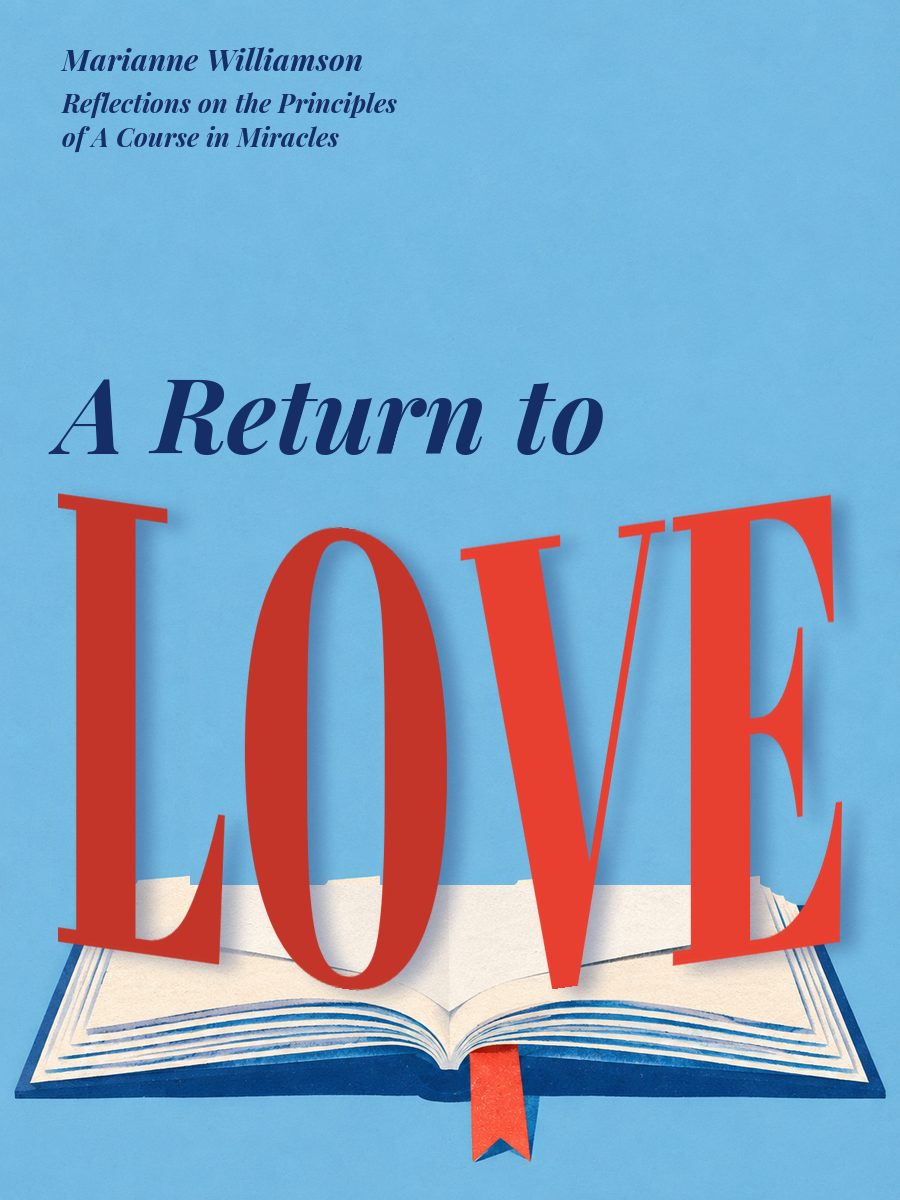
A Return to Love: Reflections on the Principles of A Course in Miracles
Why does someone who knows exactly what they are doing wrong do it anyway? Marianne Williamson asked this about herself in her twenties, and the answer she found in A Course in Miracles became this book. Love is what we are born with, fear is what we learn, and a miracle is a change in how we see. Through that idea she looks at forgiveness, love, work and the fear of our own strength.
Who it is for
For anyone who keeps ruining their own chances in love or at work and sees themselves doing it. For those who forgive in words but keep the grudge. For readers curious about A Course in Miracles who want its ideas told plainly, as one woman applied them to her own life.
Our deepest fear is not that we are inadequate. Our deepest fear is that we are powerful beyond measure.
Blue books on a coffee table
By her mid-twenties, Marianne Williamson was, in her own words, a total mess, drifting from relationship to relationship, job to job, city to city.
In 1977 she noticed blue books with gold lettering on someone's coffee table in New York: A Course in Miracles. The Christian vocabulary unsettled her, and she put them back. A miserable year later, she picked them up again.
In her book, Williamson retells the Course as she understands it, calling herself only its interpreter. The book is openly spiritual: God, the Holy Spirit and miracles belong to her faith, and in her view the Course uses Christian words in a psychological sense. Its teaching fits into one thought: love is what we are born with, and fear is what we learn. A miracle, in the Course's language, is a shift in perception from fear back to love.
Willpower could not outargue her fear
Before the Course, Williamson read books comparing the brain to a bio-computer: think success and you will get it. The effect never lasted: the old pattern returned, and she would say the exact words that made a man leave. Worse than “God, I blew it,” she writes, is “God, I blew it again.”
At a twelve-step meeting she heard people ask God to take away their desire to drink and recognised herself: her drug was her negativity. Neither intellect nor willpower had freed her. When she finally got into more trouble than she could get herself out of, her fear outweighed her pride and she said, “God, please help me.”
The Course calls the trap the ego, the belief that we are small, separate selves. It is as clever as we are, Williamson warns. It never introduces itself as self-hatred, only as your mature, rational self.
The change she describes is not a new thought forced into place but a willingness to see a situation differently, put into a short prayer: “I am willing to see this differently.”
About the author
Marianne Williamson is an American lecturer on spirituality who has taught the principles of A Course in Miracles since 1983. She founded the Centers for Living in Los Angeles and New York, which offer free non-medical support to people facing serious illness and grief.
All books by this author: Marianne Williamson
Terms from the book
- ego
- grandiosity
- A Course in Miracles: A self-study course in three volumes (a text, a workbook of 365 daily exercises and a manual for teachers) that uses Christian words in its own way. Williamson is not its author; her book is her reading of it.
- Holy Spirit: In Christianity, the name of the third person of the Trinity. In the Course as Williamson reads it, this is the voice in the mind that turns thoughts from fear back to love. It is a notion of her faith, not of psychology.
- miracle: In the language of the Course, this is not a supernatural event but a shift in perception from fear to love.
- twelve-step: Mutual-help groups that follow the Twelve Steps; the first of them was Alcoholics Anonymous. Members admit that their own will has not been enough and ask a higher power for help.
- special relationship: The Course's name for a bond built on the hope that one person will fill an inner emptiness. Here “special” means separate, not wonderful. It is an image from the book, not a psychological diagnosis.
- holy relationship: In the Course, this is a special relationship transformed: two people do not hide their weak spots and use the bond to forgive each other.
- Hill Street Blues: An American television police drama of the 1980s, popular when Williamson was lecturing in New York.
Similar books
- Anger: Wisdom for Cooling the Flames, Thich Nhat Hanh
- As a Man Thinketh, James Allen
- Be Here Now, Ram Dass
- Belonging: Remembering Ourselves Home, Toko-pa Turner
- Beyond Order: 12 More Rules for Life, Jordan B. Peterson
- Build the Life You Want: The Art and Science of Getting Happier, Arthur C. Brooks, Oprah Winfrey
- Change Your Thoughts, Change Your Life, Wayne Dyer
- Chatter: The Voice in Our Head, Why It Matters, and How to Harness It, Ethan Kross
- A Short History of Nearly Everything, Bill Bryson
- Acres of Diamonds, Russell Conwell