
The key ideas
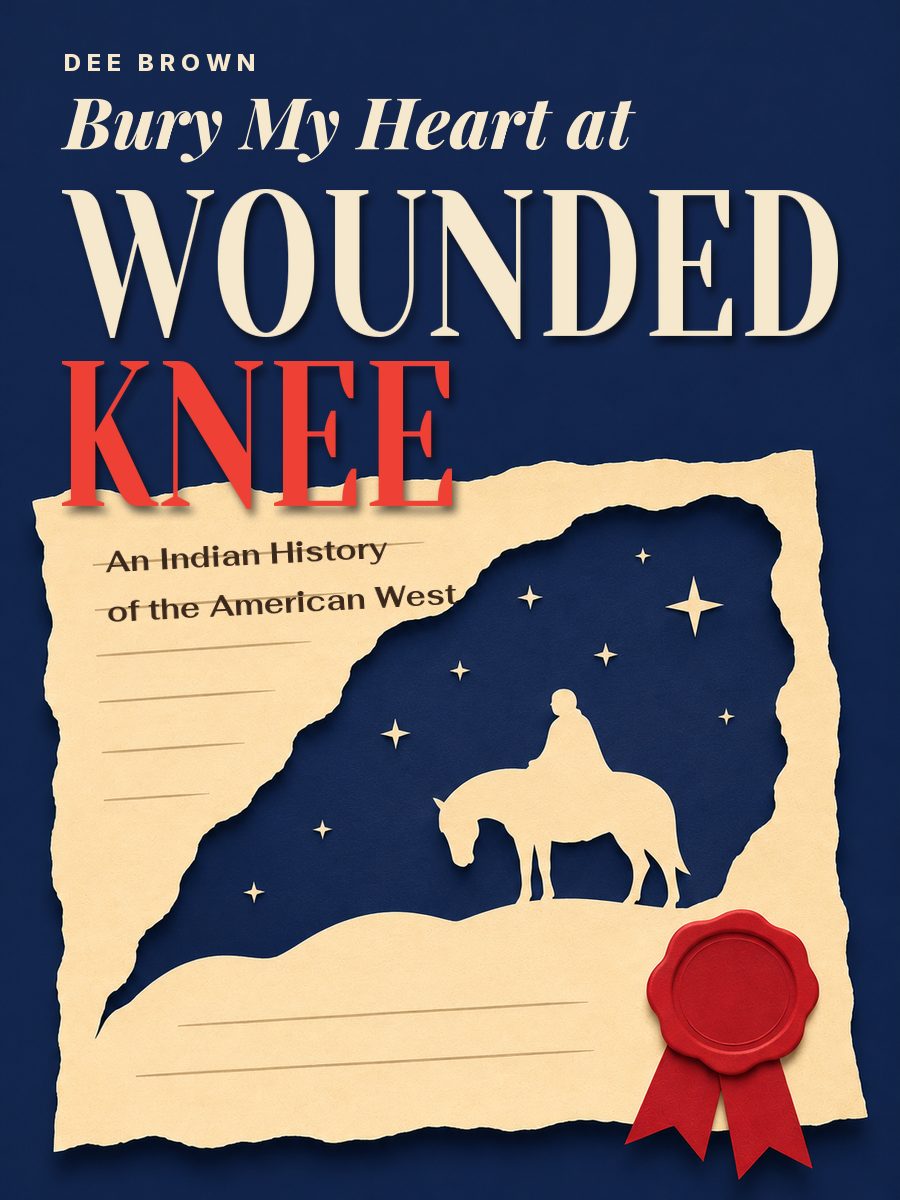
Bury My Heart at Wounded Knee
What did the conquest of the American West look like to the people whose land was being taken? Historian Dee Brown gathered council records, chiefs’ speeches and survivors’ memories, and told the story of thirty years, from 1860 to 1890, in their own words. You’ll see why treaties made “forever” didn’t hold, and how the story ended at Wounded Knee Creek.
Who it is for
For anyone who knows the Wild West from westerns and wants to hear the other side. And for anyone interested in how a government’s promises turn into paper that one of the parties can’t read.
Americans who have always looked westward when reading about this period should read this book facing eastward.
A book to be read facing east
In 1860, by the author’s estimate, about three hundred thousand Indians lived in the United States, most of them west of the Mississippi. Thirty years later, in December 1890, most of a camp that was on its way to ask for protection was killed at Wounded Knee Creek. Between those two dates lies the conquest of the West, which the world knew from stories about cowboys and cavalrymen.
In 1970 the historian and librarian Dee Brown told the same story from the other side. He gathered the records of peace councils, interviews with chiefs and the memories of survivors. His rule is simple: wherever possible, the Indians speak for themselves. Americans used to reading about this era while looking west, he suggested, should read his book facing east.
The same pattern repeats from chapter to chapter. The government promises land forever, then gold is found there or a road is laid through it, the promise is rewritten, and resistance is called an uprising.
A flag over a peace chief’s camp
The Southern Cheyenne chief Black Kettle spent his whole life seeking peace with the whites. An official gave him an American flag and promised that no soldier would ever fire on him while he stood under it. In the autumn of 1864 the commander of a fort assured him that his camp at Sand Creek would be under protection, and the men went off to hunt buffalo.
At dawn more than seven hundred of Colonel Chivington’s soldiers approached the camp. Black Kettle raised the flag on a pole and called out to his people not to be afraid. The soldiers opened fire. By the author’s count, 105 women and children and 28 men were killed, while in his report Chivington wrote of four or five hundred warriors killed.
Black Kettle survived and once again chose negotiation. In November 1868 he asked permission to move his camp near a fort, was refused, and returned to the Washita River. The morning after his return, Custer’s cavalry charged into the camp, and the chief was killed at the ford, his hand raised in a sign of peace.
Brown shows a pattern that repeats throughout the book: the first to die are those who believed the promises. In 1865, less than a year after Sand Creek, the Cheyennes and Arapahos gave up all their lands in Colorado under a new treaty. That, the author notes, was the real point of the massacre.
About the author
Dee Brown (1908–2002) was an American historian and librarian, the author of more than thirty books about the American West and the Civil War. This book has been translated into dozens of languages and became his best-known work.
All books by this author: Dee Brown
Bury My Heart at Wounded Knee Quiz
Terms from the book
- Sherman
- Mississippi
- Reservation
- Custer
- Wounded Knee: A creek on the Pine Ridge Reservation in South Dakota. On December 29, 1890, hundreds of Sioux from Big Foot’s camp died there; the book treats it as the symbolic end of Indian freedom.
- Cheyennes: A people of the Great Plains. In the 1860s they were divided into the Southern Cheyennes, who roamed Colorado and Kansas, and the Northern Cheyennes, who lived near the Sioux.
- Black Kettle: A Southern Cheyenne chief who spent his whole life seeking peace with the whites. He survived the Sand Creek massacre in 1864 and was killed when his camp on the Washita River was attacked in 1868.
- Sand Creek: A creek in southeastern Colorado. In November 1864, Colonel Chivington’s volunteers attacked a peaceful camp of Cheyennes and Arapahos there.
- Chivington: John Chivington (1821–1894), colonel of the Colorado volunteers and a former Methodist preacher. He led the attack on Sand Creek.
- Washita: A river in what is now Oklahoma. In November 1868, Custer’s Seventh Cavalry destroyed Black Kettle’s camp there.
- Arapahos: A people of the Great Plains and longtime allies of the Cheyennes. They lived in the same country and often shared their fate.
- Sioux: The largest people of the northern plains, made up of several divisions, among them the Oglalas, Hunkpapas, Brulés and Minneconjous.
- Red Cloud: An Oglala Sioux chief (about 1822–1909). In 1866–1868 he fought a war for the Powder River country and forced the army to withdraw; later he lived on the Pine Ridge Reservation.
- Powder River: A river in present-day Wyoming and Montana. Its valley was the last great hunting ground of the Sioux and the Northern Cheyennes.
- Laramie: Fort Laramie in present-day Wyoming, where treaties with the Plains tribes were signed in 1851 and 1868.
- Missouri: The longest tributary of the Mississippi. The government wanted to move the Sioux agencies to its banks, far from their hunting grounds.
- Black Hills: Mountains in the west of present-day South Dakota, called Paha Sapa by the Sioux. A sacred place, left to the Indians forever by the treaty of 1868 and taken after gold was found.
- Paha Sapa: The Sioux name for the Black Hills.
- Sitting Bull: A Hunkpapa Sioux chief and spiritual leader (about 1831–1890). He never signed a treaty selling land, lived in Canada for several years after the Little Bighorn, and was killed during his arrest in 1890.
- Little Bighorn: A river in present-day Montana, called the Greasy Grass by the Indians. On June 25, 1876, the Sioux and Cheyennes defeated the Seventh Cavalry there, and Custer’s detachment died to the last man.
- Poncas: A small, peaceful farming people from the Niobrara River in Nebraska. In 1877 they were removed to Indian Territory.
- Indian Territory: The name for the lands west of Arkansas where the government resettled tribes. They later became part of the state of Oklahoma.
- Niobrara: A river in Nebraska, the homeland of the Poncas.
- Standing Bear: A Ponca chief (about 1829–1908). In 1879 he won a court ruling that an Indian is a person under the law and cannot be held on a reservation by force.
- Crook: George Crook (1828–1890), a US Army general who fought the Apaches and the Sioux for many years. He later became a defender of Indian rights.
- Dundy: Elmer Dundy, a federal judge in Nebraska who ruled on Standing Bear’s case in 1879.
- Big Snake: Standing Bear’s brother, whom the Poncas called the Peacemaker. He was shot by soldiers during his arrest in October 1879.
- Paiute: The Paiutes, a people from Nevada and the lands around it. The prophet Wovoka came from them.
- Wovoka: An Indian prophet of the Paiute people (about 1856–1932), founder of the Ghost Dance teaching.
- Ghost Dance: Wovoka’s ritual and teaching of 1889–1890: the dance was to bring back the dead ancestors and the buffalo and renew the earth.
- Big Foot: A Minneconjou Sioux chief. He died with most of his camp at Wounded Knee Creek on December 29, 1890.
- Minneconjou: One of the divisions of the Sioux people.
- Pine Ridge: The Oglala Sioux reservation in South Dakota where Red Cloud lived.
- Black Elk: An Oglala Sioux (1863–1950), a witness of the Little Bighorn and Wounded Knee. His memories, recorded in old age, became a famous book.
Similar books
- Captivate: The Science of Succeeding with People, Vanessa Van Edwards
- Cues: Master the Secret Language of Charismatic Communication, Vanessa Van Edwards
- What You're (Not) Going to Die Of, Sergio Parra
- Designing the Future, Jacque Fresco
- Difficult Conversations: How to Discuss What Matters Most, Douglas Stone, Bruce Patton, Sheila Heen
- Dollars and Sex: How Economics Influences Sex and Love, Marina Adshade
- Everybody Lies: Big Data, New Data, and What the Internet Can Tell Us About Who We Really Are, Seth Stephens-Davidowitz
- Factfulness, Hans Rosling
- Buy Back Your Time, Dan Martell
- Buyology: Truth and Lies About Why We Buy, Martin Lindstrom