
The key ideas
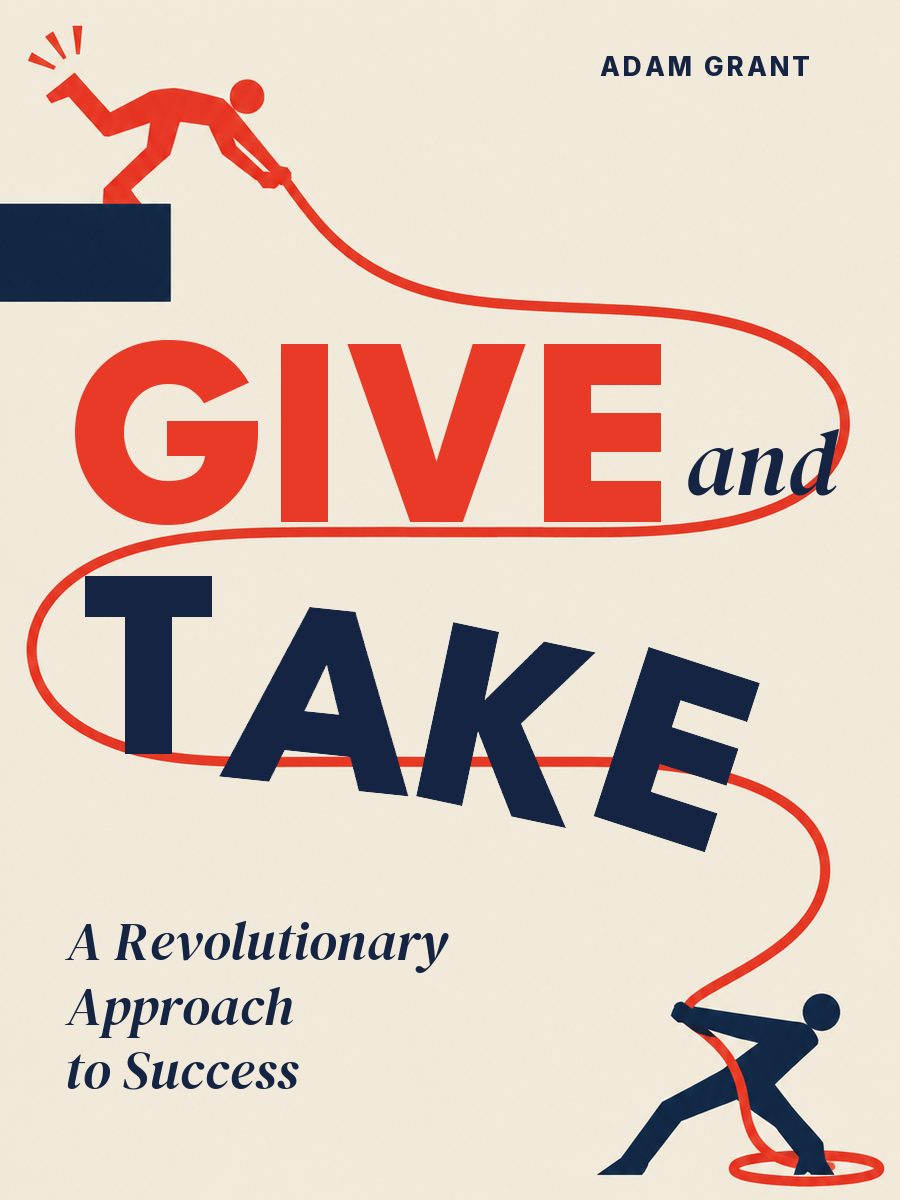
Give and Take: A Revolutionary Approach to Success
Why do some generous people end up at the bottom while others rise to the very top? Adam Grant gathered research and real-life stories of investors, screenwriters, lawyers and teachers. This book is about helping others in a way that leads to success, not to burnout.
Who it is for
For people who help everyone who asks and end up running on empty. And for anyone convinced that at work only the tough get ahead.
It isn’t spending a lot of time and energy that drains givers. They lose strength when they work with people who are suffering but can’t help them effectively.
The investor who gave him time to think
Venture capitalist David Hornik offered entrepreneur Danny Shader money for a new company and set no deadline. He even sent Shader a list of forty entrepreneurs ready to vouch for Hornik himself and told him to take as much time as he needed. A few days later Shader called to apologize: he had signed with another investor, because Hornik had struck him as too soft.
Adam Grant, a psychologist at the Wharton School, sorts people by how they weigh their own interests against other people’s. Takers try to get more than they give. Matchers keep things even by the rule of “you scratch my back, I’ll scratch yours.” Givers help without counting what they’ll get in return.
At first glance, the research Grant gathered confirms that the soft-hearted lose out: among engineers, medical students and salespeople, the bottom rungs of the ladder of success are most often taken by givers. But givers stand at the top too, while takers and matchers fill the middle.
In the end, Hornik didn’t lose. Shader himself asked him to come in as an investor and later started recommending Hornik to others. This book is about what sets the givers at the top apart from the givers at the bottom.
Five minutes that came back five years later
In 2011 Fortune magazine worked out that the person with the most connections to the 640 most powerful people in America was a shy programmer named Adam Rifkin. Back in 1994 he had built a fan site for the band Green Day. A stranger wrote to tell him Green Day wasn’t real punk, and Rifkin simply added a page with the links the stranger had sent.
Five years later Rifkin moved to Silicon Valley, knew no one there and wrote to that stranger. He turned out to be Graham Spencer, one of the founders of the Excite portal, and he introduced Rifkin to an investor.
Rifkin’s rule: be willing to do something for anyone, because it usually takes less than five minutes. A five-minute favor can be very simple: an honest answer to a question or an introduction between two people.
Grant also advises remembering your dormant ties: people you were once close to and then didn’t see for a long time. In a study by Daniel Levin, executives reached out to former colleagues they hadn’t been in touch with for at least three years. Those colleagues’ advice proved more useful than advice from the people around them now: over those years the former colleagues had picked up new ideas. For a giver, getting back in touch with old acquaintances is easy: people remember a giver for helping, not for keeping score.
About the author
Adam Grant is an organizational psychologist and a professor at the Wharton School of the University of Pennsylvania. For more than ten years he studied how people’s style of dealing with others affects their success, in organizations from Google to the US Air Force.
All books by this author: Adam Grant
Give and Take: A Revolutionary Approach to Success Quiz
Terms from the book
- venture capitalist
- Fortune
- Spencer
- Meyer
- Ross
- Polio
- Walton
- Callahan
- Hornik: David Hornik, an American venture capitalist. He was the first venture capitalist to start a blog, and he runs conferences to which he invites even his competitors.
- Shader: Danny Shader, a Silicon Valley entrepreneur. Among other things, he founded PayNearMe, a service for paying for online purchases in cash.
- Takers: In Grant’s model, people who try to get more from others than they give. It’s a style of behavior, not a diagnosis or a verdict.
- Matchers: In Grant’s model, people who keep giving and getting in balance by the rule of “you scratch my back, I’ll scratch yours.” According to his data, most people behave this way at work.
- Givers: In Grant’s model, people who help others without counting what they’ll get in return. Grant stresses that this is a style, not self-sacrifice.
- Rifkin: Adam Rifkin, a Silicon Valley programmer and entrepreneur, the founder of 106 Miles, a community where entrepreneurs help each other for free.
- Excite: One of the first internet portals with its own search engine. Founded in 1993 and sold in 1998 for 5.6 billion dollars.
- Five-minute favor: Rifkin’s rule from the book: help anyone if it takes less than five minutes. An image from the book, not a scientific term.
- Dormant ties: Acquaintances you were once close to but lost touch with long ago. The term comes from research by Daniel Levin and his colleagues.
- Levin: Daniel Levin, a management researcher. With his colleagues he studied what executives gain from reviving old acquaintances.
- Sicoly: Fiore Sicoly, a psychologist and Michael Ross’s coauthor on the study of how people exaggerate their own contribution.
- Responsibility bias: The tendency to rate your own contribution to a shared effort as bigger than it is, because you see your own efforts better than other people’s.
- Salk: Jonas Salk, an American physician and virologist. His polio vaccine, declared effective in 1955, helped all but defeat the disease in the United States.
- Powerless communication: A term from the book: a way of speaking with questions, hedges and admissions of your own weak spots instead of pressure and confident claims.
- Escoto: Kildare Escoto, an optician from North Carolina and the top salesperson in his company.
- Minds Matter: An American nonprofit where mentors prepare talented high school students from low-income families to apply to college.
- Selfless givers: In Grant’s model, people who care about others while forgetting about themselves. They are the ones who burn out more often and end up at the bottom.
- Otherish givers: In Grant’s model, people who give more than they take but don’t forget their own interests either. They more often end up at the top.
- Audet: Peter Audet, an Australian financial adviser and managing director of Genesys Wealth Advisers.
- Nowak: Martin Nowak, a mathematician and biologist at Harvard who studies the evolution of cooperation using game theory.
- Jain: Sameer Jain is a pseudonym: at the request of the man in the book, Grant kept his real name hidden.
Similar books
- Good Strategy Bad Strategy: The Difference and Why It Matters, Richard Rumelt
- Good to Great, Jim Collins
- Great by Choice: Uncertainty, Chaos, and Luck: Why Some Thrive Despite Them All, Jim Collins, Morten T. Hansen
- Gut Feelings: The Intelligence of the Unconscious, Gerd Gigerenzer
- Hagakure: The Book of the Samurai, Yamamoto Tsunetomo
- High Output Management, Andrew Grove
- How to Decide: Simple Tools for Making Better Choices, Annie Duke
- How to Sell When Nobody's Buying, Dave Lakhani
- God Is Not One, Stephen Prothero
- Going Infinite, Michael Lewis