
The key ideas
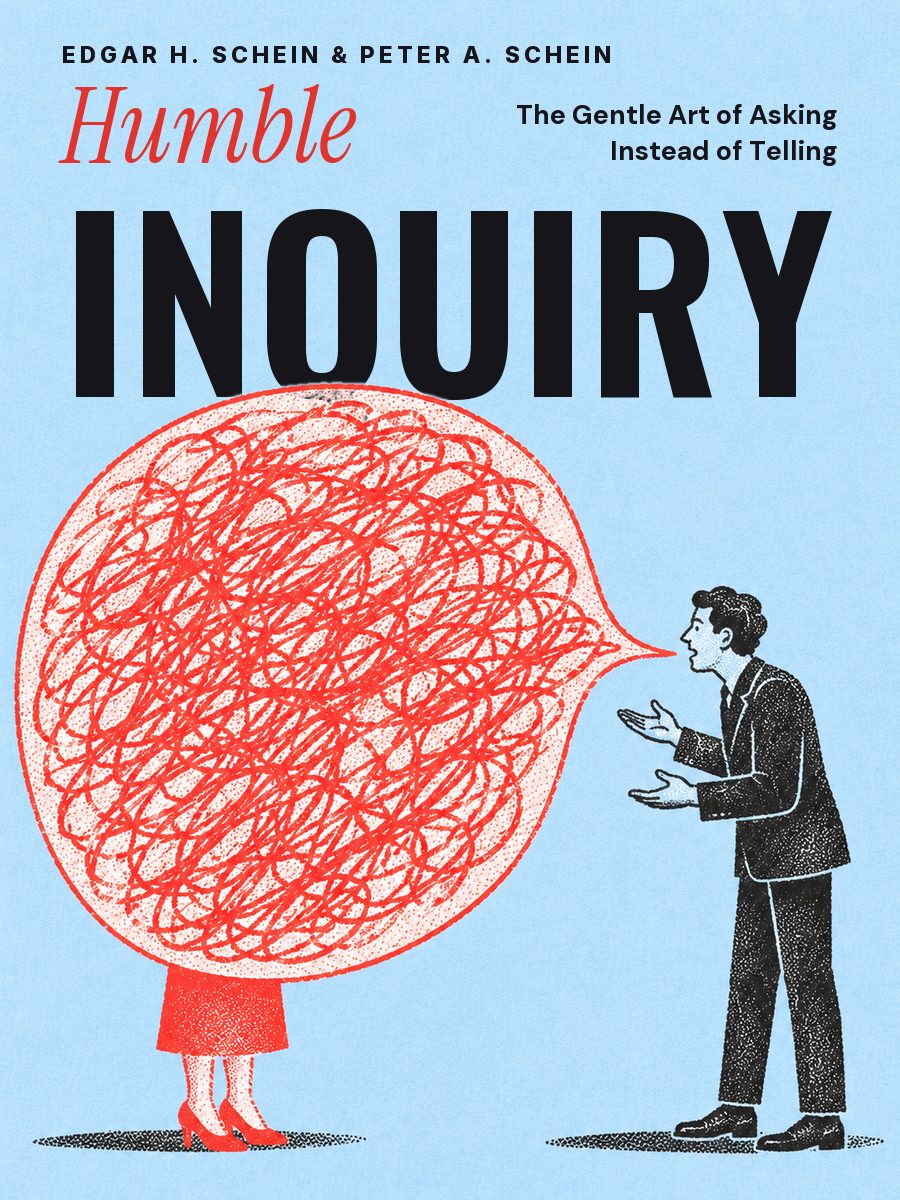
Humble Inquiry: The Gentle Art of Asking Instead of Telling
An elderly woman stops beside a man looking at mushrooms and warns him that some are poisonous. He says he knows, and she adds, wrongly, that some can kill him. Organisational psychologist Edgar Schein and his son Peter Schein start from that scene to show how unasked-for telling closes conversations and how a sincere question opens them. The book explains why asking is hard in a culture that rewards telling, and how it builds the trust that work with other people depends on.
Who it is for
For anyone who leads people, works in a team or simply notices that conversations end in silence or argument, and suspects the habit of telling has something to do with it.
We do not think and talk about what we see; we see what we are able to think and talk about.
Some of those are poisonous, you know
After a heavy rain Edgar Schein was squatting by unusual mushrooms when an elderly woman walking her dog stopped. "Some of those are poisonous, you know," she said. "I know," he replied. "Some of them can kill you, you know," she added. Besides, she was wrong: these would only have given him indigestion. Her urge to lecture offended him and left no room for a friendly reply. A simple "What are you looking at?" would have started a conversation.
In this second edition Schein, who spent decades at the MIT Sloan School of Management, and his son Peter Schein, a veteran of Silicon Valley companies, see in that scene a major problem of our time: we value telling, showing what we know and winning arguments.
Their alternative is Humble Inquiry: drawing someone out by asking questions whose answer you do not already know, out of real interest in the person. It is an attitude, not a formula, and includes listening closely and revealing something of yourself.
A tell quietly puts the other person down
After a game a quarterback tells the guard whose job is to protect him: "You have to do better. I got rushed and sacked too many times in today's game." The rebuke may be fair. The Scheins rewrite it with two changes: "we have to do better" and "Any thoughts?" Now the guard can say that in two weeks they face an all-star lineman who may beat him every time, so they should ask the coaches for different plays.
Unasked-for telling, the authors argue, cuts off information and briefly lowers the other person, because it implies they do not know what they ought to know. It betrays three kinds of arrogance: that you know more, that your knowledge is correct, and that you may shape someone else's experience for them.
A sincere question temporarily gives the other person power and makes you vulnerable. It is an investment of attention that pays off in what you learn.
About the author
Edgar H. Schein (1928–2023) was Professor Emeritus at the MIT Sloan School of Management and one of the founders of organisational psychology. Peter A. Schein spent thirty years in product and corporate development at Silicon Valley companies and co-founded the Organizational Culture and Leadership Institute with his father.
All books by this author: Edgar H. Schein, Peter A. Schein
Humble Inquiry: The Gentle Art of Asking Instead of Telling Quiz
Terms from the book
- MIT
- Stuart
- Humble Inquiry: The authors' term: asking questions to which you do not already know the answer, out of curiosity and interest in the other person, together with listening closely and revealing something of yourself.
- quarterback: In American football, the attacking player who starts each play and throws the passes. Linemen of his own team are meant to protect him from opponents.
- Woodford: The small town in an old story the authors retell: both of two roads lead there, and a traveller asks which one to take.
- Here-and-now Humility: The authors' term for a feeling, not a character trait: what you feel when you realise that in this situation you depend on another person who knows or can do what you need.
- levels of relationship: The authors' model, not a scientific scale. Level minus 1 is domination, Level 1 is a transactional relationship with professional distance, Level 2 is a personal relationship of openness and trust, Level 3 is close friendship or love.
- diagnostic question: In the authors' scheme, a question that steers the other person's attention to what the asker finds relevant, without adding the asker's own answer.
- confrontive question: In the authors' scheme, a question with the asker's own idea or advice built into it, such as asking whether someone did something because they were scared.
- ORJI: The authors' simplified model of what happens in a split second: Observe, React, Judge, Intervene. The last step counts as intervening because even silence affects the other person.
- survival anxiety: In Edgar Schein's model of change, the fear that unless you learn a new way of behaving you will fall behind.
- learning anxiety: In Edgar Schein's model of change, the fear of being clumsy while learning, of disapproval from others and of losing a familiar identity. In the authors' view it is the main source of resistance to change.
Similar books
- The Laws of Human Nature, Robert Greene
- Leaders Eat Last: Why Some Teams Pull Together and Others Don't, Simon Sinek
- Leadership and Self-Deception: Getting Out of the Box, The Arbinger Institute
- Lean Analytics, Alistair Croll and Benjamin Yoskovitz
- Made to Stick: Why Some Ideas Survive and Others Die, Chip Heath, Dan Heath
- Masters of Scale: Surprising Truths from the World’s Most Successful Entrepreneurs, Reid Hoffman, June Cohen, Deron Triff
- Measure What Matters: How Google, Bono, and the Gates Foundation Rock the World with OKRs, John Doerr
- The Murdoch Method: Notes on Running a Media Empire, Irwin Stelzer
- Hyperfocus. How to Manage Your Attention in a World of Distraction, Chris Bailey
- Hypnosis. Suggestion. Telepathy, Vladimir Bekhterev