
The key ideas
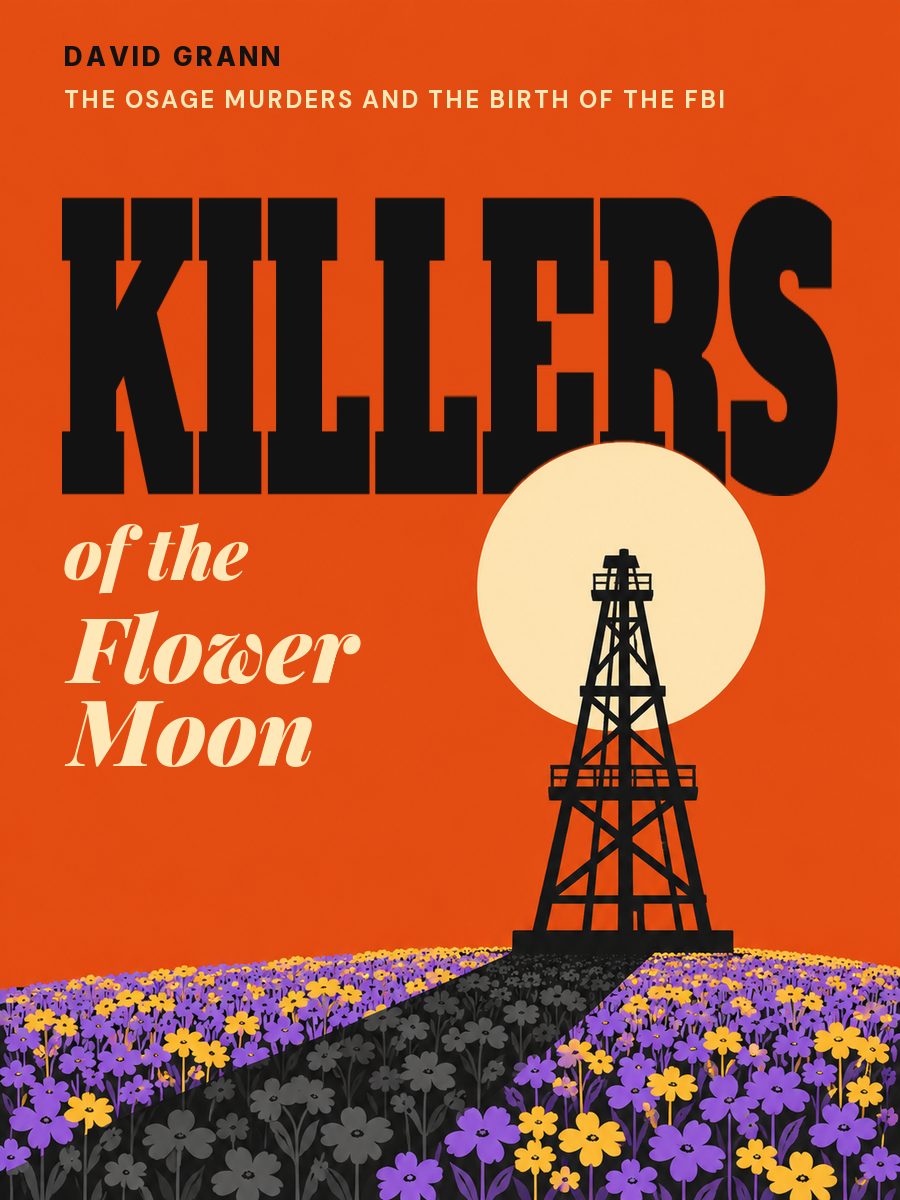
Killers of the Flower Moon: The Osage Murders and the Birth of the FBI
In the 1920s, thanks to the oil beneath their land, the Osage became the wealthiest people per capita in the world, and then they began to die one after another. Working from FBI and court archives, the journalist David Grann reconstructed the story of Mollie Burkhart, the investigator Tom White and a conspiracy that cost dozens of lives. The book shows why catching one villain did not uncover the whole truth.
Who it is for
For anyone who loves real investigations and the history that textbooks keep quiet about. And for anyone haunted by the question of how a whole society can fail to notice murders under its own windows for years.
There are many hills here…white man does not like country where there are hills, and he will not come.
The month when flowers die
In May, on the hills of Oklahoma, the tall grasses overshadow the tiny spring flowers, and these die without light and water. That is why the Osage Indians call May the time of the flower-killing moon. In May 1921 Mollie Burkhart, of the Osage people, was waiting for her sister Anna Brown. Anna had left Mollie’s house and never came back. A week later she was found in a ravine by a creek, shot in the back of the head.
Mollie’s family was rich: oil had been found beneath Osage land. Soon the sisters’ mother wasted away, then another sister’s house was blown up. And the man who arranged all this stood beside Mollie and promised her justice.
The American journalist David Grann spent years reading FBI archives, court records and wills. His book is made up of three chronicles: the victim’s, the investigator’s and the reporter’s own. Grann’s main idea is that these murders were not the work of one villain. They were made possible by a system in which greed hid behind the law and indifference helped people keep quiet.
Oil made the Osage rich and defenseless
In the early 1870s the Osage were pushed out of Kansas, and they bought their new land from the Cherokee for seventy cents an acre. White people considered this country rocky and barren. That was exactly what Chief Wah-Ti-An-Kah was counting on: the white man would not plow the hills and would not come to take the land.
In 1906, when the land was divided into private plots, the Osage won an important condition: everything beneath the ground remained the common property of the tribe. Every member of the tribe received a share in the underground wealth, in English a headright. It could not be bought or sold, only inherited.
Then the oil came. In 1923 alone the tribe took in more than 30 million dollars. But the authorities deemed many Osage “incompetent,” almost always by their share of Indian blood, and assigned them white guardians who approved every purchase. By one government estimate, before 1925 the guardians stole at least 8 million dollars from their wards.
Hence the terrible logic of the whole book. If someone else’s headright can’t be bought, it can be obtained by marrying into the family and waiting for the heirs to die. Or by not waiting.
About the author
David Grann is an American journalist and a staff writer at The New Yorker. He writes investigative nonfiction; his books include The Lost City of Z.
All books by this author: David Grann
Killers of the Flower Moon: The Osage Murders and the Birth of the FBI Quiz
Terms from the book
- Lewis
- Brown
- Cherokee
- Smith
- Brookshire
- Insulin
- Hoover
- White
- Ranger
- Thompson
- Osage: The Osage are a Native American people who in the nineteenth century were pushed out to the northeast of what would become Oklahoma. Today they are the Osage Nation, with their own constitution, government and court.
- Burkhart: Mollie Burkhart, an Osage woman whose family was murdered for their oil shares; her husband, Ernest Burkhart, a nephew of William Hale, helped the conspiracy and later confessed.
- Wah-Ti-An-Kah: An Osage chief in the 1870s. He argued for buying the hilly land from the Cherokee and won agreement in Washington for the tribe to be paid in money rather than given food and clothing.
- Headright: The English name for a share in the Osage mineral trust. Every member of the tribe on the 1906 roll received one; a headright could not be sold, only inherited.
- Guardian: A white person appointed by the authorities to manage the money of a Native American deemed “incompetent.” Many guardians robbed their wards.
- Hale: William Hale, a cattleman known as the King of the Osage Hills. He organized the murders of Mollie Burkhart’s family; in 1926 he was sentenced to life in prison for the murder of Henry Roan.
- Lizzie: The mother of Mollie Burkhart, Anna, Rita and Minnie. She died in July 1921 of an illness the doctors never explained; her family suspected poisoning.
- McBride: Barney McBride, a white oilman whom the Osage trusted. In 1922 he went to Washington to ask for an investigation and was murdered.
- Vaughan: William Vaughan, a lawyer from Pawhuska who was gathering evidence in the case. In 1923 he was thrown from a night train.
- Bureau: The Bureau of Investigation of the US Department of Justice. In 1935 it was renamed the Federal Bureau of Investigation, the FBI.
- Wren: John Wren, a Bureau agent from the Ute people. He worked on White’s team disguised as a medicine man.
- Ute: A Native American people who lived on the lands of what are now the states of Colorado and Utah.
- Roan: Henry Roan, an Osage man who in his youth was briefly married to Mollie. He was shot in 1923 for the insurance policy Hale had taken out on his life.
- Burt: H. G. Burt, a banker from Pawhuska and guardian of several Osage. Agents believed he was involved in the murder of the lawyer Vaughan, but he was never charged.
- Mathis: Scott Mathis, owner of a trading company in Fairfax and guardian of Anna Brown and her mother. Seven of his nine wards died.
- McAuliffe: Dennis McAuliffe, a journalist and the grandson of Sybil Bolton, who died in 1925. He wrote a book about her death.
Similar books
- Public Opinion, Walter Lippmann
- Man, the Manipulator: The Inner Journey from Manipulation to Actualization, Everett L. Shostrom
- Midnight in Chernobyl, Adam Higginbotham
- Nonviolent Communication: A Language of Life, Marshall B. Rosenberg
- Nudge: Improving Decisions About Health, Wealth, and Happiness, Richard H. Thaler, Cass R. Sunstein
- Of Boys and Men, Richard Reeves
- Outliers: The Story of Success, Malcolm Gladwell
- Prisoners of Geography, Tim Marshall
- The Conquest of Fear, Basil King
- King, Warrior, Magician, Lover: Rediscovering the Archetypes of the Mature Masculine, Robert Moore, Douglas Gillette