
The key ideas
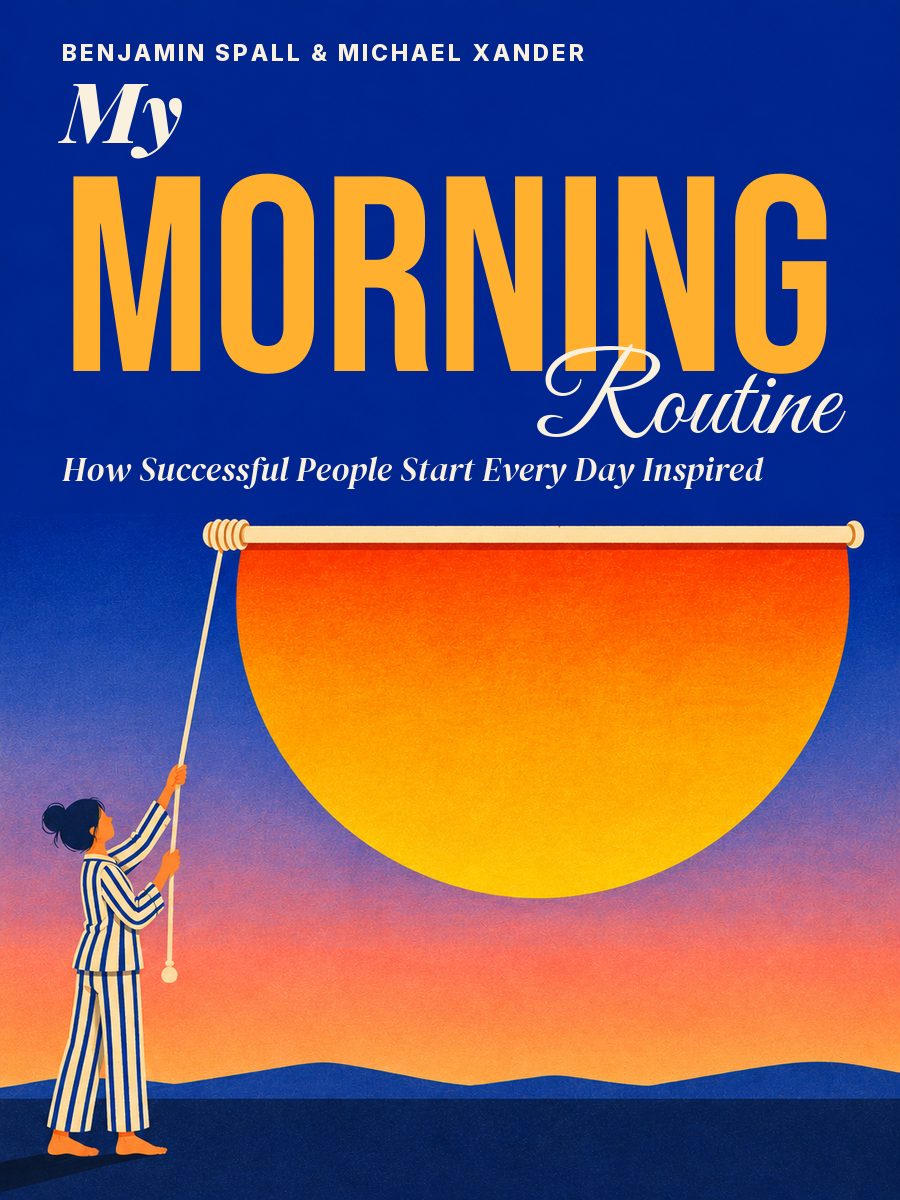
My Morning Routine: How Successful People Start Every Day Inspired
Many mornings run on autopilot, from the pillow straight into email. Benjamin Spall and Michael Xander asked hundreds of people, from an army general to the president of Pixar, how they start the day, and found no single right recipe. What they found instead are patterns, honest stories of failure and a way to build a morning of your own.
Who it is for
For anyone whose day starts with the phone and turns into a rush, and who wants a morning that fits their own life rather than someone else's.
You don't work for the routine; the routine works for you.
From the pillow straight into the inbox
For years, Michael Xander in Berlin and Benjamin Spall in London started the day the same way. They rolled out of bed, grabbed the phone, went through the night's email and notifications, and rushed out the door. The stress of those mornings leaked into the whole working day and left them exhausted by evening.
So they started asking others how they begin the day. Their website, My Morning Routine, has collected more than three hundred interviews, and the book gathers sixty-four of them, including conversations with a retired general, an Olympic champion swimmer, the president of Pixar and Marie Kondo. Each chapter ends with the authors' tips and a reversal: where their advice does not apply.
Their conclusion is modest on purpose. The first hour after waking has an outsized effect on the day, but there is no single correct way to spend it. Other people's mornings are raw material, and you choose what fits.
Your morning begins when you wake, whatever the clock says
The authors are most often asked whether you must become an early riser. Their answer is a flat no. Your morning begins when you wake up, at six in the morning or six in the evening. Benjamin learned this at home: he is wide awake at dawn, while his wife is a night owl.
Novelist and Zen priest Ruth Ozeki goes further. She keeps three routines, for teaching, writing and meditation retreats, and treats her life as an experiment in which she is both experimenter and subject. She changes one variable and watches the result. She leans on the Hawthorne effect as she understands it: a change can lift performance simply because it is new, but the lift fades, so it pays to adjust things now and then.
The authors make this a working rule: give each new element one or two weeks before you judge it. For more morning time, move the alarm five minutes earlier each week rather than an hour at once. And if your best hours come late, flip the usual advice: email and small chores in the morning, your main work in the evening.
About the author
Benjamin Spall and Michael Xander founded the website My Morning Routine and have spent years interviewing people about the first hours of their day. For most of their adult lives, Benjamin lived in London and Michael in Berlin.
All books by this author: Benjamin Spall, Michael Xander
My Morning Routine: How Successful People Start Every Day Inspired Quiz
Terms from the book
- Plank
- Rose
- Carey
- Pixar
- Zen
- Vanguard
- Buffer
- Kondo: Marie Kondo, a Japanese organizing consultant and author of The Life-Changing Magic of Tidying Up, one of the people interviewed in the book.
- Ozeki: Ruth Ozeki, a novelist, filmmaker and Zen Buddhist priest who keeps different morning routines for her different roles.
- retreats: Several days set apart for meditation, often in silence and away from everyday life.
- Hawthorne: The Hawthorne effect: the observation, from studies of factory workers, that people may perform better simply because they are being watched or because something in their work has changed. Ozeki applies it to her own routines.
- habit stack: The authors' name for a chain of habits in which each action triggers the next one.
- Jenga: A game in which players pull blocks from a wooden tower until it falls. The authors use it as an image for a chain of habits.
- Parrish: Shane Parrish, founder of the website Farnam Street, interviewed in the book.
- Farnam Street: Shane Parrish's website about thinking clearly and making better decisions.
- O'Reilly: Tim O'Reilly, founder and CEO of the publisher O'Reilly Media, interviewed in the book.
- McChrystal: Stanley McChrystal, a retired four-star general of the U.S. Army, interviewed in the book.
- McNabb: Bill McNabb, chairman of the investment company Vanguard and its CEO from 2008 to early 2018.
- Gascoigne: Joel Gascoigne, CEO of Buffer, quoted in the book.
- limiting factor: McChrystal's term, limfac in military shorthand: the one thing that holds a plan back.
- Bilton: Nick Bilton, special correspondent for Vanity Fair and an author, interviewed in the book.
- Ward: Patrick Ward, a writer and designer quoted in the book.
- Cox: Ana Marie Cox, a political columnist and culture critic interviewed in the book.
Similar books
- Outwitting the Devil: The Secret to Freedom and Success, Napoleon Hill
- Peak: Secrets from the New Science of Expertise, Anders Ericsson, Robert Pool
- The Power of Habit, Charles Duhigg
- Psycho-Cybernetics, Maxwell Maltz
- Quarterlife: The Search for Self in Early Adulthood, Satya Doyle Byock
- Range: Why Generalists Triumph in a Specialized World, David Epstein
- Rejection Proof: How I Beat Fear and Became Invincible Through 100 Days of Rejection, Jia Jiang
- Rest: Why You Get More Done When You Work Less, Alex Soojung-Kim Pang
- Never Eat Alone: And Other Secrets to Success, One Relationship at a Time, Keith Ferrazzi, Tahl Raz
- Never Split the Difference: Negotiating As If Your Life Depended On It, Chris Voss, Tahl Raz