
The key ideas
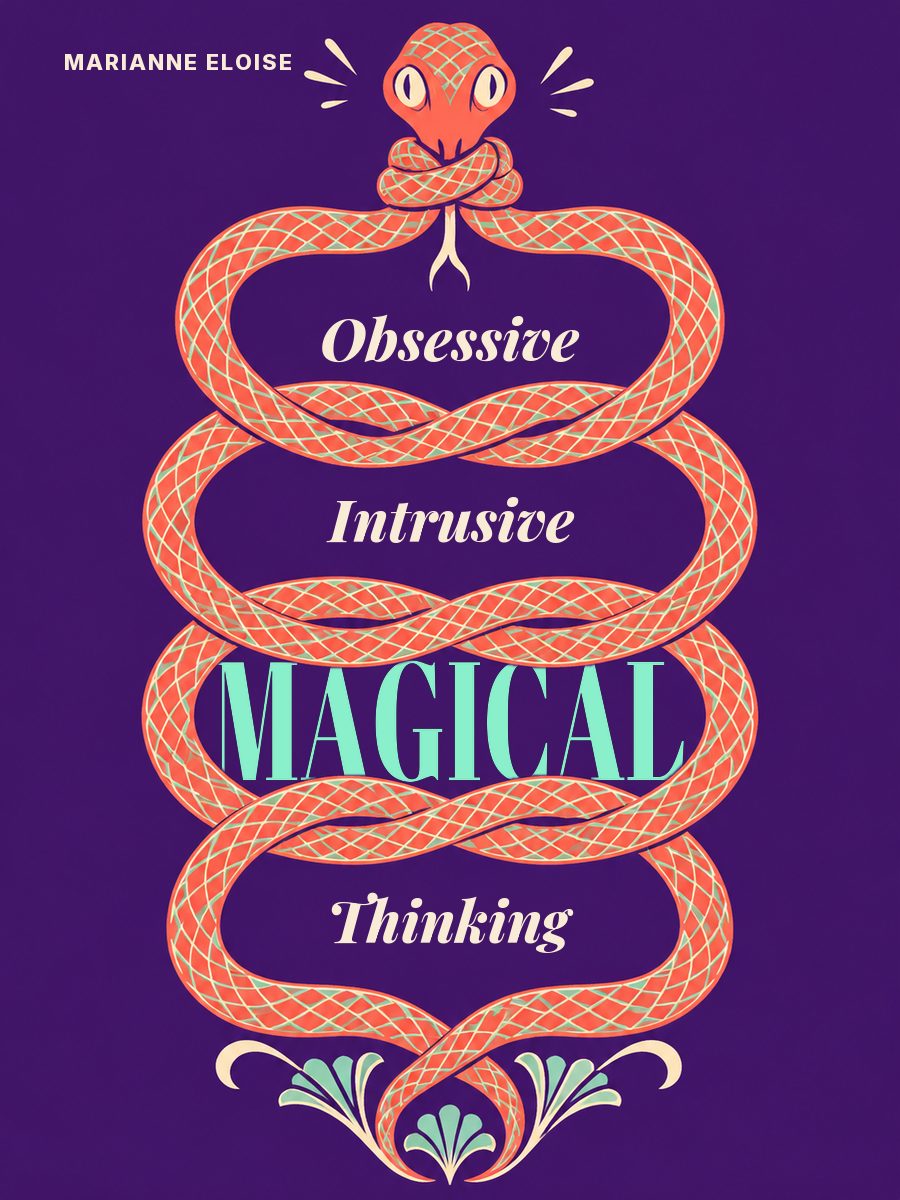
Obsessive Intrusive Magical Thinking
What if your brain won’t let go of a single thought? Marianne Eloise lived with OCD from childhood, and only ten years after her OCD diagnosis did she learn that she is autistic. Her personal story shows how obsession can take a life away, and how the same force, turned toward what you love, gives it back.
Who it is for
For anyone who lives with intrusive thoughts, or loves someone who does, and wants to understand what it looks like from the inside.
Wouldn’t you rather live in a world where magic was possible?
A racetrack in her head
Marianne Eloise describes her head not as a brain but as a toy racetrack. An invisible force loads an electric car with thoughts, phrases and images, and there’s no exit ramp off the track. Her thoughts race around in a figure eight, day and night. It has been this way for as long as she can remember, and for a long time she thought everyone lived like this.
At seventeen she was diagnosed with obsessive-compulsive disorder, OCD. Ten years later she learned about her autism and ADHD. Her book isn’t a textbook or a guide. It’s a collection of essays by a British journalist about her own life: about the fear of fire, about Medusa behind a fish tank, about Disneyland and the sea.
The book’s main idea sounds unexpected. For Eloise, obsessiveness isn’t an illness that can be cut out but a cast of mind. The disorder turned it into a prison, and her favorite passions turned the same force into something to lean on. Her story is about how to tell one from the other without losing herself.
If you do everything right, everyone will stay alive
Marianne is about seven. In a pub she sees a newspaper with a headline about arson and asks what the word means. She’s told: it’s when someone sets a house on fire on purpose to hurt people. From that evening on, she is afraid of her own wheelie bin, hops over cracks in the pavement and holds her breath under scaffolding.
Her mum smokes one pack after another, and the girl can’t stop her. So she starts secretly carrying paper out of the classroom. A voice in her head promises that this way her mum and everyone she loves will stay alive. Her family thinks she’s strange, and her teacher thinks she’s a thief.
Specialists call this magical thinking: the belief that thoughts or random actions influence events that have nothing to do with them. Eloise explains where this belief came from in her case. Her parents were fighting and divorcing, and the child felt responsible for things beyond her power. It seemed to her that if she performed the right action the right number of times, she could save everyone and even make her parents love her.
In the author’s words, OCD feeds on whatever a person fears most: guilt, fear, a sense of responsibility. The ritual changes, but the belief stays the same.
About the author
Marianne Eloise is a British journalist and writer. She writes about film, music and internet culture for The Cut, The New York Times, The Guardian and other publications.
All books by this author: Marianne Eloise
Obsessive Intrusive Magical Thinking Quiz
Terms from the book
- OCD
- autism
- ADHD
- magical thinking
- ritual
- Glee: An American musical TV series about a high school glee club. One of its characters lives with OCD.
- CBT: Cognitive behavioral therapy: an approach in psychotherapy that works with a person’s thoughts and behavior.
- sensory overload: A state in which the brain can’t keep up with filtering out sounds, smells, light and touch, and there’s too much of them.
- meltdown: The word autistic people use for an attack of overload: a person loses control of themselves because of built-up tension. It isn’t a tantrum or hysterics.
- Good Charlotte: An American pop punk band. Its founders, the twin brothers Joel and Benji Madden, grew up poor and moved to Los Angeles.
- special interest: What autistic people call a deep, all-consuming passion for one subject. It’s an expression from the community, not a diagnosis.
- Medusa: A Gorgon from ancient Greek myths: a woman with snakes instead of hair, whose gaze turns people to stone.
- Ovid: An ancient Roman poet. In his poem Metamorphoses, he told how Medusa became a monster.
- Tarbuck: Alice Tarbuck, a British writer. The author of A Spell in the Wild, a book about modern witchcraft.
Similar books
- Option B: Facing Adversity, Building Resilience, and Finding Joy, Sheryl Sandberg, Adam Grant
- Outlive: The Science and Art of Longevity, Peter Attia, Bill Gifford
- Quit Like a Woman: The Radical Choice to Not Drink in a Culture Obsessed with Alcohol, Holly Whitaker
- In the Realm of Hungry Ghosts: Close Encounters with Addiction, Gabor Maté
- Rethinking Narcissism: The Bad and the Surprising Good in Wanting to Feel Special, Craig Malkin
- Sane New World: Taming the Mind, Ruby Wax
- Self-Compassion: The Proven Power of Being Kind to Yourself, Kristin Neff
- Sensitive: The Hidden Power of the Highly Sensitive Person in a Loud, Fast, Too-Much World, Jenn Granneman and Andre Sólo
- Obviously Awesome, April Dunford
- Of Boys and Men, Richard Reeves