The key ideas
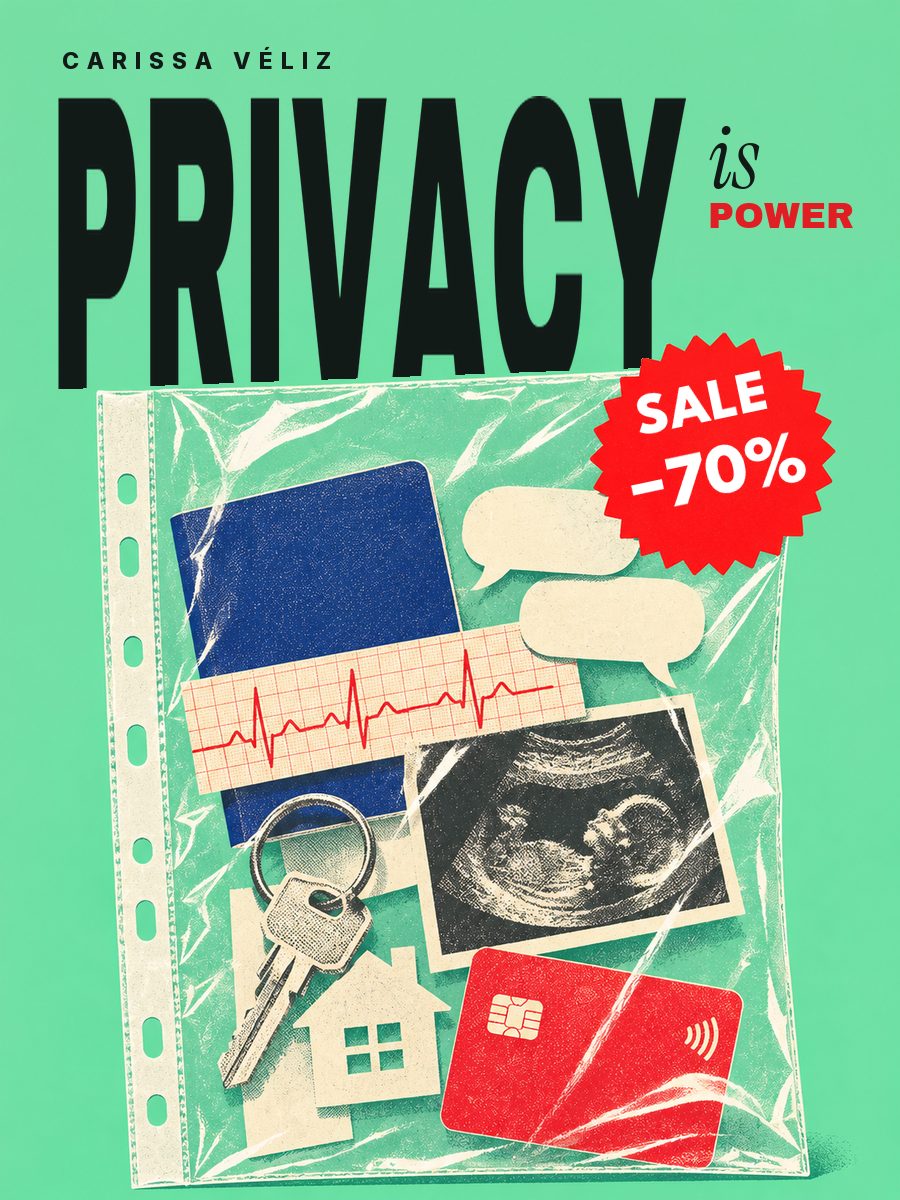
Privacy Is Power: Why and How You Should Take Back Control of Your Data
Every morning your phone tells a crowd of companies when you woke up and where you slept. Oxford philosopher Carissa Véliz shows how the trade in personal data began, why it gives companies and governments power over each of us, and why one person’s data always exposes others. She also explains what laws could stop it and where each of us can start right now.
Who it is for
For anyone who taps “accept all” just to make a cookie banner go away. For parents who post photos of their children and for anyone who wonders where the data from their apps ends up. For those who are sure they have nothing to hide.
If you weren’t that important, businesses and governments wouldn’t be going to so much trouble to spy on you.
The first data point of the day
You wake up and reach for your phone. In Carissa Véliz’s picture of an ordinary day, that is the first piece of data you lose: the phone maker, your apps and your mobile company now know when you woke up and where you slept. Later a smart TV listens in while your teenage son tells you something private. Researchers found that one Samsung smart TV connected to more than 700 internet addresses within fifteen minutes.
Véliz, an Oxford philosopher who studies privacy and the ethics of technology, published this book in 2020, during the coronavirus pandemic. In it she asks why so many companies and governments want to know so much about each of us.
Her answer is in the title. Personal data is not only money but power: whoever knows you can predict you, influence you and use what they know against you. Privacy, for Véliz, is how ordinary people keep that power for themselves.
How data exhaust became gold dust
For years, the traces we leave on computers were a by-product, and Google used searches only to improve its search engine. In a 1998 paper its founders, Sergey Brin and Larry Page, were wary of advertising.
Then investors grew impatient. Google began using what people searched for to choose the ads they saw, and its revenue grew from $19 million in 2000 to $3.2 billion in 2004. In Véliz’s account, this is when users stopped being Google’s clients and became its product, and other companies raced to copy it. She calls the result the surveillance economy.
It could have gone differently. In 2000 the Federal Trade Commission asked Congress for a law on online privacy. Then came the attacks of 11 September 2001. Security became the priority, and intelligence agencies, Véliz writes, saw a chance to copy everything companies collected. Privacy regulation was shelved.
About the author
Carissa Véliz is an Associate Professor at the Faculty of Philosophy and the Institute for Ethics in AI at the University of Oxford. She works on privacy, the ethics of technology and political philosophy.
All books by this author: Carissa Véliz
Terms from the book
- Brin
- Page
- Schmidt
- privacy: In Véliz’s definition, being able to keep certain intimate things to yourself: your thoughts, experiences, conversations and plans.
- surveillance economy: The author’s name, along with surveillance capitalism, a term coined by Shoshana Zuboff, for an economy that earns money by collecting, analysing and trading personal data.
- Federal Trade Commission: The US agency that protects consumers. In 2000 it proposed that Congress pass a law on online privacy.
- hard power: In the book, the power to carry out one’s will despite resistance: doing something to you after you have said no.
- soft power: In the book, the power to use design, persuasion and stories to make you think or do what you otherwise would not.
- Associated Press: An American news agency. Its 2018 investigation found that Google kept storing location data after users had turned off Location History.
- Cambridge Analytica: A political data firm that obtained the Facebook data of about 87 million people. It closed down two months after its methods were revealed.
- GEDmatch: A free online genealogy database that includes data from commercial DNA tests.
- Golden State Killer: The nickname of a serial murderer and rapist in California, caught in 2018 through his relatives’ DNA.
- Usry: Michael Usry, an American who became a murder suspect because his father’s DNA resembled a sample from the crime scene; his own test cleared him.
- asbestos: A cheap, durable, fire-resistant mineral once used in buildings and goods. It causes cancer and other serious lung diseases.
- Ashley Madison: A dating site for married people seeking affairs. In 2015 hackers published its entire customer database.
- Lentz: Jacobus Lambertus Lentz, the Dutch Inspector of Population Registries, who designed the identity card the Nazi occupiers adopted.
- Carmille: René Carmille, Comptroller General of the French Army and a member of the Resistance. Detained by the SS in 1944, he died in Dachau in 1945.
- Montreal Protocol: The 1987 international agreement banning the chemicals that destroy the ozone layer.
- contextual advertising: Ads chosen by what a person is looking at right now, such as shoes after a search for shoes, rather than by a profile of who they are.
- data brokers: Companies that collect personal data from many sources and sell it to banks, insurers, employers, governments and anyone else who pays.
- fiduciary duty: A legal duty of loyalty and care, like that of doctors, lawyers and financial advisers. Véliz proposes applying it to companies that hold personal data.
Similar books
- Pygmalion in the Classroom: Teacher Expectation and Pupils' Intellectual Development, Robert Rosenthal, Lenore Jacobson
- Quiet, Susan Cain
- Read People Like a Book: How to Analyze, Understand, and Predict People's Emotions, Thoughts, Intentions, and Behaviors, Patrick King
- The Revenge of Power, Moisés Naím
- Sapiens: A Brief History of Humankind, Yuval Noah Harari
- Scam Me If You Can: Simple Strategies to Outsmart Today's Rip-off Artists, Frank Abagnale
- Skin in the Game: Hidden Asymmetries in Daily Life, Nassim Nicholas Taleb
- The Sociopath Next Door, Martha Stout
- Profit First: Transform Your Business from a Cash-Eating Monster to a Money-Making Machine, Mike Michalowicz
- Psycho-Cybernetics, Maxwell Maltz