
The key ideas
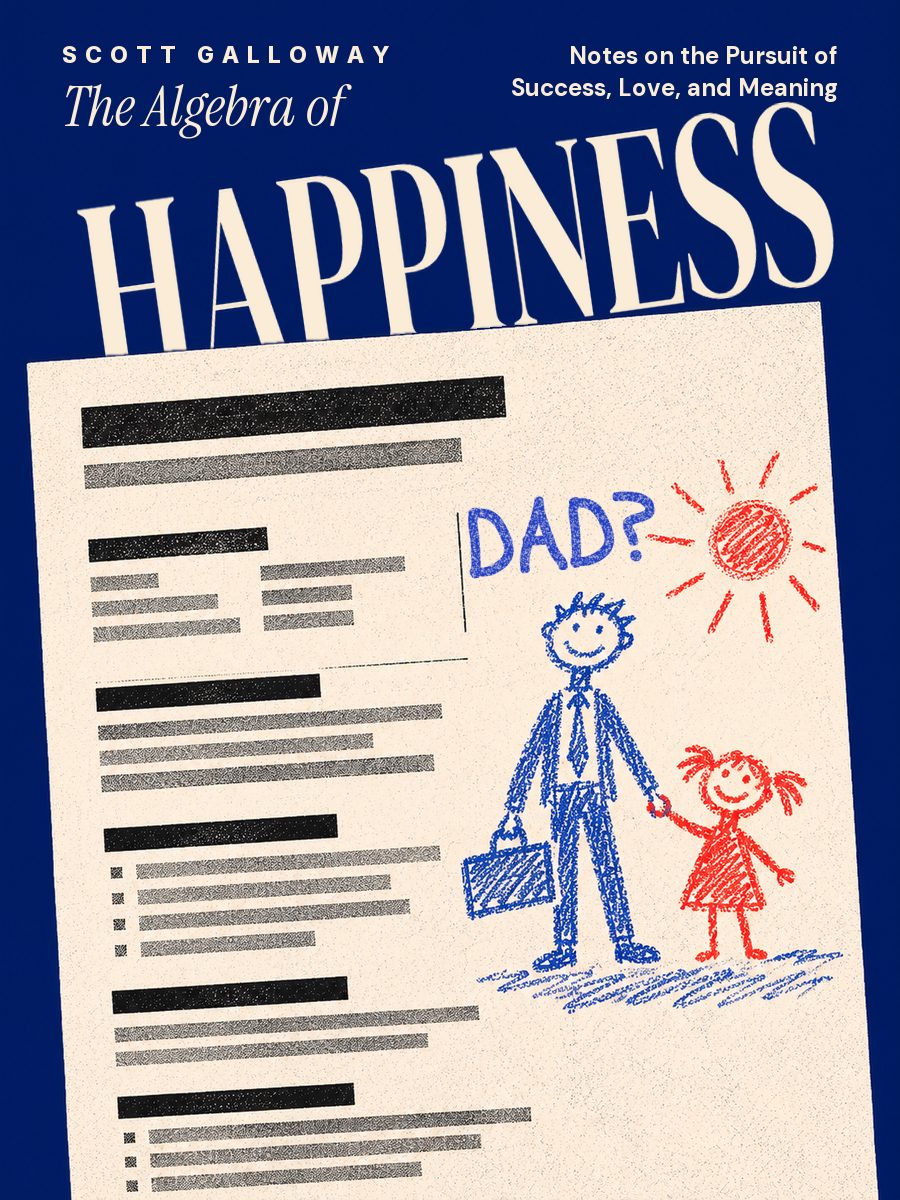
The Algebra of Happiness: Notes on the Pursuit of Success, Love, and Meaning
A marketing professor with nine companies, a divorce and a long list of rejections behind him turns his most popular lecture into a book. He writes his rules like equations and tests them on his own life: ambition, money, marriage, children and his mother's last months. His conclusion is blunt: success is worth chasing, but only as the means to the people you love.
Who it is for
For readers in their twenties and thirties torn between a fast career and a full life. For people who measure progress in salary and titles yet find less and less joy in it. For readers who like advice delivered bluntly, with the author's own failures laid out on the table.
Achievement is just a moment in pencil unless you can share it with people you care about.
Lunch on the fifty-fifth floor
For years David Carey invited his college friend Scott Galloway to lunch on the fifty-fifth floor of Hearst Tower, where he ran the company's magazines. In 2018, still young and well regarded, he said he was stepping down. His reason: he wanted to help young people and was sick of firing his friends.
Galloway calls him a role model, and not because of his career. Carey has been married to Laurie for over three decades, and his four grown children are always around. He never forgot what work was for.
Galloway, a professor at NYU's Stern School of Business, ends each spring with a lecture called The Algebra of Happiness. A short version online passed a million views in ten days, and this book grew out of it. He warns that he has no credentials for life advice, only failed businesses and a divorce by thirty-four. What follows are observations, not research.
His main thought fits in one line: professional success is the means, and relationships are the end.
Balance can wait, manners cannot
Galloway gives ambitious young people unwelcome advice. In his view, balance while you build a career is largely a myth: the slope of a career is set, unfairly, in the first five years after graduation. From twenty-two to thirty-four he remembers little but work, and that cost him his marriage, his hair and arguably his twenties.
Effort alone is not enough without the easy stuff. In 2010 a student walked into his evening class an hour late, after sampling two others. Sent away, he wrote to complain. Galloway's answer: getting a good job and working long hours are really hard, while respect, manners and a little humility are relatively easy. They won't make you successful, but lacking them will hold you back.
He admits failing at this himself: he turns up late to presentations his team has prepared and is slow to answer clients. His rule has three parts: show up early, have good manners, follow up.
About the author
Scott Galloway is a professor at New York University's Stern School of Business and a serial entrepreneur who has founded nine firms, including L2, Red Envelope and Prophet. He is also the author of The Four, a book about Amazon, Apple, Facebook and Google.
All books by this author: Scott Galloway
Terms from the book
- Carey
- Laurie
- Stern
- Morgan Stanley
- UCLA
- Berkeley
- compound interest
- dividends
- Hearst: An American media company that publishes many well-known magazines; its headquarters is Hearst Tower in New York.
- Raleigh: A hotel in Miami Beach, Florida.
- passive income: Money that comes in without your current work, such as dividends, a pension or rent.
- Evans: Karsen and Charly Evans: Karsen was the best friend of Galloway's mother, and Karsen's husband Charly owned a printing business.
Similar books
- The Antidote: Happiness for People Who Can’t Stand Positive Thinking, Oliver Burkeman
- The Art of Happiness, The Dalai Lama, Howard C. Cutler
- The Burnout Society, Byung-Chul Han
- The Courage to Be Disliked: The Japanese Phenomenon That Shows You How to Change Your Life and Achieve Real Happiness, Ichiro Kishimi, Fumitake Koga
- The Fifth Mountain, Paulo Coelho
- The Gay Science, Friedrich Nietzsche
- The Happiness Hypothesis: Finding Modern Truth in Ancient Wisdom, Jonathan Haidt
- The Happiness Trap: How to Stop Struggling and Start Living, Russ Harris
- The Anthropologists, Ayşegül Savaş
- The Anxious Generation: How the Great Rewiring of Childhood Is Causing an Epidemic of Mental Illness, Jonathan Haidt