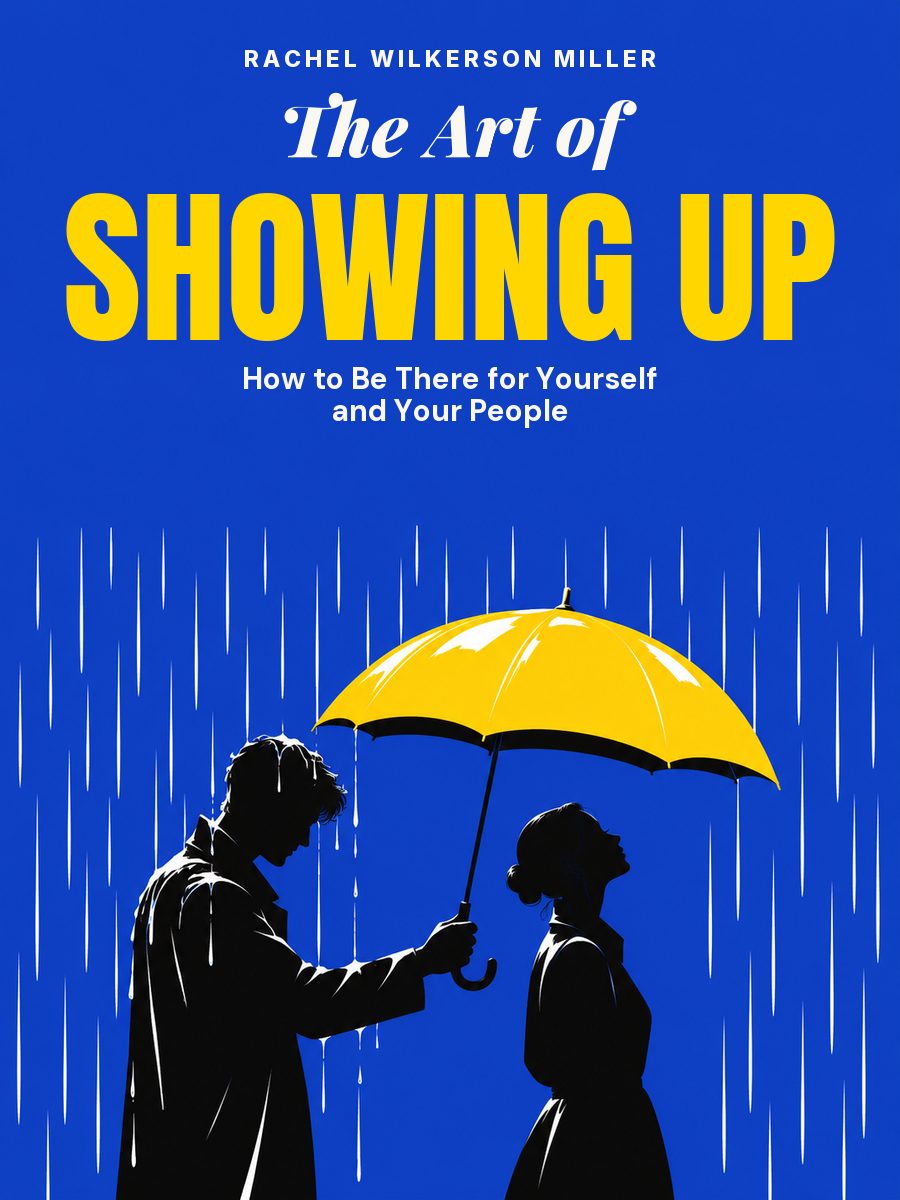

The key ideas
The Art of Showing Up: How to Be There for Yourself and Your People
How can you be a good friend if you barely have the strength for yourself? Journalist Rachel Wilkerson Miller begins her answer with how to look after yourself. Her book is about noticing your own needs and other people's, getting through hard times, making friends as an adult and supporting people in a way that really makes things easier for them.
Who it is for
For anyone who has ended up in a new place without their people, and for everyone who wants to support themselves and those close to them with actions, not stock phrases.
If showing up is so easy, then why are so many people so bad at it?
The box that became a nightstand
In 2014 Rachel Wilkerson Miller moved from Houston to Brooklyn. Her new apartment stood almost empty: her things had stayed in storage in Texas, and after a move across the whole country there was no money for furniture. After a few anxious nights she taped an empty box shut, put a lamp on it and called it a nightstand. The lamp no longer stood on the floor, and for the first time the apartment felt like home to her.
Miller has spent many years writing articles about how to live a little better, and in this book she has boiled her experience down to one skill, which she calls showing up: being there for yourself and for others. The author breaks it down into four steps. Notice that a person needs something. Make sense of it in light of what you know about them. Name what is really going on. And respond so that they feel seen. That person may turn out to be you.
The book's central idea sounds unusual: you can't be there for others until you learn to be there for yourself. So first the book talks about you, and then about others: those who are already close, and those you have yet to find.
First, tell a stranger about something small
Miller believes you can't look after yourself if you don't know your own needs. Values, tastes, what drains you and what gives you energy seem obvious, but few people can list them. Yet knowing them matters: if your decisions don't rest on your values, other people's values dictate them.
Feelings are the hardest part. The author advises looking for a need behind every strong feeling. Her example: anger that only a few people answered a birthday invitation turns out, on an honest look, to be loneliness and a wish to be sure your friends care. Anger pushes you towards a quarrel, but loneliness needs a completely different answer.
Saying a need out loud is frightening, so Miller suggests a ladder. First answer strangers honestly when they ask you themselves: for example, tell the dentist that it actually really hurts. Then talk about your needs to people you know when they ask, and to strangers without being asked: for example, ask a taxi driver to turn up the heating. And only after that, ask people you know without being asked. The author admits she wasn't born fearless. She simply practised, again and again daring to make requests that scared her but turned out to be harmless in the end.
About the author
American journalist Rachel Wilkerson Miller writes about how to live a little better. For four years she was a senior lifestyle editor at BuzzFeed, then became deputy editor-in-chief of VICE Life.
All books by this author: Rachel Wilkerson Miller
The Art of Showing Up: How to Be There for Yourself and Your People Quiz
Terms from the book
- Houston
- Thanksgiving
- Nelson
- shift response
- Brooklyn: One of the five boroughs of New York City. The author moved there in 2014.
- showing up: The book's name for the skill of being there for someone: noticing that a person needs something and responding. It is the author's image, not a scientific term.
- triangle: Shasta Nelson's diagram: friendship rests on a base of positivity, while consistency of contact and vulnerability grow together. It is Nelson's model, not a scientific law.
- Headlee: Celeste Headlee, an American journalist and radio host, author of the book We Need to Talk about how to hold conversations.
- Derber: Charles Derber, an American sociologist who studied how people compete for attention in conversation.
- ring theory: A rule for how to behave around someone else's trouble: comfort is directed towards whoever is closer to the trouble, and complaints only towards those further from it. It was devised by Susan Silk and Barry Goldman.
- Silk: Susan Silk, an American clinical psychologist, co-author of ring theory.
- Goldman: Barry Goldman, an American arbitrator and writer, co-author of ring theory.
Similar books
- The Charisma Myth, Olivia Fox Cabane
- The Compound Effect: Jumpstart Your Income, Your Life, Your Success, Darren Hardy
- The Confidence Gap: A Guide to Overcoming Fear and Self-Doubt, Russ Harris
- The Creative Act: A Way of Being, Rick Rubin
- The Defining Decade: Why Your Twenties Matter and How to Make the Most of Them Now, Meg Jay
- The Gifts of Imperfection: Let Go of Who You Think You’re Supposed to Be and Embrace Who You Are, Brené Brown
- The Happiness Advantage, Shawn Achor
- The Happiness Equation: Want Nothing + Do Anything = Have Everything, Neil Pasricha
- The Art of Strategy, Avinash Dixit, Barry Nalebuff
- The Art of the Deal, Donald Trump, Tony Schwartz