
The key ideas
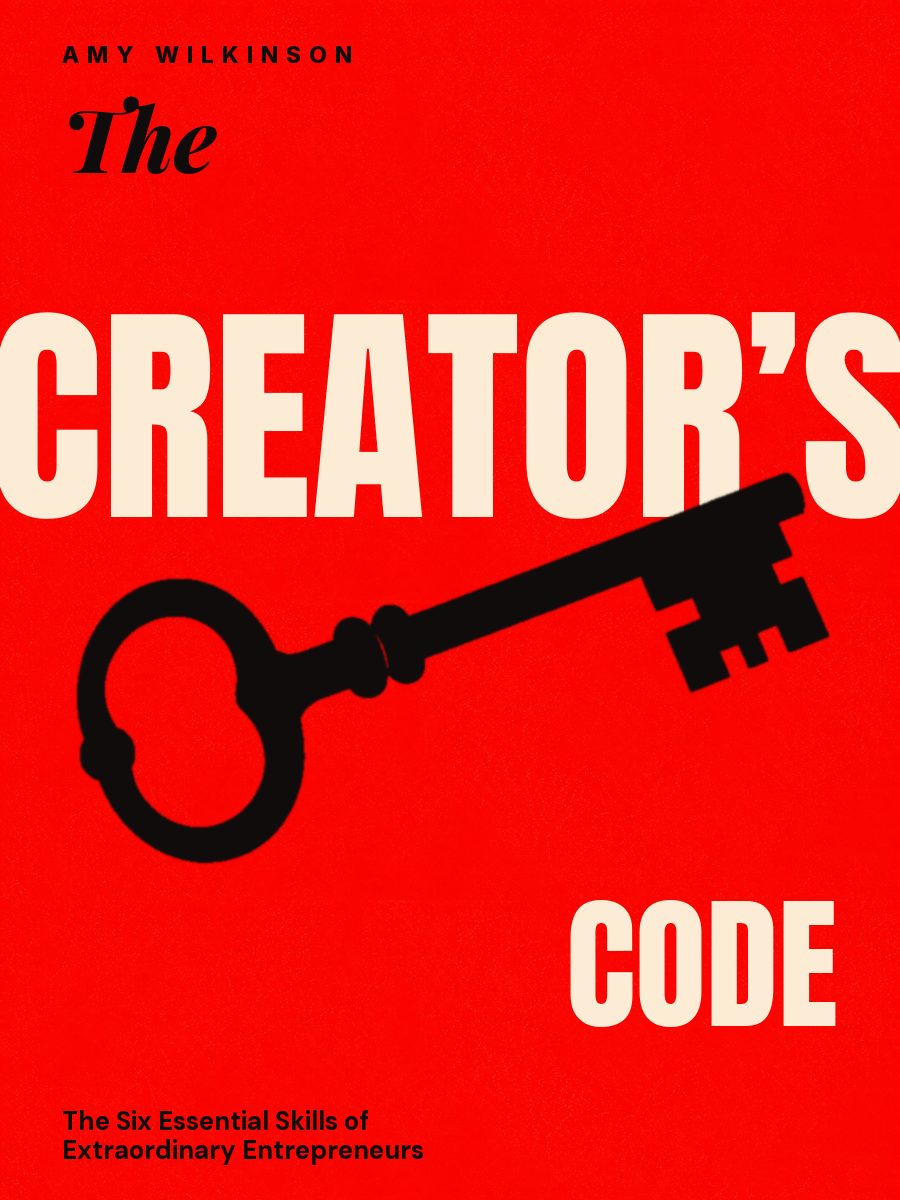
The Creator’s Code: The Six Essential Skills of Extraordinary Entrepreneurs
A college football player slowed down by his sweat-soaked T-shirt built a $2.9 billion sports brand. Stanford lecturer Amy Wilkinson interviewed 200 founders of companies such as Under Armour, PayPal and Chipotle and found six skills they share. She shows how each one works and why none of them needs a degree, a fortune or anyone’s permission.
Who it is for
For anyone thinking of starting a business or a project of their own. For those held back from the first step by fear of failure. For team leaders who want their people to look beyond the usual answers.
Creators are not born with an innate ability to conceive and build $100 million enterprises. They work at it.
A T-shirt that gained three pounds
Kevin Plank played American football for the University of Maryland and was smaller than most of his teammates. He sweated a lot: his soaked cotton undershirt added three pounds. Plank bought a stretchy synthetic fabric, hired a local tailor and, after seven prototypes and $450, had a shirt that weighed seven ounces wet.
He worked out of his grandmother’s basement and ran up $40,000 in credit-card debt. When the book came out, his company, Under Armour, was a $2.9 billion global brand.
Amy Wilkinson, a lecturer at the Stanford Graduate School of Business, spent five years studying people like him. She interviewed 200 founders of companies with over $100 million in annual revenue, or of social enterprises serving more than 100,000 people, and looked for what they shared.
She calls these people creators. In her view they are not born with a special gift and need no MBA, fortune or permission. They share six skills that can be learned and that strengthen one another.
Three ways to see a gap that others miss
The first skill is to find the gap: a need that nobody is meeting yet. Wilkinson describes three ways to do it.
• Sunbirds, named after small birds that carry pollen between flowers, move a working solution into a new field. Asked for a stent that would not collapse inside a blood vessel, inventor Dean Kamen studied his helicopter’s blades, which withstand enormous stress.
• Architects take a problem apart. Elon Musk asked what a rocket is made of and found its materials cost less than 2 percent of the usual price. The rest came from the way rockets were built, so he founded SpaceX.
• Integrators join things that seem incompatible. Steve Ells, a chef trained in fine dining, wanted fresh, carefully cooked food served fast and cheaply, and Chipotle combined the two.
Wilkinson calls curiosity the creator’s main tool. Ask what surprises you, what you could be missing and which paradoxes you see.
About the author
Amy Wilkinson is a lecturer at the Stanford Graduate School of Business and an adviser to startups and large companies. She worked at McKinsey & Company and J.P. Morgan and served as a White House fellow.
All books by this author: Amy Wilkinson
Terms from the book
- Plank
- MBA
- Kamen
- Musk
- SpaceX
- PayPal
- eBay
- Hoffman
- Phillips
- Flynn
- Under Armour: An American sportswear brand that began with a moisture-wicking T-shirt for American football players.
- creators: Wilkinson’s word for founders who turn an idea into a large business or social enterprise. A term of the book, not a scientific category.
- Sunbirds: In Wilkinson’s scheme, creators who move a solution that works in one field into another. Named after small nectar-eating birds that carry pollen between flowers.
- stent: A small tube placed inside a blood vessel to keep it open.
- Architects: In Wilkinson’s scheme, creators who build a solution from the ground up by taking a problem apart and asking what is missing.
- Integrators: In Wilkinson’s scheme, creators who combine existing ideas, often opposite ones, into something new.
- Ells: Steve Ells, a chef and founder of the Chipotle restaurant chain, which opened in 1993.
- Chipotle: An American chain of fast-casual Mexican restaurants: fresh ingredients, fast service, moderate prices.
- Koo: Minjung Koo, a psychologist who studied motivation with Ayelet Fishbach at the University of Chicago.
- Fishbach: Ayelet Fishbach, a psychologist at the University of Chicago who studies goals and motivation.
- Charged Cotton: An Under Armour cotton fabric that, the book says, dries five times faster than ordinary cotton.
- Boyd: John Boyd, an American fighter pilot and military theorist who flew in the Korean War and devised the OODA loop.
- MiG: A family of Soviet fighter jets; in the Korean War they fought American Sabre jets.
- Sabre: The F-86 Sabre, an American fighter jet of the Korean War.
- OODA loop: Boyd’s decision cycle: observe, orient, decide, act, then start again.
- Levchin: Max Levchin, a programmer born in Ukraine and a cofounder of PayPal.
- Thiel: Peter Thiel, an investor and a cofounder of PayPal.
- Palm Pilots: Pocket handheld computers popular in the late 1990s.
- Dow: Steven Dow, a professor at the Human-Computer Interaction Institute of Carnegie Mellon University.
- Herrin: Jessica Herrin, founder of the jewellery company Stella & Dot, which sells through independent stylists at home parties and online.
- Stella & Dot: An American company, launched in 2004, that sells jewellery through independent stylists.
- failure ratio: Wilkinson’s term: the share of attempts a person or company expects, in advance, to fail.
- fraternities: Student societies at American universities whose members often live in one house; for women they are called sororities.
Similar books
- The Culture Code: The Secrets of Highly Successful Groups, Daniel Coyle
- The Culture Map: Breaking Through the Invisible Boundaries of Global Business, Erin Meyer
- The E-Myth Revisited, Michael E. Gerber
- Entrepreneurial You: Monetize Your Expertise, Create Multiple Income Streams, and Thrive, Dorie Clark
- The Fearless Organization: Creating Psychological Safety in the Workplace for Learning, Innovation, and Growth, Amy Edmondson
- The Fifth Discipline: The Art and Practice of the Learning Organization, Peter Senge
- The Goal: A Process of Ongoing Improvement, Eliyahu M. Goldratt, Jeff Cox
- The Hard Thing About Hard Things: Building a Business When There Are No Easy Answers, Ben Horowitz
- The Crowd, Gustave Le Bon
- The Cryptopians: Idealism, Greed, Lies, and the Making of the First Big Cryptocurrency Craze, Laura Shin