
The key ideas
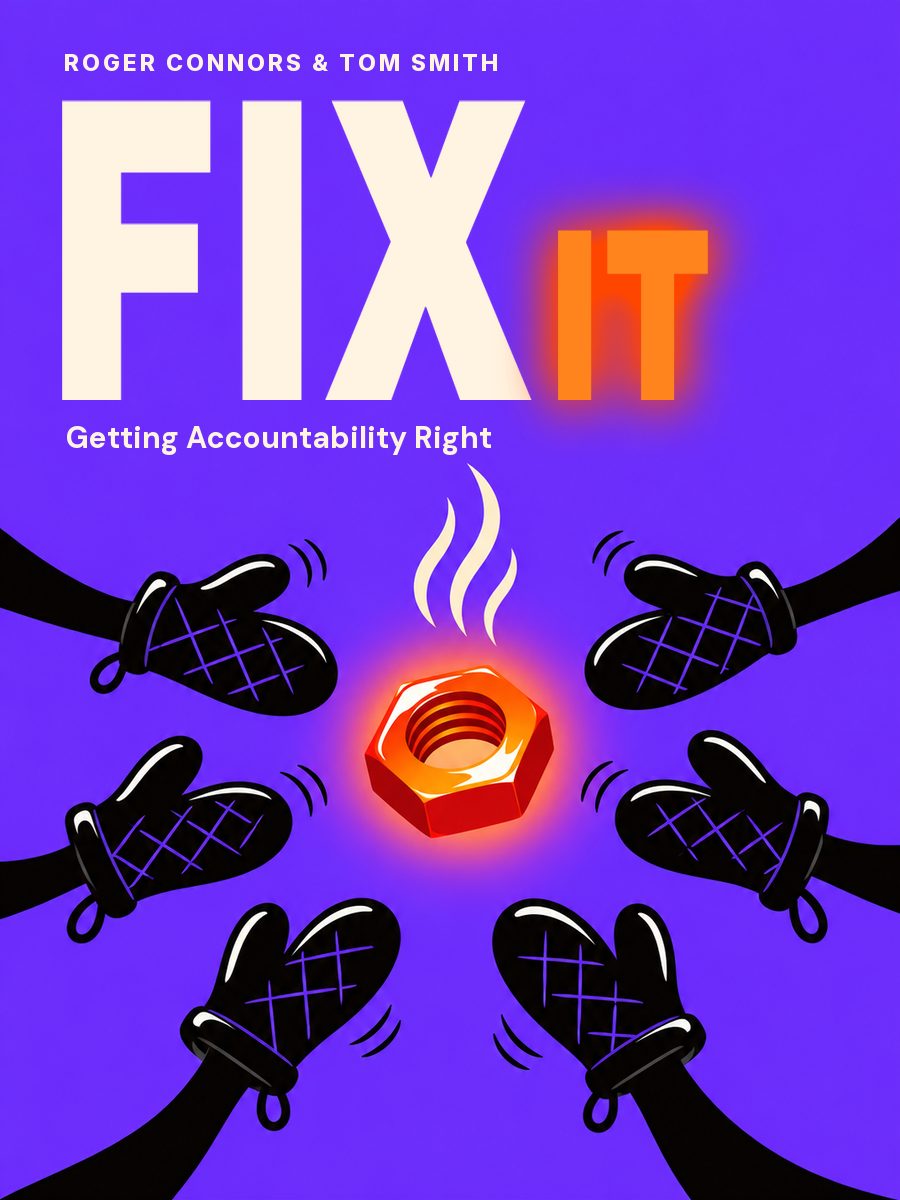
Fix It: Getting Accountability Right
Why does the word “accountability” at work almost always come up after a failure? Roger Connors and Tom Smith, the authors of The Oz Principle, suggest seeing it as a choice, not a punishment. Drawing on a survey of more than 40,000 people and the experience of 120 leaders, they show where people most often turn this choice down and which simple techniques help them come back to it.
Who it is for
For managers and employees who are tired of the blame game at work and want people to take responsibility on their own.
There is nothing shameful about being Below the Line; it is simply ineffective.
Accountability mistaken for punishment
When the word “accountability” comes up at work, something has usually already broken and the search for culprits is starting. Roger Connors and Tom Smith open a dictionary and find the same thing there: an obligation to report, to justify yourself, to take the punishment. With that understanding, the most sensible thing is to hide, and the authors believe this is exactly how most organizations understand accountability today.
For almost thirty years Connors and Smith have taught companies accountability at their consulting firm Partners In Leadership. This book is the sequel to The Oz Principle. It rests on a survey that Partners In Leadership ran itself: from 2012 to 2015, more than 40,000 participants in its webinars answered the questions. Added to it are 240 techniques shared by 120 leaders.
The book’s main idea: accountability does not catch up with you after a mistake, you choose it in advance. The authors draw a line. Below the Line, people look for someone to blame, wait for instructions and explain why nothing can be done. Above the Line, they go through four steps: they see the whole situation, accept their share in it, look for a solution and act.
The book can be read in three ways: to fix yourself, your team or the whole organization. Here each chapter covers one step and the most useful techniques for it.
If no one tells you the unpleasant things, they tell others
In a survey at one international technology company, almost every employee wrote the same thing about the CEO, whom the authors call Bill Sherman: he does not know how to listen. When the results were read out to him and about fifty senior executives, Bill asked whether this should be taken as a sign of his personal shortcomings. More than half the room answered: “No!”
The authors believe the room was wrong. The feedback was about Bill’s style in particular, and the very people who had given it immediately helped their boss not to hear it. So the authors asked him one question: did he want people to keep saying this about him? He did not, and that is where the change began.
The first step, See It, means seeing the whole situation, including what is unpleasant to hear. The authors write that most people stumble right here: 73% of respondents said their organizations fail to benefit from the ability to say and hear unpleasant things. If nobody has told you anything unpleasant in a long time, it does not mean everything is fine. Perhaps the unpleasant things are being discussed with everyone except you.
The authors advise asking what they call Deep Questions: questions that a simple “yes” or “no” will not settle. Instead of “Do you agree?”, it is better to ask “What do you disagree with?” Instead of “Can you get this done on time?”, it is better to ask “What is most likely to stop you from getting this done on time?”
About the author
Roger Connors and Tom Smith founded the consulting firm Partners In Leadership, which teaches organizations a culture of accountability, and wrote the New York Times bestseller The Oz Principle. They wrote Fix It together with the firm’s partners Craig Hickman, Tracy Skousen and Marcus Nicolls.
All books by this author: Roger Connors, Tom Smith
Fix It: Getting Accountability Right Quiz
Terms from the book
- Sherman
- Engagement
- Marshall
- Partners In Leadership: Roger Connors and Tom Smith’s consulting and training firm. It teaches organizations what the authors call a culture of accountability.
- The Oz Principle: The first book on accountability by Connors, Smith and Craig Hickman. In it the authors first described the line and the four steps that this book is built on too.
- Webinars: Seminars or lectures held online. The authors collected the answers for their survey at webinars like these.
- Below the Line: An image from the book, not a scientific term: the state in which a person looks for someone to blame, makes excuses or waits for someone else to solve the problem.
- Above the Line: An image from the book: the state in which a person accepts the situation as their own and asks what else they can do.
- See It: The first of the four steps in the authors’ model: seeing the whole situation, including other people’s views and unpleasant facts.
- Deep Questions: The authors’ term: open questions that cannot be answered with a short “yes” or “no”. They show the other person that you really need the answer.
- Brinker International: An American company that owns the Chili's and Maggiano's Little Italy restaurant chains.
- Staff turnover: The share of employees who leave a company in a year. A figure above 100% means that more people left the company during the year than worked there on average.
- Bridwell: Tony Bridwell, head of human resources at Brinker International.
- Own It: The second step in the authors’ model: accepting your share in the situation and linking your work to the key goals.
- Ownership Conversation: The authors’ technique: a conversation a person starts on their own when they see that their work has drifted away from the key goals. It ends with two lists, “stop doing” and “start doing”.
- Native Foods Café: An American café chain with a menu free of animal products.
- Solve It: The third step in the authors’ model: looking for a way out nobody thought of before by constantly asking yourself what else can be done.
- Van Tassell: Denise Van Tassell, learning and talent development manager at Spirent.
- Spirent: A company that provides services in communications and network technology.
- Hawkshead: Troy Hawkshead, manager of one of Hormel Foods’ plants.
- Hormel Foods: A large American food manufacturer.
- Do It: The fourth step in the authors’ model: seeing decisions through, keeping promises and not shifting the blame onto others.
Similar books
- My Life and Work, Henry Ford
- Game Theory: A Very Short Introduction, Ken Binmore
- Get Smart!: How to Think and Act Like the Most Successful and Highest-Paid People in Every Field, Brian Tracy
- Getting Past No: Negotiating with Difficult People, William Ury
- Getting to Yes: Negotiating Agreement Without Giving In, Roger Fisher, William Ury, Bruce Patton
- Fatigue Study, Frank Gilbreth, Lillian Gilbreth
- The Psychology of Management, Lillian Gilbreth
- Give and Take: A Revolutionary Approach to Success, Adam Grant
- Flow: The Psychology of Optimal Experience, Mihaly Csikszentmihalyi
- Fooled by Randomness: The Hidden Role of Chance in Life and in the Markets, Nassim Nicholas Taleb