
The key ideas
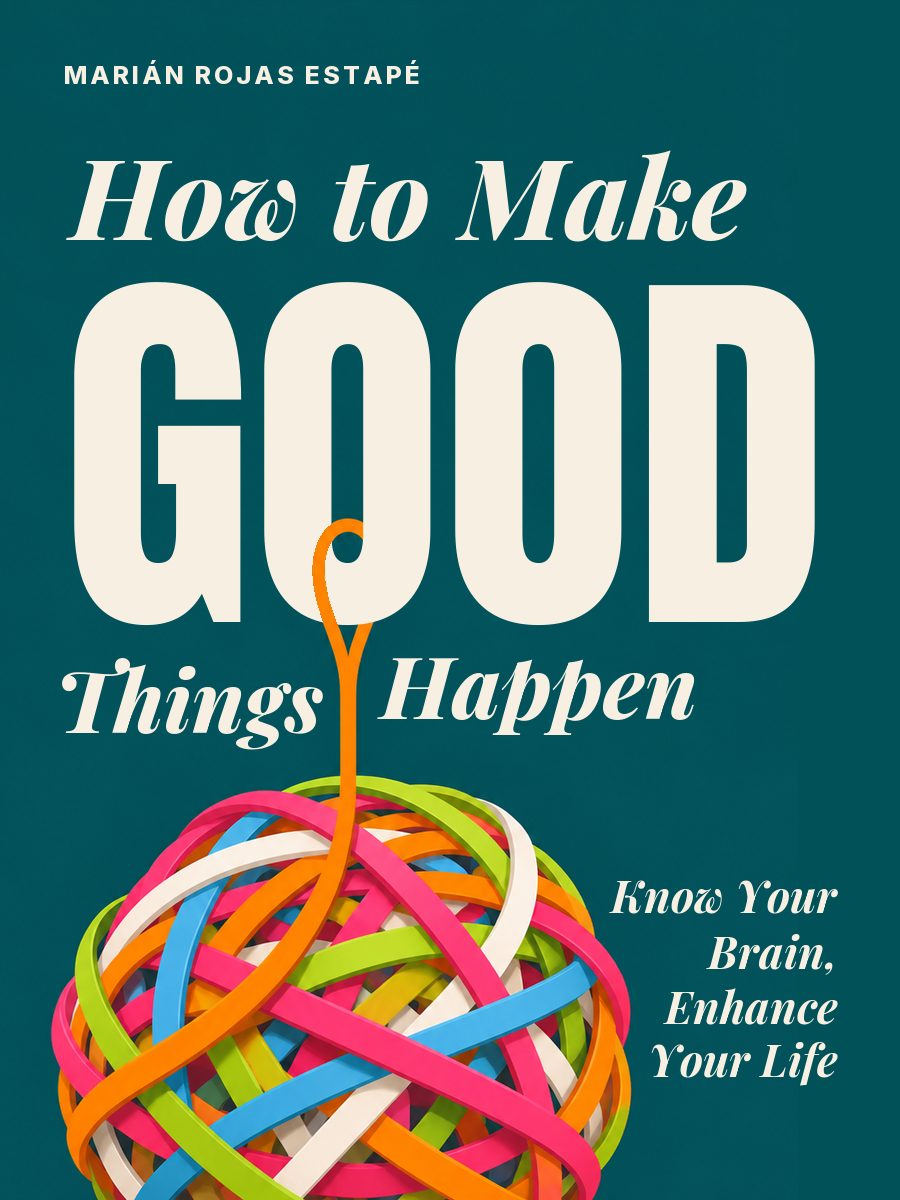
How to Make Good Things Happen: Know Your Brain, Enhance Your Life
The false fire alarm at the movies is over, yet for several hours the body carries on as if there had been a fire. Madrid psychiatrist Marian Rojas Estapé explains why the brain can barely tell a real threat from an imagined one, and what that leads to. Through the stories of her patients and of the Cambodian girls she worked with, the author shows how to calm anxiety, let go of resentment and notice the opportunities we walk past.
Who it is for
For those who often worry about things that haven't happened yet, keep their hurt to themselves and wait for good things to come on their own. And for anyone curious about how thoughts and feelings echo in the body.
Nothing interesting happens to most people for a very simple reason: they don't know what they want to happen to them.
A conversation over the Atlantic
A medical student is flying from New York to London, cramming anatomy. The older man next to her glances at her notes, they get talking, and it turns out he worked for the CIA for more than thirty years. When he hears she wants to become a psychiatrist, he offers her a job with them after she finishes her studies. She never went to work there, but she still carries his business card in her wallet.
That student, Marian Rojas Estapé, became a psychiatrist in Madrid and wrote this book in 2018. She uses the story of that flight to argue with the saying “it will come when you least expect it”. In her view, few words have done so much harm: nobody is going to show up and offer you your life's work; you have to go out and meet it yourself.
The book's main idea: happiness depends less on events than on how we interpret them. The author brings together the simple biology of stress, her patients' stories and her experience working in Cambodia. The explanations of how the brain works are deliberately simplified here: this is the view of a practicing doctor, not a textbook.
The fire that never was
The author asks you to imagine this: you're at the movies, and someone shouts “Fire!” Your heart is pounding, your palms are sweaty, you run for the exit. Outside it turns out a faulty alarm went off, and ten minutes later everyone goes back to their seats. The audience is the same, but the body hasn't calmed down yet: the surge of cortisol, according to Rojas, only subsides after several hours.
Cortisol is released by the adrenal glands to get the body ready to run or fight. In itself it isn't the enemy: without it we would just sit there watching the smoke. The harm, the author believes, begins when anxiety doesn't switch off for weeks.
The key point here, in the author's view: the body is poor at telling the real from the imagined. Close your eyes and imagine cutting a lemon and bringing a slice to your mouth. Your mouth is already watering, even though there is no lemon. Your body responds to the thought “what if I get fired” in the same way.
Rojas writes that ninety percent of our worries never come true. This is her estimate, not a measurement. So the first step is simple: ask yourself whether this is happening now or only might happen.
About the author
Marian Rojas Estapé is a Spanish psychiatrist from Madrid and the daughter of psychiatrist Enrique Rojas. As a young woman she worked in Cambodia with girls rescued from sexual exploitation.
All books by this author: Marian Rojas Estapé
How to Make Good Things Happen: Know Your Brain, Enhance Your Life Quiz
Terms from the book
- cortisol
- Harvard
- CIA
- Adrenal glands
- Beatriz: A patient of Rojas, a mother of three small children, whose story the author tells in the book.
- Luis: Beatriz's husband, an architect the author writes about.
- Irritable bowel syndrome: A disorder of how the bowel works, with pain, bloating, diarrhea or constipation and no visible damage. Its causes are not fully known; stress can make the symptoms worse.
- Mey: A girl from Cambodia whom the author met at a shelter for those rescued from sexual exploitation. She was thirteen years old.
- Wiesenthal: Simon Wiesenthal, an Austrian architect of Jewish origin. He survived five concentration camps, and after the war he tracked down Nazi criminals and wrote a book on whether it is possible to forgive.
- SS officer: A member of the SS, the paramilitary organization of the Nazi Party in Germany, guilty of mass murder.
- Boston: A large city in the northeastern United States, near which Harvard University is located.
- Waldinger: Robert Waldinger, an American psychiatrist and director of the Harvard Study of Adult Development, which has been running since 1938.
- Somaly Mam: A Cambodian activist and the founder of a foundation against human trafficking. By her own account, she was sold to a brothel as a child. Journalists later called parts of her life story into question.
- Phnom Penh: The capital of Cambodia.
- Reticular activating system: A network of nerve cells in the brainstem that controls wakefulness and attention. The author describes it as a filter that lets through to our awareness what matters for our goals; this is a simplified image.
Similar books
- I Don’t Want to Talk About It: Overcoming the Secret Legacy of Male Depression, Terrence Real
- I Hate You—Don't Leave Me: Understanding the Borderline Personality, Jerold J. Kreisman and Hal Straus
- In the FLO: Unlock Your Hormonal Advantage and Revolutionize Your Life, Alisa Vitti
- Life Without Ed: How One Woman Declared Independence from Her Eating Disorder and How You Can Too, Jenni Schaefer, Thom Rutledge
- Lifespan: Why We Age—and Why We Don’t Have To, David Sinclair, Matthew LaPlante
- The Little Book of Hygge, Meik Wiking
- Lost Connections: Why You're Depressed and How to Find Hope, Johann Hari
- Love’s Executioner and Other Tales of Psychotherapy, Irvin D. Yalom
- How to Manage Your Slaves, Marcus Sidonius Falx, Jerry Toner
- How to Raise a Reader, Pamela Paul