
The key ideas
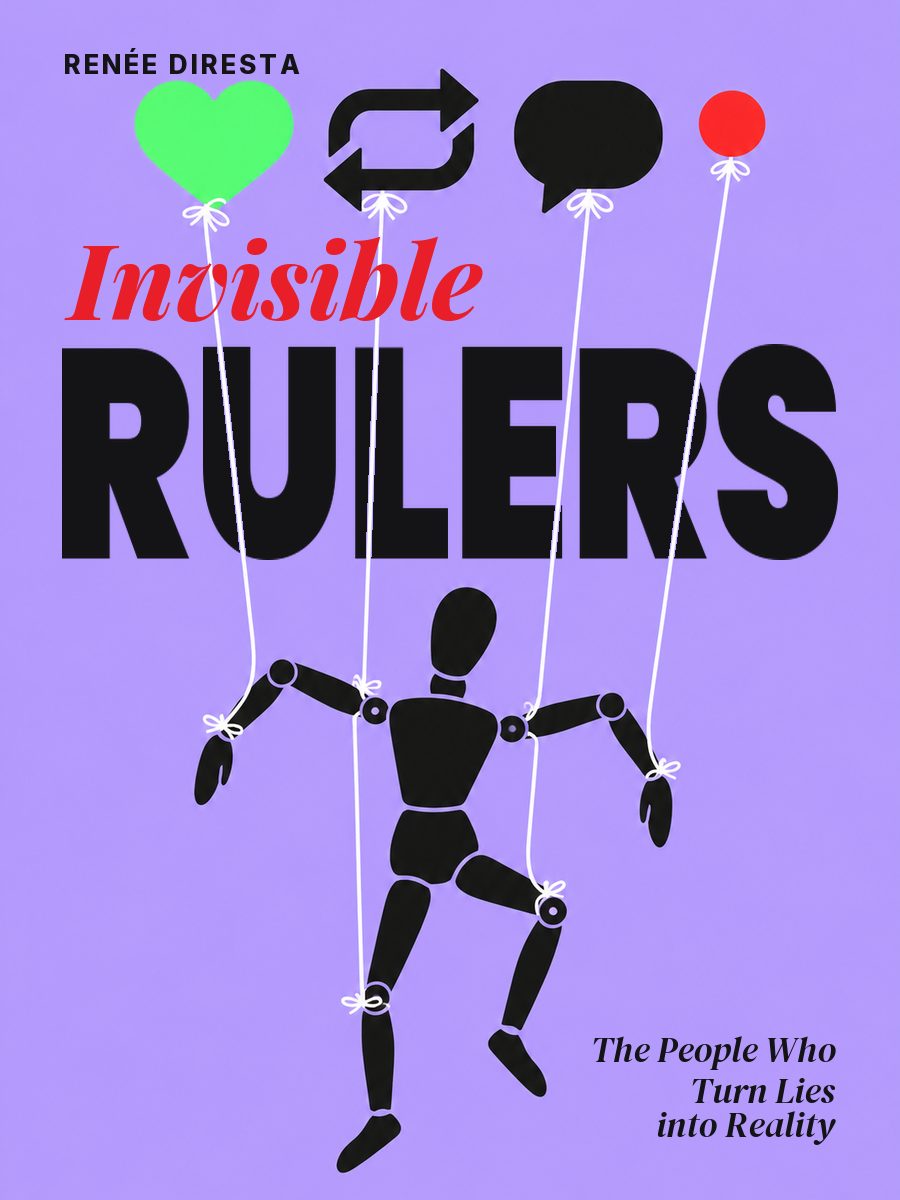
Invisible Rulers: The People Who Turn Lies into Reality
How did one tweet about a furniture store turn into a worldwide panic about kidnapped children within a month? Researcher Renée DiResta shows that the opinions of millions are now shaped not by newsrooms but by a combination of an influencer, an algorithm and a crowd. The book explains why a loud minority seems like the majority, how a rumor outruns fact-checking, and what each of us can do to avoid becoming part of someone else’s campaign.
Who it is for
For anyone who keeps asking whether everyone around has lost their mind, and wants to understand who really decides what the feed is arguing about today.
If you make it trend, you make it true.
The cabinets that supposedly hid children
In the summer of 2020 a chilling story spread across social media: the online furniture store Wayfair was supposedly trafficking kidnapped children. The proof was said to be expensive cabinets named after women. It all started with a single tweet by a woman from Canada with the handle Amazing Polly. Within a month the story had collected millions of reactions, and the services that search for real missing children were begging people to stop calling them about cabinets.
Renée DiResta studied waves like this at the Stanford Internet Observatory. She took the book’s title from Edward Bernays: in 1928 he used the phrase invisible rulers for those who steer the opinions of millions from behind the scenes. In the author’s view, today these are no longer PR people and editors but a combination of three players: the influencer, the algorithm and the crowd.
The blogger tells a story, the algorithm notices the spike of interest and shows it to new people, and the crowd picks it up and makes it its own. DiResta boils this down to a formula: if you make it trend, you make it true. Next you’ll see how this combination works, who profits from it, and how the researcher herself became a character in someone else’s conspiracy theory.
The guitarist rewritten by his own audience
DiResta opens the book with an invented character and warns that he is a caricature. A music teacher nicknamed Guitar Guy has been posting videos for years and has gathered forty thousand fellow guitar lovers. One day on a livestream he brings up a famous rock musician’s controversial remarks about vaccines. The likes and tips go up.
Guitar Guy keeps going: less and less music, more and more arguments. The algorithm notices the high engagement and starts recommending his videos, and soon Guitar Guy has 480,000 subscribers. But these are different people now. They came for the controversy and expect ever harsher words, while his old fans leave or fall silent.
The author has a name for this: audience capture. A blogger tailors their words to those who reward them, and gradually comes to believe them. Platforms, according to DiResta, offer influence as a service: tools, reach and a statistics dashboard. Money comes from advertising, subscriptions and sponsors, and it is far from always disclosed. The author found hundreds of posts by well-known political bloggers with no advertising label and with links from a firm that paid to promote petitions.
So it helps to ask two questions about a favorite voice in your feed: how have its topics changed, and who pays for it? Trust in a blogger resembles trust in a friend, but a friend usually doesn’t have a view counter.
About the author
Renée DiResta was technical research manager at the Stanford Internet Observatory, where she studied how rumors and propaganda spread. She writes for The Atlantic and Wired.
All books by this author: Renée DiResta
Invisible Rulers: The People Who Turn Lies into Reality Quiz
Terms from the book
- Stanford
- Bernays
- algorithm
- QAnon
- primaries
- Mann
- Wayfair: An American online furniture store. In the summer of 2020 it was falsely accused of trafficking children hidden in expensive cabinets.
- Amazing Polly: The handle of a Canadian blogger from the QAnon community. Her tweet of June 14, 2020, started the rumor about children in Wayfair cabinets.
- influencer: A blogger who shapes the opinions and purchases of their followers. They feel like “one of us,” yet their reach can rival a TV channel’s.
- audience capture: A concept the author uses: a blogger tailors topics and tone to their most active followers, and then comes to believe what they are saying.
- asymmetry of passion: The author’s phrase: a small group of committed people posts so much and so heatedly that on social media it looks stronger than the silent majority.
- majority illusion: A situation in which the opinion of a few highly visible, well-connected people seems to be everyone’s opinion.
- Discord: A chat and voice service where communities gather on closed servers.
- hashtag: A word or phrase marked with # in a post. It helps find all the posts on one topic and can make it onto the list of trends.
- Pelosi: Nancy Pelosi, an American Democratic politician, Speaker of the US House of Representatives in 2020.
- Sonoma: A county in California, north of San Francisco.
- Iowa: A Midwestern US state that traditionally holds the first vote of the primaries.
- Sanders: Bernie Sanders, an American senator who ran in the 2020 Democratic primaries.
- trope: A familiar plot device or character type from books and films that the audience recognizes at once. The author finds the same ready-made devices in rumors.
- prebunking: Explaining the techniques of deception in advance, before people run into a specific lie. The opposite of debunking after the fact.
- Benz: Mike Benz, a former US State Department employee and head of the Foundation for Freedom Online. In the author’s account, he portrayed her team’s work as a conspiracy for the sake of censorship.
- Taibbi: Matt Taibbi, an American journalist. In 2022 and 2023 he went through Twitter’s internal correspondence in a series of posts called the Twitter Files.
- Serengeti strategy: Michael Mann’s image: just as a predator cuts one animal from the herd, a harassment campaign singles out one researcher to frighten the rest. It is a figurative comparison, not a scientific concept.
Similar books
- Killers of the Flower Moon: The Osage Murders and the Birth of the FBI, David Grann
- Public Opinion, Walter Lippmann
- Man, the Manipulator: The Inner Journey from Manipulation to Actualization, Everett L. Shostrom
- Midnight in Chernobyl, Adam Higginbotham
- Nonviolent Communication: A Language of Life, Marshall B. Rosenberg
- Nudge: Improving Decisions About Health, Wealth, and Happiness, Richard H. Thaler, Cass R. Sunstein
- Of Boys and Men, Richard Reeves
- Outliers: The Story of Success, Malcolm Gladwell
- It Didn't Start with You: How Inherited Family Trauma Shapes Who We Are and How to End the Cycle, Mark Wolynn
- It's How You Play the Game: The Powerful Sports Moments That Taught Lasting Values to America's Finest, Brian Kilmeade