
The key ideas
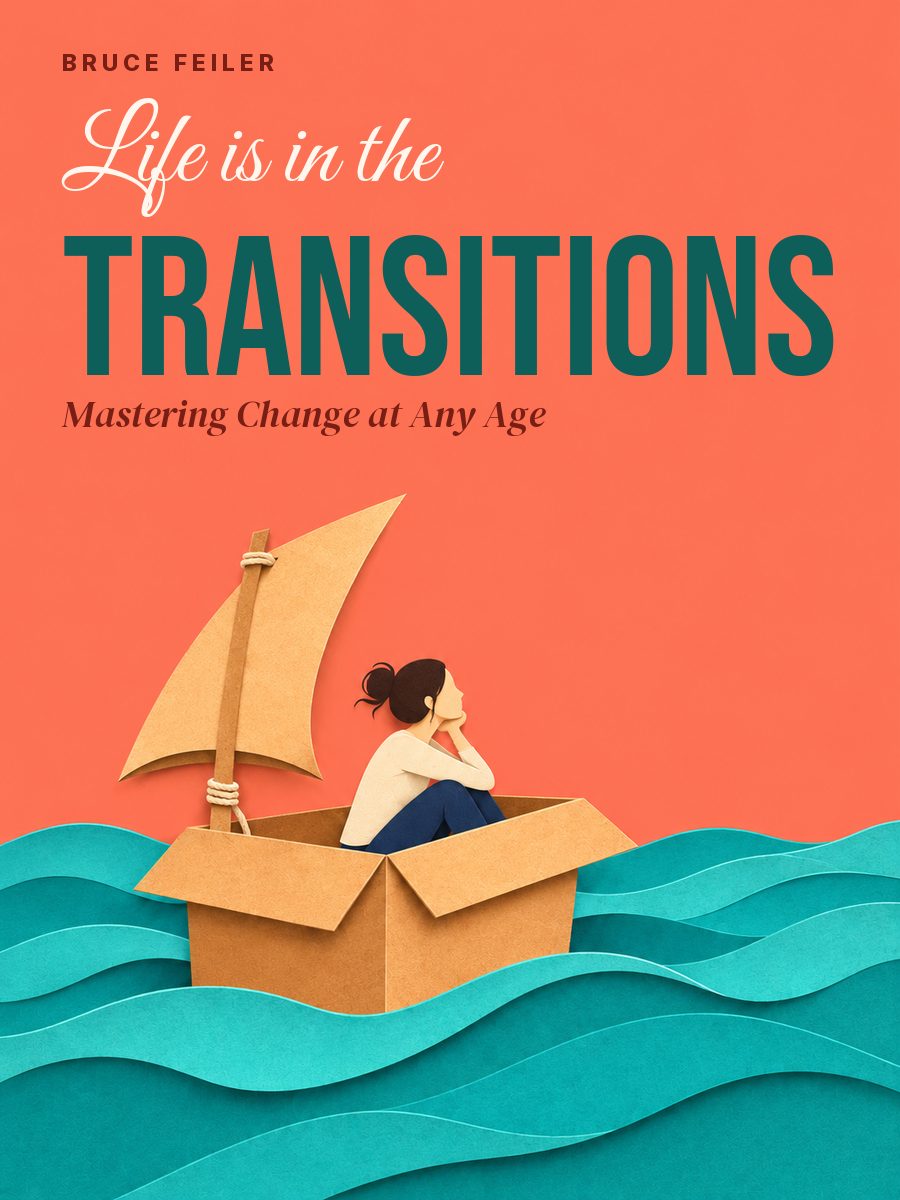
Life Is in the Transitions: Mastering Change at Any Age
Illness, divorce, losing a job, moving to a strange city. Bruce Feiler recorded 225 life stories and found that big changes happen more often than we expect and follow no timetable. The book shows how the transition after such a change works and which tools people use to get through it.
Who it is for
For anyone who has moved, lost a job, got divorced or simply feels that life isn't going to plan, and wants to understand how to get through a change.
We're all comparing ourselves to an ideal that no longer exists and beating ourselves up for not achieving it.
A question every Monday
One day Bruce Feiler's mother called him: his father had tried to kill himself. His father was nearly eighty, Parkinson's was stiffening his body and weighing on his spirit, and he, as Feiler writes, had lost his sense of meaning in life.
Feiler had spent thirty years writing about how stories give life meaning. One Monday morning he sent his father a question: "What toys did you love as a child?" For four years a question arrived every Monday. His father dictated his answers into his phone, corrected the printouts, added photographs. A man who had never written anything longer than a work memo put together an autobiography.
That was how the Life Story Project began. Feiler recorded the stories of 225 people from every state in the US: more than a thousand hours of conversations about illness, divorce, losing jobs and fresh starts. From them he drew the book's formula. The linear life is a thing of the past. A nonlinear life brings more transitions. And getting through them is something you can learn.
Disruptors come with no timetable
Elisa Korentayer went to six different schools as a child, then lived in London and Tel Aviv. When she decided to write songs, she was turned down by nineteen artists' programmes, and the twentieth, in rural Minnesota, accepted her. There Elisa went on a canoe trip with a guide and a year later married him. The move didn't frighten her, but she had to change her work, lose friends and build a family all at once.
Feiler calls anything that knocks the usual course of life off track a disruptor, from a wedding to being fired. By his count, an adult faces such a disruptor roughly once every twelve to eighteen months. Usually it passes almost painlessly. But about one in ten grows into a lifequake, as the author calls it: a change after which life splits into "before" and "after". Disruptors often pile into each other like cars in a crash, and for Elisa three collided at once.
The old theories promised order: life goes in stages, and the crisis arrives around forty. A large American study from 1995 with seven thousand participants did not confirm that most people go through a midlife crisis. Feiler also saw that the low points of life are scattered across every age. We feel we are falling behind because we have linear expectations in a nonlinear life.
About the author
Bruce Feiler is an American writer, the author of books about family, faith and travel. After surviving bone cancer, a crisis in the family business and his father's illness, he recorded the life stories of 225 people from every state in the US.
All books by this author: Bruce Feiler
Life Is in the Transitions: Mastering Change at Any Age Quiz
Terms from the book
- Goldman Sachs
- Gennep
- Adams
- Maine
- Minneapolis
- James
- Parkinson's: Parkinson's disease: a slowly progressing disease of the nervous system that disrupts movement and often affects mood.
- Korentayer: Elisa Korentayer, one of the people in the book. She left a job in IT to write songs, went to rural Minnesota on an artists' programme and married a local guide.
- Minnesota: A state in the north of the US with thousands of lakes and a sparsely populated countryside.
- disruptor: The author's term for any event that knocks the usual course of life off track, from a wedding or a new job to an illness or being fired. Feiler's term, not a scientific one.
- lifequake: The author's term for a powerful change after which life splits into "before" and "after" and a long transition begins. The author's image, not a scientific term.
- Levine: Jamie Levine, one of the people in the book, a former partner at Goldman Sachs. After his daughter's illness and being fired, he moved to a small company and rebuilt his life around his family.
- shape-shifting: The author's term for redistributing weight between the three pillars of meaning after a big change. Feiler's model, not a personality type.
- Bridges: William Bridges (1933-2013), an American consultant, author of the popular 1979 book Transitions about the three phases of a transition.
- long goodbye: Feiler's name for the phase of a transition when a person parts with their former life.
- messy middle: Feiler's name for the phase of a transition when the old is already gone and the new has not yet taken shape.
- kryptonite: An invented mineral from the Superman comics, the only thing that takes away his strength. Figuratively: a weak spot.
- Zak: Gena Zak, one of the people in the book, a Coast Guard veteran. In her fifties she left Verizon and started her own business in Maine looking after second homes.
- Goodwin: Davon Goodwin, one of the people in the book, a US Army veteran. After a roadside bomb in Afghanistan he went back to university and became a farm manager.
- Angelo: Michael Angelo, one of the people in the book, a New York hairstylist who owns a salon in Manhattan.
- McAdams: Dan McAdams, an American psychologist at Northwestern University who researches life stories. His interview method became the basis of Feiler's project.
- Shafer: Ellen Shafer, one of the people in the book. She worked in advertising in Minneapolis, and after her husband lost his job she went back to North Dakota, to her home town of Fargo.
- Fargo: The largest city in the state of North Dakota in the north of the US.
Similar books
- Make It Stick: The Science of Successful Learning, Peter C. Brown, Henry L. Roediger III, Mark A. McDaniel
- Make Your Bed: Little Things That Can Change Your Life...And Maybe the World, William H. McRaven
- Manage Your Day-to-Day, Jocelyn K. Glei (ed.), 99U
- Pushing to the Front, Orison Swett Marden
- Mindset, Carol Dweck
- Mini Habits: Smaller Habits, Bigger Results, Stephen Guise
- Moonwalking with Einstein: The Art and Science of Remembering Everything, Joshua Foer
- My Morning Routine: How Successful People Start Every Day Inspired, Benjamin Spall, Michael Xander
- Life Without Ed: How One Woman Declared Independence from Her Eating Disorder and How You Can Too, Jenni Schaefer, Thom Rutledge
- Lifespan: Why We Age—and Why We Don’t Have To, David Sinclair, Matthew LaPlante