
The key ideas
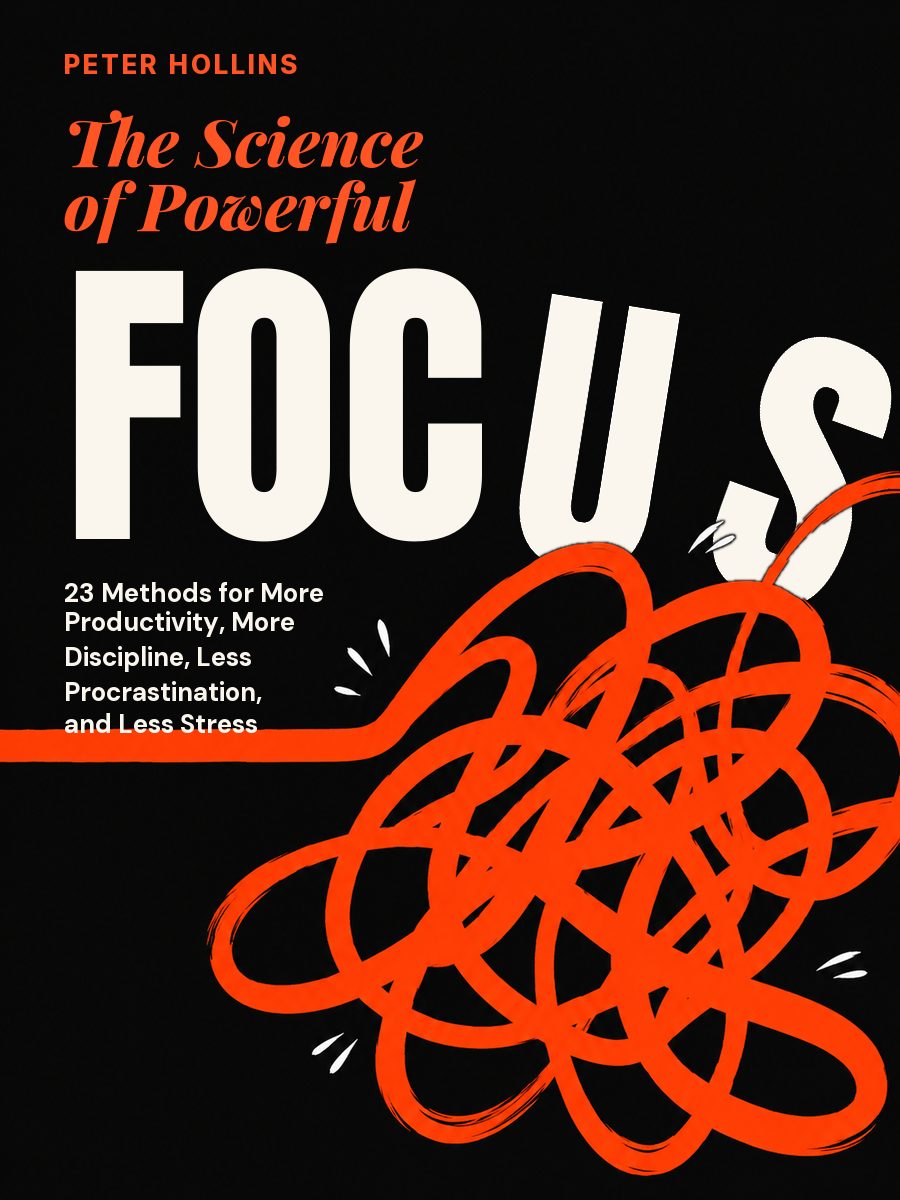
The Science of Powerful Focus: 23 Methods for More Productivity, More Discipline, Less Procrastination, and Less Stress
For years a student handed in his papers a minute before the deadline, until a simple timer changed his habit. Later that student became an author and gathered methods that help you hold your attention: from the ten-minute rule to one word that makes saying no easier. Here are only the main ones and what they rest on.
Who it is for
For anyone who opens an important task and five minutes later is scrolling a feed. And for anyone used to pulling everything off in a last-minute sprint before the deadline.
Emails are a to-do list that other people have made for you.
A paper handed in a minute before the deadline
At university, Peter Hollins had a reputation nobody would brag about. If a paper was due at nine in the evening, he sent it in at 8:59 p.m., after two days without sleep. Once he simply couldn’t make himself sit down to a paper on Eastern philosophy. So he asked a friend to deliberately corrupt the file, sent it in and won himself one more night.
The turning point came in his final year, when he was assigned a fifty-page paper on the philosophy of Karl Marx. The same friend showed him the Pomodoro Technique: twenty-five minutes of complete concentration, five minutes of rest, and then the cycle repeats. The paper was done ahead of schedule, and for the first time Hollins got a good night’s sleep before handing one in.
Since then he has gathered everything written about attention: about the brain, sleep, stress and habits. The book has twenty-three methods, and they don’t all carry the same weight. The author retells research briefly and loosely, so in what follows it is presented as the author’s view, not as proven science.
The main idea is simple. Focus rests not on iron willpower but on knowing how the brain and body work. Whoever works with them gets more done and gets less tired.
The brain picks the pleasant thing before you’ve had time to think
Procrastination, the habit of putting off the hard thing in favor of the pleasant one, isn’t laziness, according to Hollins, but an argument inside the brain. In his simplified picture, the amygdala, which is linked to emotions, instantly spots an unpleasant task and pulls you toward something easier. The prefrontal cortex, which weighs things up and decides, kicks in a few seconds later. It’s a popular simplification, not an exact map of the brain, but it explains a familiar scene.
You sit down to a report and suddenly start tidying your desk drawer. The author calls this productive procrastination: the scary task is swapped for a safe one, and the visible result serves as the excuse.
Hollins takes his cue from the researcher Kenneth McGraw: the hardest part isn’t doing the work but starting it. Until the task is started, your imagination keeps replaying its worst parts over and over. Hence the rule: promise yourself you’ll work on the task for just ten minutes. In that time you build momentum, and the next ten come easier.
If the task still won’t get going after ten minutes, the author advises not grabbing a different task but moving for ten minutes: take a walk or stretch. Then set the timer again. A big task is better broken into small steps, so that each one brings a small win.
About the author
Peter Hollins writes popular books on psychology, self-discipline and thinking. By his own account, as a student he handed in every paper at the last minute.
All books by this author: Peter Hollins
Terms from the book
- Stanford
- multitasking
- Marx
- Procrastination
- amygdala
- McGraw
- Parkinson
- Leroy
- single-tasking
- Pomodoro: A time management method invented by Francesco Cirillo in the late 1980s: 25 minutes of work, a short break, and after four of these stretches, a long rest. The name comes from a tomato-shaped timer.
- prefrontal: The prefrontal cortex is the very front part of the frontal lobes. Planning, self-control and decisions depend on it to a large extent.
- Kleitman: Nathaniel Kleitman, an American physiologist and one of the founders of sleep science. With colleagues, he described REM sleep and suggested that cycles of rest and activity continue during the day too.
- Yerkes: Robert Yerkes, an American psychologist. In 1908, together with John Dodson, he described the link between the level of arousal and how well people perform.
- Dodson: John Dodson, an American psychologist, Robert Yerkes’s coauthor on the law now known as the Yerkes-Dodson curve.
- attention residue: Sophie Leroy’s term: the part of your attention that stays with the previous task for a while after you switch, and gets in the way of the new one.
- Nass: Clifford Nass, an American researcher at Stanford University, who studied how people interact with technology and how multitasking affects them.
Similar books
- The Seven Decisions: Understanding the Keys to Personal Success, Andy Andrews
- The Slight Edge, Jeff Olson
- The Talent Code, Daniel Coyle
- The Time Management Masterclass, James Manktelow, Namita Anand
- The War of Art: Winning the Inner Creative Battle, Steven Pressfield
- The Willpower Instinct, Kelly McGonigal
- Think Like a Rocket Scientist: The Workbook, Ozan Varol
- Thinking, Fast and Slow, Daniel Kahneman
- The Scout Mindset: Why Some People See Things Clearly and Others Don't, Julia Galef
- The Second Mountain: The Quest for a Moral Life, David Brooks