The key ideas
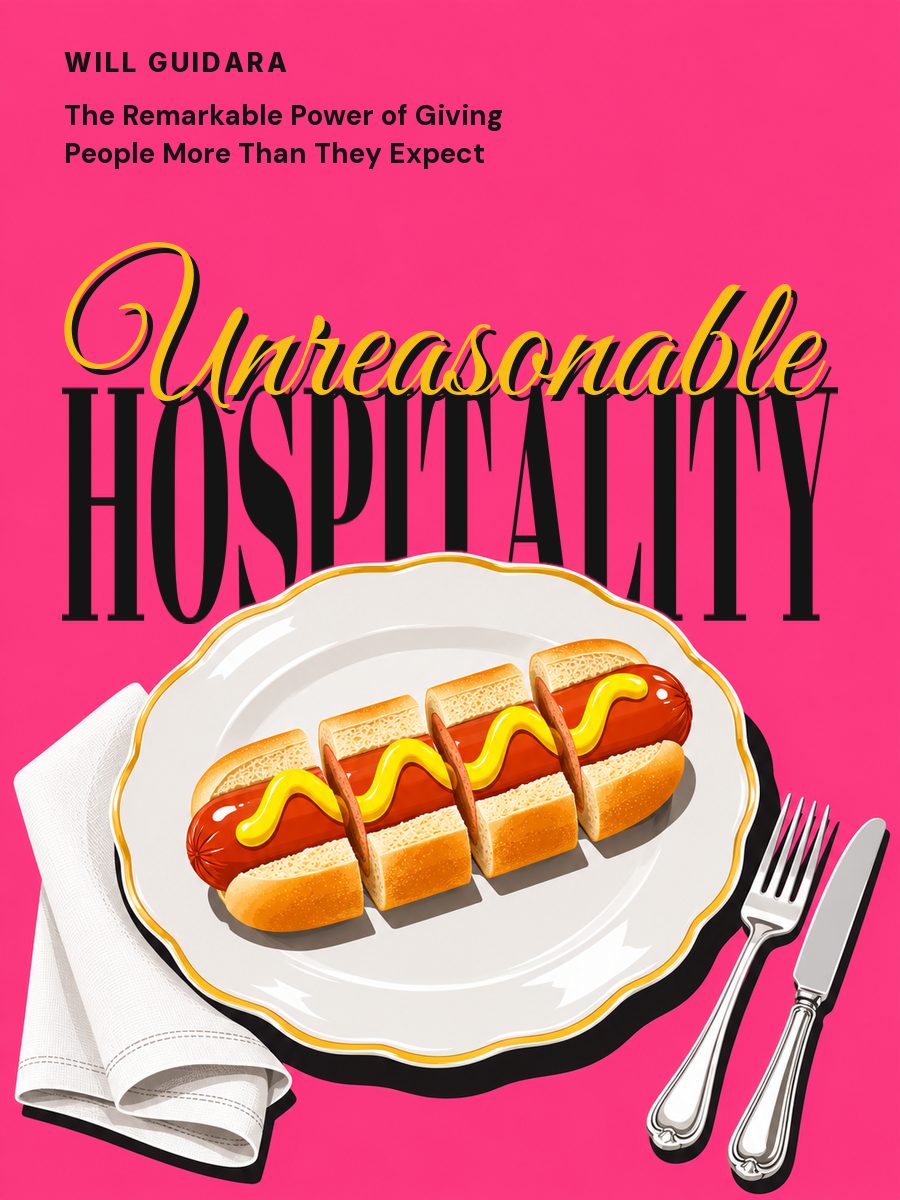
Unreasonable Hospitality: The Remarkable Power of Giving People More Than They Expect
Why do we forget some places by the next day and keep talking about others for years? Will Guidara took a New York restaurant from last place in the world ranking to first, and he explains how. His answer: take what people feel as seriously as the product itself, and start with your own team.
Who it is for
For anyone who works with people: in sales, in service, in an office or in a business of their own. And for leaders who want their team to actually want to take care of customers.
Hospitality is a selfish pleasure. It feels great to make other people feel good.
Last place and a napkin
London, 2010, the ceremony for the ranking of the world's fifty best restaurants. New York's Eleven Madison Park is announced first, and the faces of its two leaders go up on a giant screen. But there is nothing to celebrate: the first one named is fiftieth, last place. That night general manager Will Guidara and chef Daniel Humm sit on the hotel steps with a bottle of bourbon and write on a cocktail napkin: “We will be Number One in the world.”
Guidara sees what they are missing. The great chefs became famous by changing food. He decides to bet on something that never changes: people want to be taken care of. Before he falls asleep, he adds two words to the napkin: “Unreasonable Hospitality.”
He once heard the best explanation of how service differs from hospitality in a job interview: service is black and white, hospitality is color. Service is bringing the right plate to the right person at the right time. Hospitality is making the person feel good about how you do it. The author believes this difference holds in any line of work, from banking to selling apartments.
Seven years later Eleven Madison Park will be named the best restaurant in the world. Next come the rules that got it there.
Blue spoons at a crazy price
Before Eleven Madison Park, Guidara ran the cafés at New York's Museum of Modern Art. There he came up with a gelato cart for the sculpture garden and found tiny blue plastic paddle-shaped spoons in Italy. They were beautiful and absurdly expensive. When his boss learned the price, she narrowed her eyes and promised they would talk about it later.
That talk never happened. When they went over the first report, it turned out Guidara had worked out everything else down to the penny: he got the ice cream at a big discount and the cart itself for free. That is how the Rule of 95/5 was born: manage ninety-five percent of your costs as strictly as you possibly can, and spend the last five percent “foolishly”.
The author sees this as precise math: those five percent are exactly what a person notices and remembers. At Eleven Madison Park, inexpensive wines were paired with almost every dish on the tasting menu, so that at the end they could pour one rare glass the guests would talk about afterward.
One evening a family from Spain was at dinner, and the children were seeing snow for the first time in their lives through the huge windows. Guidara sent someone out to buy four sleds, and after dinner a car with a driver took the family sledding in Central Park. Spending like that is only possible if you save for the whole rest of the year.
About the author
Will Guidara is an American restaurateur. Together with chef Daniel Humm he ran Eleven Madison Park, which was named the best restaurant in the world in 2017.
All books by this author: Will Guidara
Unreasonable Hospitality: The Remarkable Power of Giving People More Than They Expect Quiz
Terms from the book
- Meyer
- Eleven Madison Park: A restaurant in New York by Madison Square Park. Guidara ran its dining room from 2006; in 2009 the restaurant got four stars from The New York Times, and in 2017 it was named the best restaurant in the world.
- Humm: Daniel Humm, a Swiss chef. From 2006 he ran Eleven Madison Park together with Guidara, and later the two of them bought the restaurant.
- Dreamweaver: A job invented at Eleven Madison Park and named after Gary Wright's song “Dream Weaver”. The person in this role brings to life the surprises the team dreams up for guests.
- Per Se: Chef Thomas Keller's New York restaurant; in the book, a model of perfection that Eleven Madison Park measured itself against.
- Betz: Jim Betz, a member of the Eleven Madison Park team and a coffee expert. He was put in charge of the restaurant's coffee program and switched it to brewing right at the table.
- Kelewae: Kirk Kelewae, a Cornell University graduate. He started out running plates, took over the beer program and later became general manager of Eleven Madison Park.
- Wells: Pete Wells, the restaurant critic of The New York Times after Frank Bruni. In 2012 he panned Eleven Madison Park's New York-themed menu, and in 2015 he gave the restaurant four stars after all.
Similar books
- Verbal Judo: The Gentle Art of Persuasion, George J. Thompson, Jerry B. Jenkins
- Wake Up and Smell the Coffee, Simon Mac Rory
- Way of the Wolf: Straight Line Selling: Master the Art of Persuasion, Influence, and Success, Jordan Belfort
- What Got You Here Won't Get You There, Marshall Goldsmith, Mark Reiter
- Who Not How: The Formula to Achieve Bigger Goals Through Accelerating Teamwork, Dan Sullivan, Benjamin Hardy
- Will It Fly? How to Test Your Next Business Idea So You Don't Waste Your Time and Money, Pat Flynn
- Winning, Jack Welch, Suzy Welch
- Words That Change Minds, Shelle Rose Charvet
- Until the End of Time: Mind, Matter, and Our Search for Meaning in an Evolving Universe, Brian Greene
- Unwinding Anxiety: New Science Shows How to Break the Cycles of Worry and Fear to Heal Your Mind, Judson Brewer