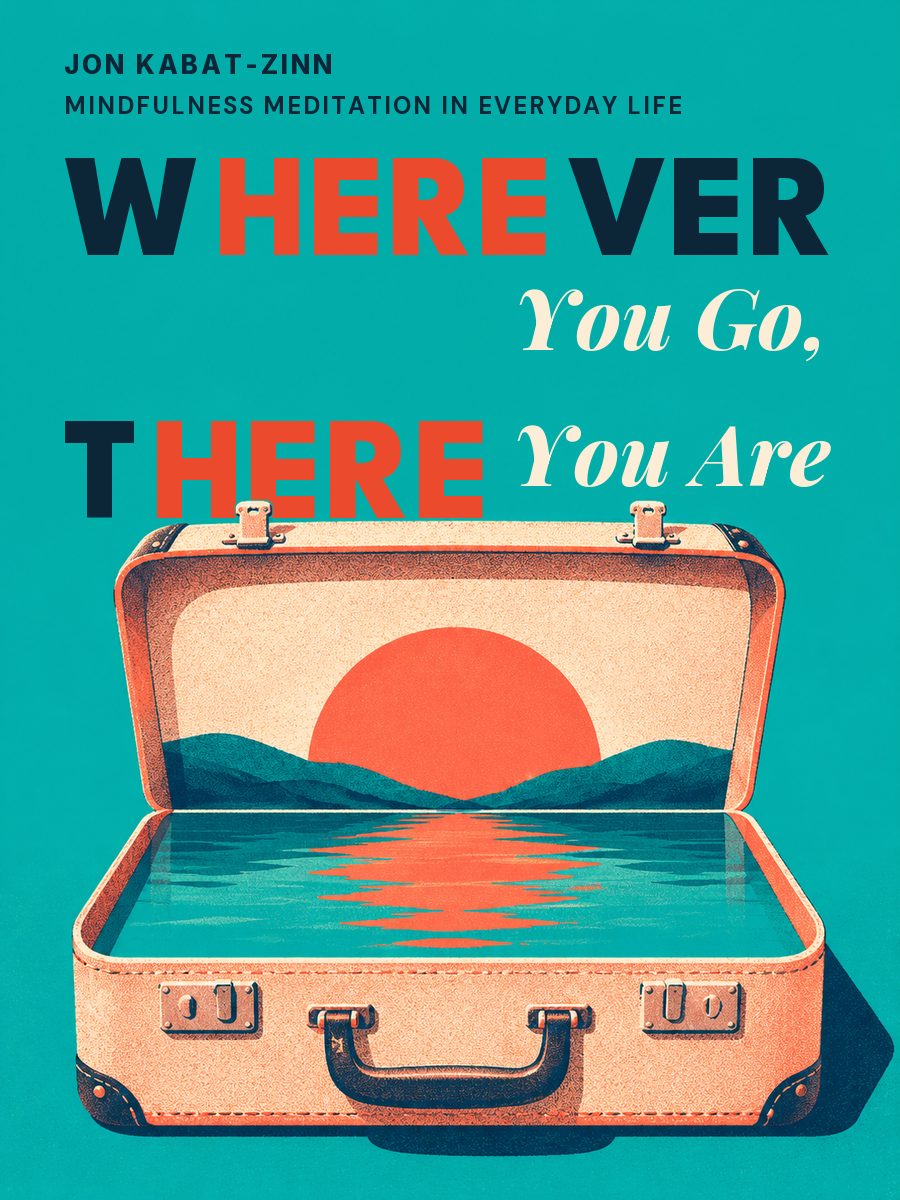

The key ideas
Wherever You Go, There You Are: Mindfulness Meditation in Everyday Life
The astronomers at Kitt Peak Observatory first saw their galaxies with their own eyes when a visiting physicist asked to simply look through the telescope. Jon Kabat-Zinn, the founder of a stress reduction clinic, shows how often we live the same way, among thoughts about life rather than in life itself. A short book about how to stop, notice the present moment and stop running away from yourself.
Who it is for
For anyone who is always in a hurry and only notices a day they’ve lived once it’s already over. And for anyone who once tried meditating, felt nothing special and gave up.
Meditation is not about feeling a certain way. It’s about feeling the way you feel.
The astronomers who didn’t look through the telescope
The physicist Victor Weisskopf was invited to lecture in Arizona, and he asked for one thing: an evening at the big telescope of Kitt Peak Observatory. He was turned down, because the telescope was always busy with photography and research. So Weisskopf replied that in that case he wouldn’t come, and an evening was found at once. While he was looking at Saturn and the galaxies, the dome filled up with people. They were the observatory’s astronomers, and they had never before had the chance to see the objects they studied with their own eyes.
Jon Kabat-Zinn tells this story. In 1979 he opened a stress reduction clinic at the medical center of the university in the state of Massachusetts. His 1994 book is about exactly this kind of gap: we live among thoughts about life and rarely meet life itself. The author compares this way of living to a waking sleep: it’s as if a person switches on autopilot and doesn’t notice what they’re doing and feeling.
Mindfulness helps you wake up. In the author’s definition, it is a particular kind of attention: on purpose, in the present moment and nonjudgmental. The definition is simple, but the author warns right away that simple doesn’t mean easy. Ahead are five ideas from the book about how to come back to your own life.
Wherever you go, you take yourself along
A familiar thought: if it’s bad here, I should go there. Wrong job, so it’s time to change jobs. Wrong city, so it’s time to move. Kabat-Zinn calls this the romantic view. It assumes that the cause of your troubles lies outside: in the place, in the people, in the circumstances.
The trap is that a person takes their head and heart along with them. If the problems grow largely out of their habits of seeing, thinking and acting, they’ll show up again in the new place. According to the author, this applies even to meditation. You can dream of a cave in the mountains, but fifteen minutes in, it may get lonely there, or water may start dripping from the ceiling. There will always be something you don’t like.
The author doesn’t say you should never leave. First it’s worth doing everything in your power where you are now, and only then deciding whether it’s time to move on. The real work, he believes, happens right here.
About the author
Jon Kabat-Zinn is an American scientist and meditation teacher, a professor emeritus of medicine at the University of Massachusetts. In 1979 he founded a stress reduction clinic there, through which mindfulness meditation made its way into hospitals.
All books by this author: Jon Kabat-Zinn
Wherever You Go, There You Are: Mindfulness Meditation in Everyday Life Quiz
Terms from the book
- Massachusetts
- Autopilot
- Mindfulness
- Meditation
- Weisskopf: Victor Weisskopf, an Austrian-born American theoretical physicist, the author’s friend and mentor. He told the telescope story in his memoir The Joy of Insight.
- Kitt Peak: A national observatory on the mountain of the same name in Arizona, USA, with several large telescopes.
- Non-doing: The author’s word for a deliberate pause, when a person stops trying to change anything and is simply present. The author sets it apart from idleness: non-doing takes effort and intention.
- New Yorker: An American weekly magazine, known among other things for its cartoons.
- Swami: An honorific for a Hindu monk or spiritual teacher.
- Satchitananda: Swami Satchitananda, an Indian yoga teacher who taught in the US for many years.
- Yogi: A person who practices yoga, the Indian system of exercises for body and mind.
- Surfing: Riding a board on ocean waves.
Similar books
- Who Moved My Cheese?, Spencer Johnson
- Who Says You Can't? You Do, Daniel Chidiac
- Win the Day: 7 Daily Habits to Help You Stress Less & Accomplish More, Mark Batterson
- Working Identity: Unconventional Strategies for Reinventing Your Career, Herminia Ibarra
- Year of Yes: How to Dance It Out, Stand in the Sun and Be Your Own Person, Shonda Rhimes
- You Are a Badass: How to Stop Doubting Your Greatness and Start Living an Awesome Life, Jen Sincero
- Your Erroneous Zones, Wayne Dyer
- 13 Things Mentally Strong People Don't Do, Amy Morin
- Who Not How: The Formula to Achieve Bigger Goals Through Accelerating Teamwork, Dan Sullivan, Benjamin Hardy
- The Whole-Brain Child, Daniel J. Siegel, Tina Payne Bryson