
Book quiz
A Conflict of Visions Quiz
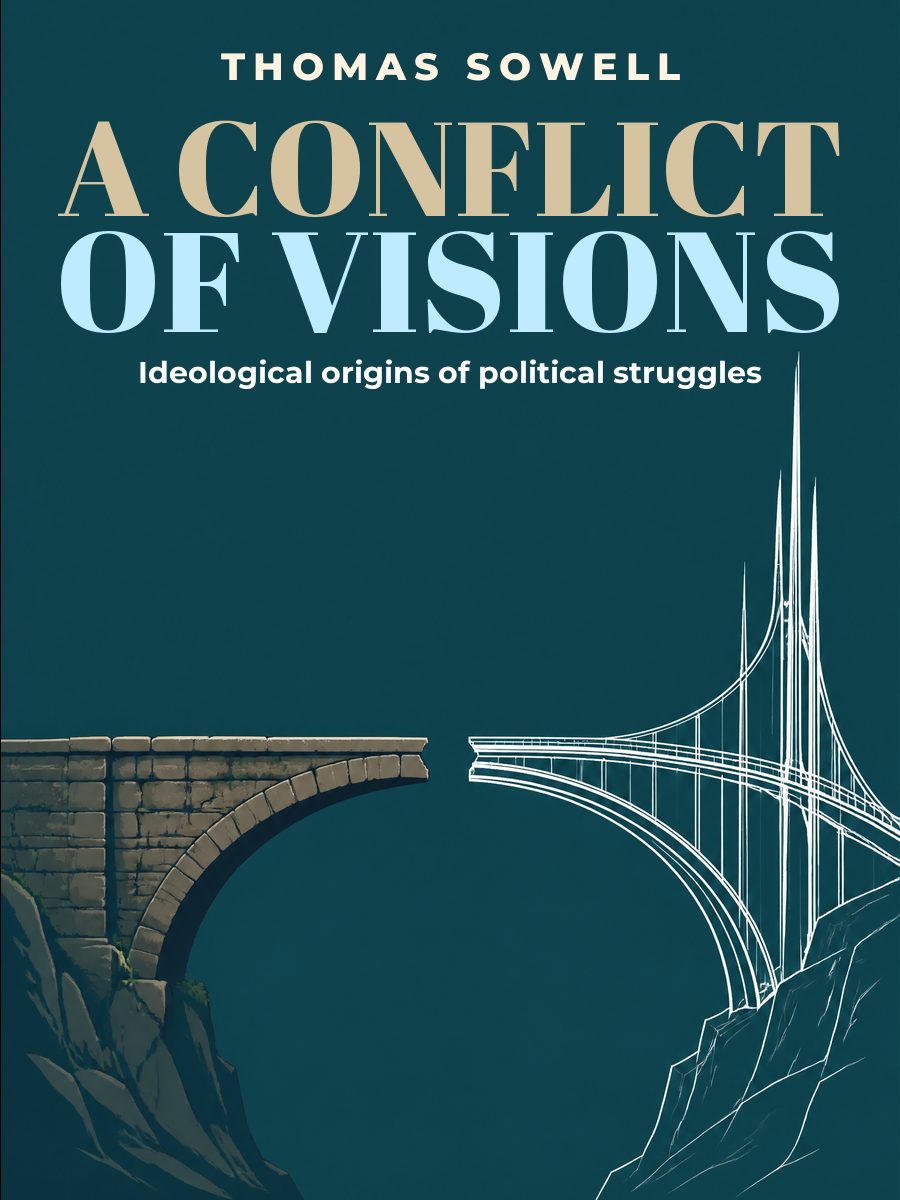 A Conflict of VisionsThomas Sowell
Why do the same people end up on opposite sides again and again, whether the argument is about taxes, crime or war? Thomas Sowell shows that behind it stand two old visions of human beings: one sees them as limited, the other as capable of perfection. You will learn how these visions understand knowledge, equality…
Question 1 of 5
The person you're talking to has reached a completely different political conclusion. What does Sowell advise you not to do?
Show the answer
Right answer: Don't take them for stupid or dishonest
The easiest thing is to decide your opponent is stupid or dishonest. But more often they simply stand on a different foundation, and until it's named, the two of you argue past each other.
Question 2 of 5
Both sides value freedom and the well-being of the poor. What, according to Sowell, are they arguing about then?
Show the answer
Right answer: What actually leads there
A vision is not the same as values. The sides differ on causes and effects: what really leads to the shared goal.
Question 3 of 5
How does the constrained vision see social problems?
Show the answer
Right answer: There are only trade-offs, and every gain has a price
More security means less freedom, more aid means higher taxes. The best you can hope for is a sensible balance.
Question 4 of 5
Where, according to the constrained vision, does a society's real knowledge live?
Show the answer
Right answer: In habits, traditions and prices
Knowledge is scattered: each person knows things about their own place and circumstances, and that knowledge can only be used if the decision is left to the person.
Question 5 of 5
What argument does the constrained vision make against equalizing incomes?
Show the answer
Right answer: Equalizing would take enormous power
To equalize incomes, someone needs enormous power, and in this vision inequality of power is more dangerous than inequality of income.
Want all of the book's key ideas? Read or listen to its retelling in Livria.