
Book quiz
A Brief History of Time: From the Big Bang to Black Holes Quiz
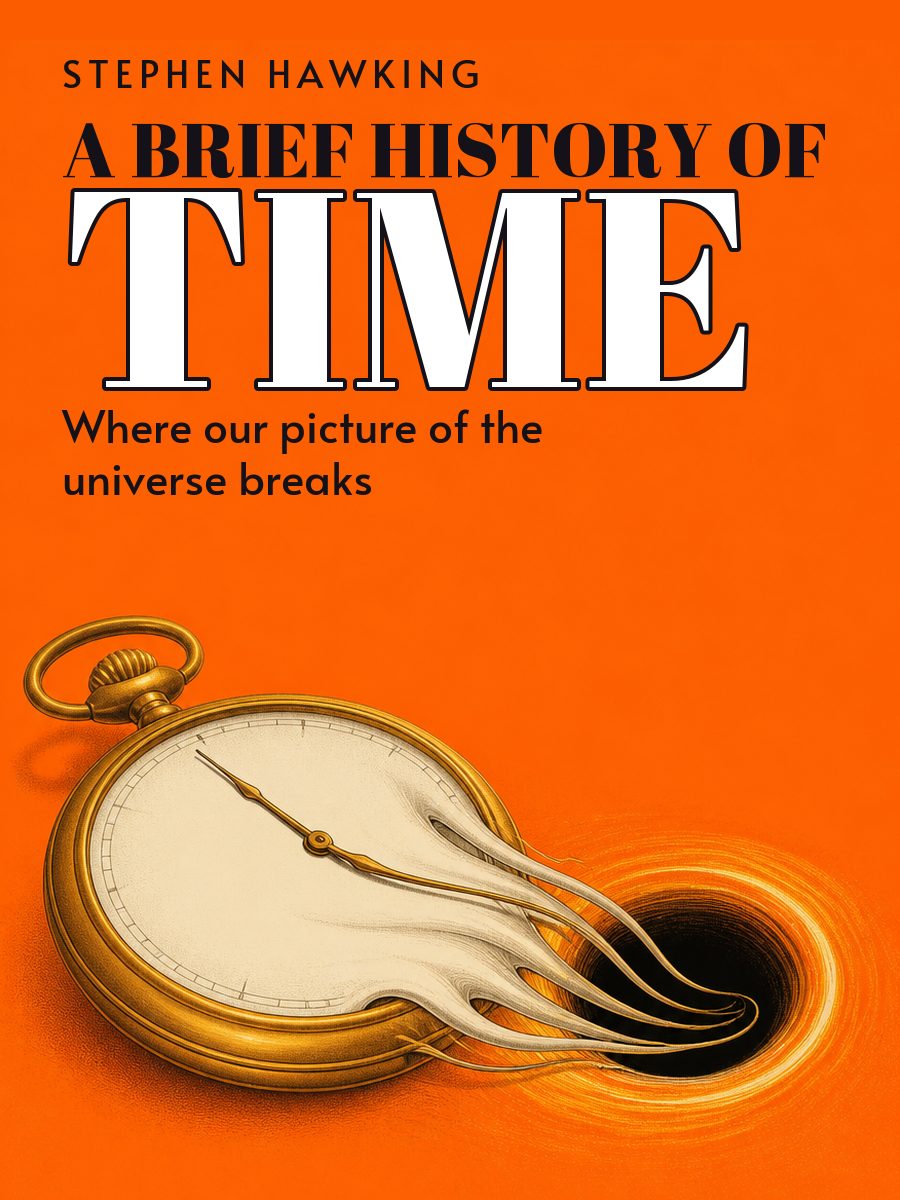 A Brief History of Time: From the Big Bang to Black HolesStephen Hawking
Did the universe have a beginning? What happens at the edge of a black hole? Why do we remember the past but not the future? Stephen Hawking tried to answer these questions with almost no equations and to bring the answers together into one picture of the world. Here you will find his key thought experiments and an…
Question 1 of 5
Why, according to Hawking, can a theory never be proved once and for all?
Show the answer
Right answer: The next experiment can always disprove it
For Hawking, a theory is a model in your head. However many experiments confirm it, a new one can disprove it: that's how Newton's theory gave way to Einstein's.
Question 2 of 5
What does Hawking mean by the singularity at the beginning of the universe?
Show the answer
Right answer: The place where the theory has nothing more to say
By calculation the density there is infinite, and the laws of physics stop working. Einstein's theory itself predicts the place where it breaks down.
Question 3 of 5
What did Hawking's 1974 calculation show when he applied quantum mechanics to the edge of a black hole?
Show the answer
Right answer: It gives off faint radiation and loses mass
That's how Hawking radiation came about: black holes evaporate over time. It's the first bridge between the large and the small, though so far only a theoretical calculation.
Question 4 of 5
If the universe has no edge, what is the question "what came before the beginning of time" like?
Show the answer
Right answer: Asking what lies north of the North Pole
The Earth is finite but has no edge, and there's simply nothing north of the Pole. In the same way, in Hawking and Hartle's idea, there's nothing "before" the beginning of time.
Question 5 of 5
You see a loud headline about a scientific discovery. What does the book advise doing?
Show the answer
Right answer: Ask: is this an observation, a conclusion or a hypothesis?
In the book, Hawking himself separates observations, conclusions drawn from theory and his own hypotheses. The expansion of the universe, for example, is an observation, while the singularity is a conclusion from theory.
Want all of the book's key ideas? Read or listen to its retelling in Livria.