
Book quiz
How Minds Change: The Surprising Science of Belief, Opinion, and Persuasion Quiz
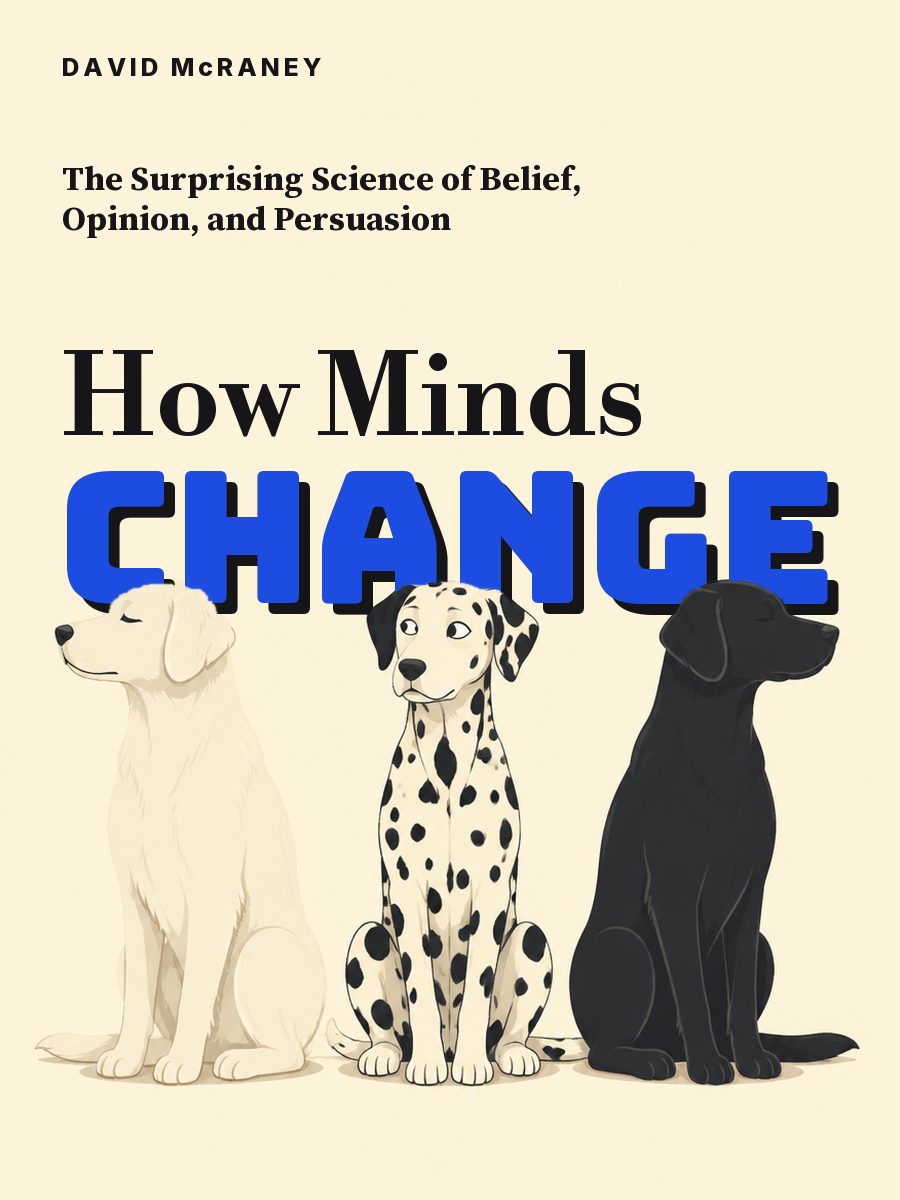 How Minds Change: The Surprising Science of Belief, Opinion, and PersuasionDavid McRaney
You bring irrefutable facts, and the other person only digs in harder. Science journalist David McRaney believed for years that changing people’s minds was pointless, until he met people who do it in twenty minutes on a stranger’s doorstep. The book explains why the brain resists new facts and how to talk so that…
Question 1 of 5
Why did people see the color of the famous dress differently?
Show the answer
Right answer: Their brains filled in the lighting differently
Wallisch found that a lot depended on the light a person was used to. The brain decided for itself what the lighting was, and no one noticed the ambiguity.
Question 2 of 5
Why, according to McRaney, does a person cling to an opinion even when they see arguments against it?
Show the answer
Right answer: Giving it up threatens the loss of their people
We hold on to many opinions as a pass into our group. If giving one up threatens the loss of friends or family, stubbornness is quite rational.
Question 3 of 5
In deep canvassing, what turned out to matter most for changing minds?
Show the answer
Right answer: Listening without judgment and swapping stories
Broockman and Kalla tested the method and found that when the listening and the story swapping were removed, the conversation stopped working.
Question 4 of 5
The person you're talking to is eighty out of a hundred sure of their opinion. What would Magnabosco ask?
Show the answer
Right answer: Why not a hundred
Street epistemology doesn't argue with the conclusion but asks about the reasons and how they were tested. The other person should feel slightly uncomfortable.
Question 5 of 5
According to Mercier and Sperber, why is it hard to notice your own weak argument?
Show the answer
Right answer: We learned to reason in order to check others
The weak spots of your own argument show only when you look from the outside. In a Swiss experiment, people rejected their own reasoning when it was presented as someone else's.
Want all of the book's key ideas? Read or listen to its retelling in Livria.