
Book quiz
Influence, New and Expanded: The Psychology of Persuasion Quiz
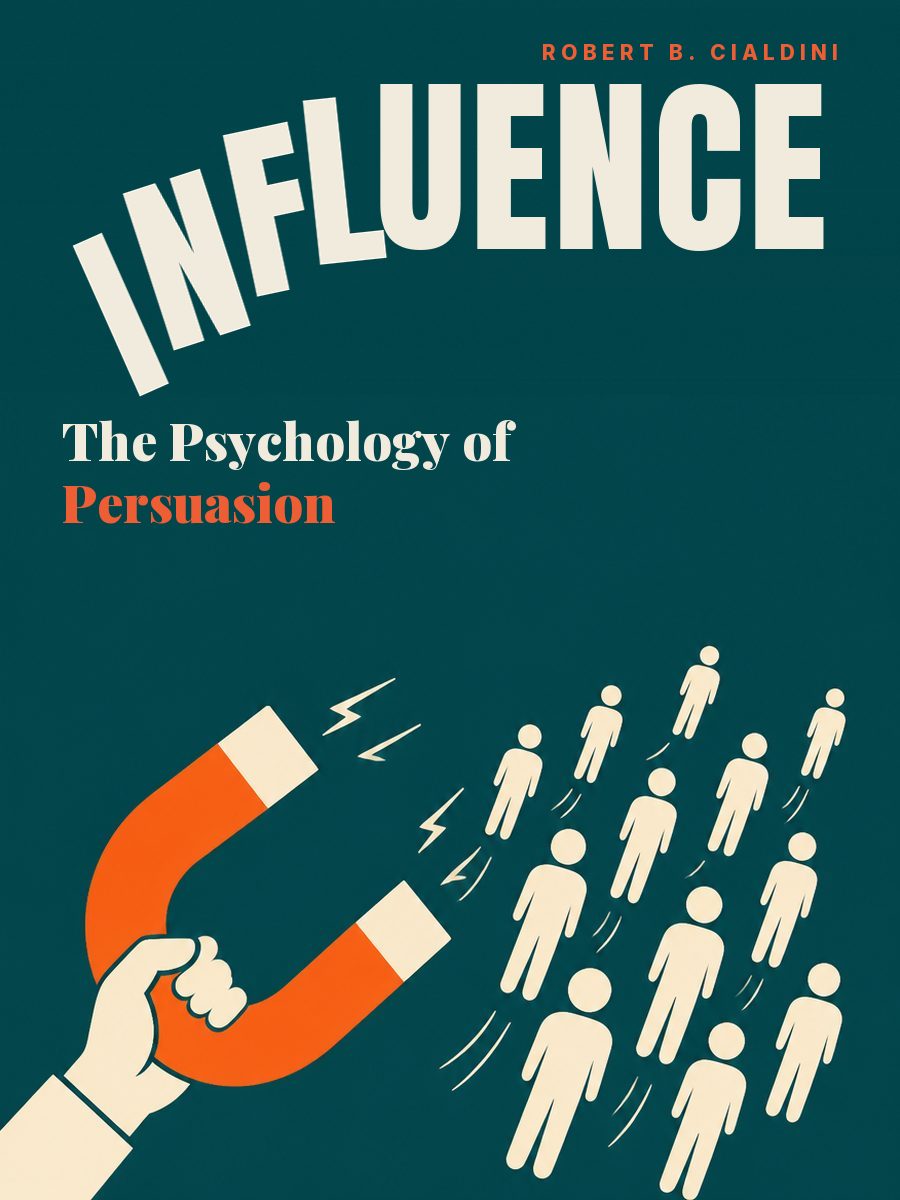 Influence, New and Expanded: The Psychology of PersuasionRobert Cialdini
The jewelry wouldn't sell at its normal price, but it sold out when it was mistakenly priced at double. A social psychologist spent years studying salespeople, advertisers, and fundraisers and described the principles that trigger our agreement almost automatically. This book teaches you to spot them before they work…
Question 1 of 5
A salesperson gave you coffee and spent a long time showing you the product. Leaving without buying feels awkward. Which principle is at work?
Show the answer
Right answer: Reciprocation: you want to pay back what you got
The rule of reciprocation: we try to repay what we've received, even if we didn't ask for anything or promise anything.
Question 2 of 5
A Boy Scout first offered tickets, and after a no asked Cialdini to buy chocolate bars. Why did he buy them?
Show the answer
Right answer: A smaller request after a big one feels like a concession
This is the rejection-then-retreat technique. The second, smaller request looks like a concession, and you want to answer it with a concession of your own.
Question 3 of 5
Why were homeowners who had put up a small sign more likely to agree to a huge billboard later?
Show the answer
Right answer: The small act changed how they saw themselves
Cialdini explains this by the drive for consistency: a person starts seeing themselves as someone who cares about safety and acts in line with that.
Question 4 of 5
A parent says: "Half the class didn't do their homework again." What does the book say this risks?
Show the answer
Right answer: The child hears that lots of people do it
This is social proof: "many people do it" sounds like a message that it's normal. That's how a park sign about stolen fossils increased the thefts.
Question 5 of 5
What does Cialdini advise to put a person in a partnership frame of mind?
Show the answer
Right answer: Ask for their advice rather than their opinion
This comes from the principle of unity, "one of us." According to the author's data, asking for advice puts people in a partnership mood more often than asking for an opinion.
Want all of the book's key ideas? Read or listen to its retelling in Livria.