
Book quiz
Phaedo Quiz
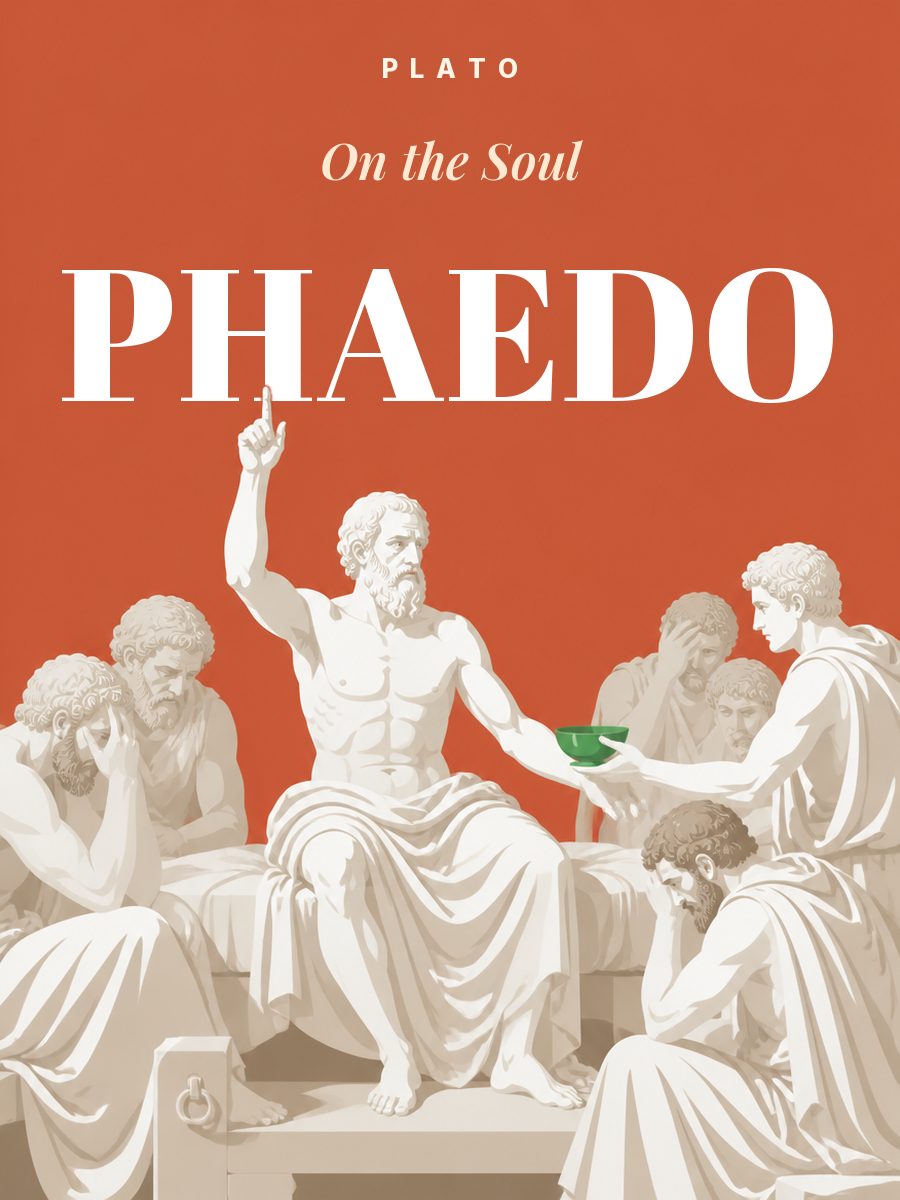 PhaedoPlato
In the evening Socrates is to drink poison, and all day he argues with his friends about whether the soul will outlive the body. Four proofs, two strong objections, and a conversation about what to do when an argument you trusted gives way. This is a book about a man for whom the truth matters more than comfort.
Question 1 of 5
A person faces danger only out of fear of an even greater misfortune. What does Socrates call such courage?
Show the answer
Right answer: Exchanging fear for fear
Ordinary people, according to Socrates, are brave out of fear of something worse. That's an exchange of coins, and the genuine coin is only one: understanding.
Question 2 of 5
According to Socrates, why can we call two sticks almost equal?
Show the answer
Right answer: We already know the measure of equality
The eyes give us only almost-equal things. To notice that the sticks fall short of equality, the soul must already know it, and Socrates believes it knew it before birth.
Question 3 of 5
In the heat of a fight, a decision seems obvious and the only right one. What does Socrates say about this feeling?
Show the answer
Right answer: The object of the feeling only seems true
When pleasure or pain is strongest, its object seems clearest and truest, though it isn't. Socrates compares them to nails that fasten the soul to the body.
Question 4 of 5
A friend has been let down by arguments a few times and decided that reasoning is pointless. What does Socrates call this?
Show the answer
Right answer: Misology
Misology, the hatred of reasoning, grows like the hatred of people: burned by a few arguments, a person blames them all rather than his own lack of skill.
Question 5 of 5
How does Socrates explain why he's sitting in prison instead of fleeing Athens?
Show the answer
Right answer: He decided it was more right to stay
Bones and muscles are only a condition of an action. The real cause is a decision: the Athenians condemned him, and he judged it more right to stay and accept the sentence.
Want all of the book's key ideas? Read or listen to its retelling in Livria.