
Book quiz
A Treatise Concerning the Principles of Human Knowledge Quiz
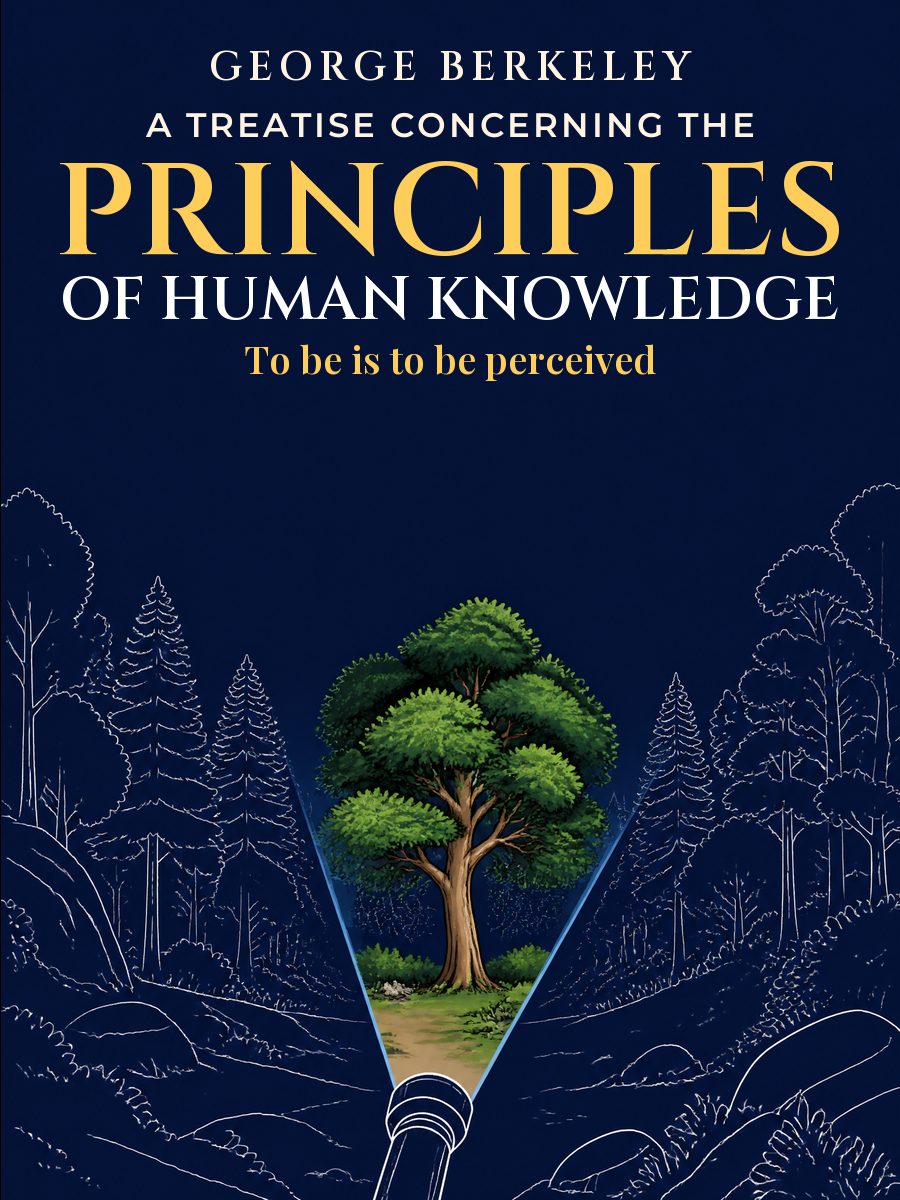 A Treatise Concerning the Principles of Human KnowledgeGeorge Berkeley
A twenty-five-year-old Irishman declared that things have no existence apart from being seen and felt. People laughed at him, but refuting him turned out to be surprisingly hard. Here is his reasoning step by step: from a triangle nobody can picture to a tree in the courtyard that nobody is looking at, and to the one…
Question 1 of 5
Your reasoning leads you into a dead end and paradoxes. According to Berkeley, where should you look for the cause?
Show the answer
Right answer: In false first principles accepted without checking
Berkeley doesn't believe that sound conclusions from sound principles lead to absurdities. We have first raised a dust and then complain we cannot see.
Question 2 of 5
How does a geometer prove something about all triangles if there's no general idea of a triangle?
Show the answer
Right answer: He draws one figure but doesn't rely on its particular features
One particular figure serves as a sign for all the others: the proof doesn't use its right angle or the length of its sides, so the conclusion is general.
Question 3 of 5
According to Berkeley, how is the sun you see by day different from the sun you imagine at night?
Show the answer
Right answer: It's stronger, more orderly and doesn't depend on your will
The difference between real and imagined remains: ideas of sense are stronger, more connected and don't obey us. Imagined ones can be called up and erased at will.
Question 4 of 5
You close your eyes. According to Berkeley, does the furniture in the room disappear?
Show the answer
Right answer: No, another, eternal mind goes on perceiving it
For Berkeley, "outside the mind" means outside all minds whatsoever. What you saw can go on existing in another mind, and he takes that mind to be God.
Question 5 of 5
Johnson kicked a stone and felt pain. By the logic of the Treatise, why doesn't this refute Berkeley?
Show the answer
Right answer: Berkeley didn't deny hardness, he denied the matter behind it
Berkeley never said you can't stub your foot on a stone. He claimed there is no invisible matter behind the hardness you feel.
Want all of the book's key ideas? Read or listen to its retelling in Livria.