
Book quiz
Sapiens: A Brief History of Humankind Quiz
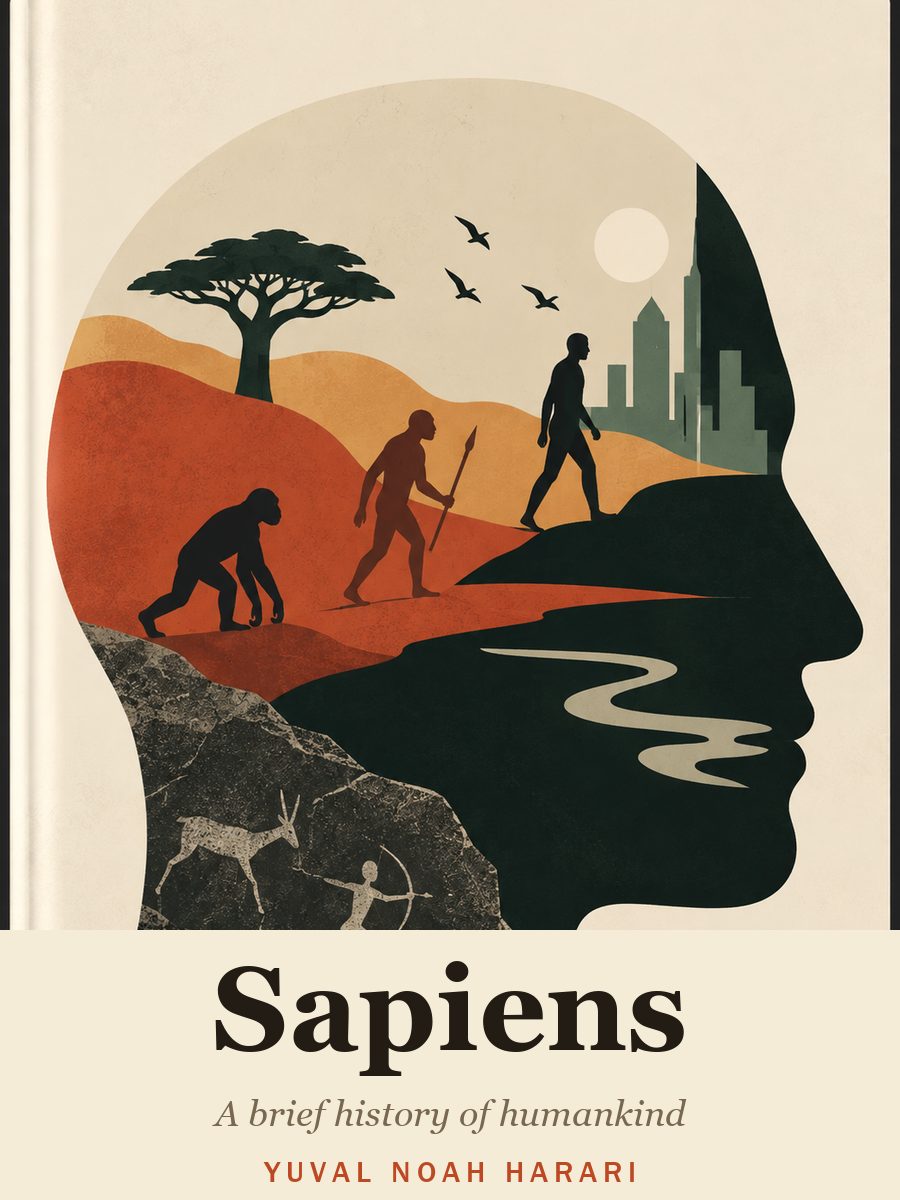 Sapiens: A Brief History of HumankindYuval Noah Harari
How did a weak African ape, one that was afraid even of hyenas, become master of the entire planet? Yuval Noah Harari shows that it wasn’t strength or weapons. It was the ability to believe in shared fictions — money, laws, states — that let people unite by the millions. A big, honest story about the price we paid…
Question 1 of 5
According to Harari, what allowed humans, unlike chimpanzees, to cooperate in the millions?
Show the answer
Right answer: The ability to believe shared stories about things that don't exist in nature
A chimpanzee needs to know every other one personally. People who believe the same story act together, even if they've never met.
Question 2 of 5
A company owns buildings and pays taxes. According to Harari, what is it?
Show the answer
Right answer: A shared fiction that lives as long as people believe in it
You can't touch a company or shake its hand. It exists in documents and in a shared agreement to treat it as real, like money and states.
Question 3 of 5
Why does Harari call the shift to farming a trap of progress?
Show the answer
Right answer: There were more people, but each person's life was harder
More food per plot meant more people, but backs ached, the diet became monotonous, and a bad harvest threatened famine. There was no way back.
Question 4 of 5
According to Harari, how did the Scientific Revolution begin?
Show the answer
Right answer: With openly admitting that we don't know a lot
As long as people believed everything important had already been said in ancient texts, they didn't look for anything new. Admitted ignorance became the starting point.
Question 5 of 5
You bought your dream apartment, and a month later the joy is gone. How does the book explain this?
Show the answer
Right answer: People quickly get used to what they've achieved and want more
Happiness is only weakly linked to wealth and more strongly to expectations. Once a goal is reached, people get used to it, and the race for "just a bit more" never satisfies.
Want all of the book's key ideas? Read or listen to its retelling in Livria.