
Book quiz
Sprint: How to Solve Big Problems and Test New Ideas in Just Five Days Quiz
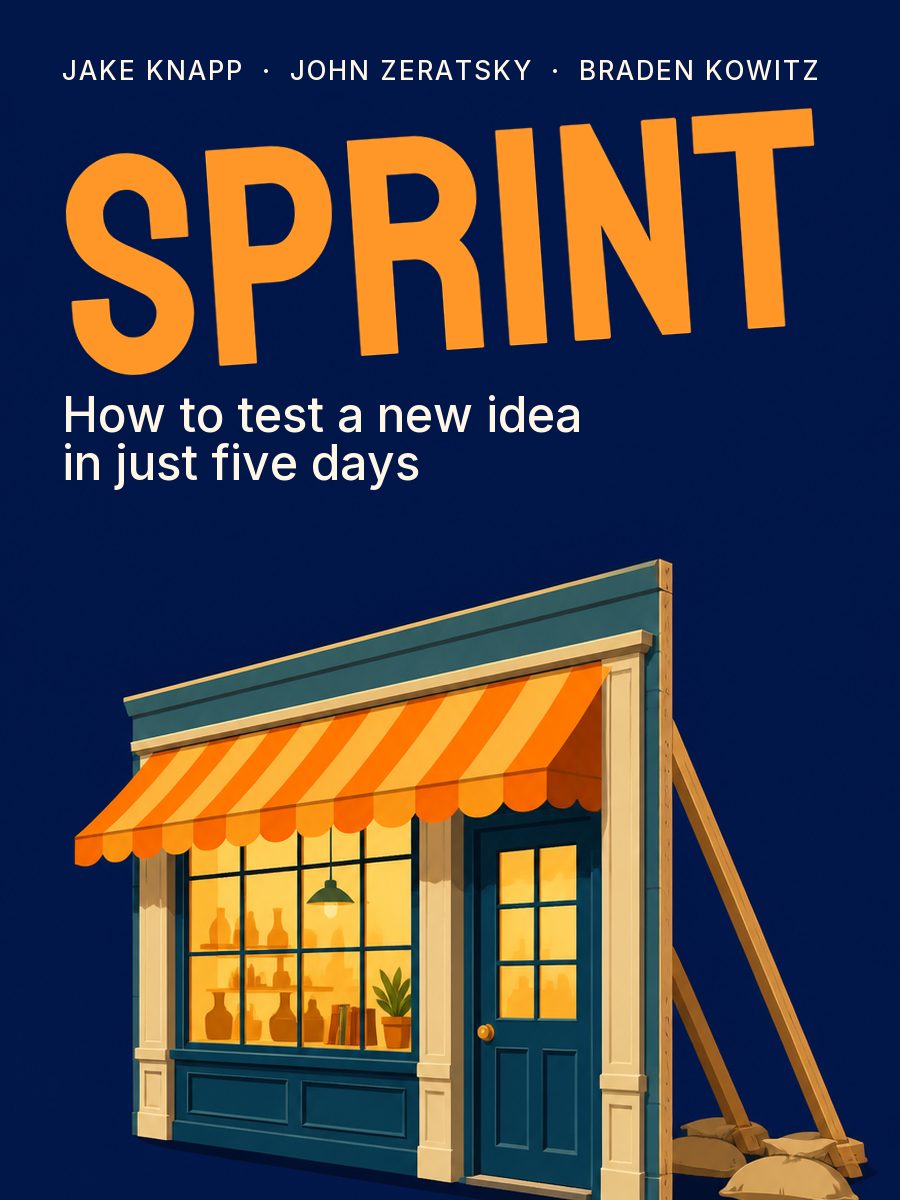 Sprint: How to Solve Big Problems and Test New Ideas in Just Five DaysJake Knapp, John Zeratsky, Braden Kowitz
A team is arguing over whether to give a robot a face and teach it to dance. Instead of months of development, they get five scheduled days and five hotel guests on Friday. A method invented at Google and refined at the venture fund GV: how to turn a big problem into a question you can test in a week, and get a real…
Question 1 of 5
On Monday of the sprint, the team is afraid of failure. What happens to these fears?
Show the answer
Right answer: Each fear is rewritten as a question to test
Monday morning starts with a long-term goal, and the fears are rewritten as questions. A fear turned into a question shows right away what needs testing.
Question 2 of 5
Why does everyone come up with solutions silently on Tuesday of the sprint, rather than in a group brainstorm?
Show the answer
Right answer: In a noisy brainstorm, loud voices beat quiet ones
Knapp noticed back at Google that a noisy brainstorm rarely produces ideas that get carried out, and a raw thought said out loud is forgotten a minute later.
Question 3 of 5
The sketches are up on the wall. By the rules of the sprint, who makes the final decision?
Show the answer
Right answer: The Decider, who has the supervote
When everyone decides at once, bold ideas get smoothed into a safe middle. So the choice is made by the Decider, usually the head of the team or the founder.
Question 4 of 5
You want to test an idea for an online course. In the spirit of the sprint's Thursday, what should you do?
Show the answer
Right answer: Build a page in one evening and show it to people
A facade looks real just enough for people to behave honestly. Blue Bottle built three versions of a website in a day without a single line of code.
Question 5 of 5
Why is it enough to talk to five customers on Friday of the sprint?
Show the answer
Right answer: Five people find most of the main problems
The authors rely on Nielsen: five people find most of the main problems, and each one after that adds almost nothing. It doesn't guarantee sales.
Want all of the book's key ideas? Read or listen to its retelling in Livria.