
Book quiz
The Righteous Mind: Why Good People Are Divided by Politics and Religion Quiz
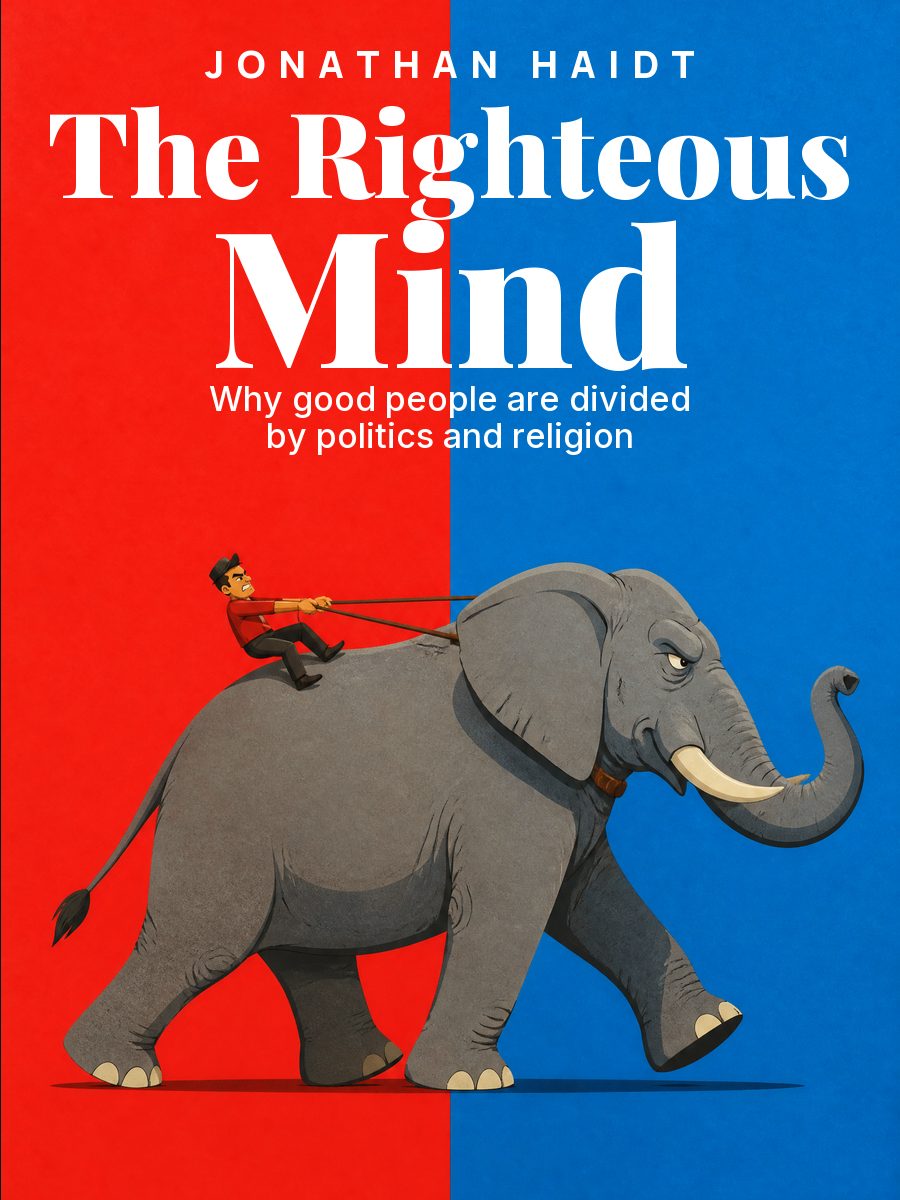 The Righteous Mind: Why Good People Are Divided by Politics and ReligionJonathan Haidt
Why do smart, kind people clash so fiercely over politics and religion? Jonathan Haidt shows that morality rests on intuition, not logic, and that it reaches far beyond care and fairness. You will see why the other side seems blind to you, and learn how to really talk with them.
Question 1 of 5
A person can't explain what's wrong with an act but doesn't change his mind. According to Haidt, what does this mean?
Show the answer
Right answer: The judgment came as a feeling, and reasons are being sought to justify it
This is moral dumbfounding: the reasons ran out, but the certainty stayed. So it never rested on the reasons; the intuition came first.
Question 2 of 5
You want to change a friend's mind in an argument about politics. What does Haidt advise?
Show the answer
Right answer: Start with intuition: respect and common ground
A person's reasons are written by a press secretary, and the press secretary isn't the one who decides. So you have to speak to the intuition first, not argue with the arguments.
Question 3 of 5
According to Haidt, when does reasoning come closest to the truth?
Show the answer
Right answer: When people with different views check each other's reasoning
One mind is bad at seeing the weak spots in its own position but great at spotting them in others'. Mutual checking works if something unites the people.
Question 4 of 5
People were asked to answer as a typical person from the other camp would. Who got it most wrong?
Show the answer
Right answer: Very liberal people answering for conservatives
Someone who senses all six tastes of morality can understand a cuisine of three. But to someone who knows only three, the other cuisine seems to make no sense.
Question 5 of 5
According to Sosis's data, why did religious communes last longer than secular ones?
Show the answer
Right answer: Sacrifices made sacred by faith held the community together
In religious communes, the more sacrifices, the longer the community lasted, while in secular ones demanding sacrifices didn't help. Religion rests on belonging.
Want all of the book's key ideas? Read or listen to its retelling in Livria.