
The key ideas
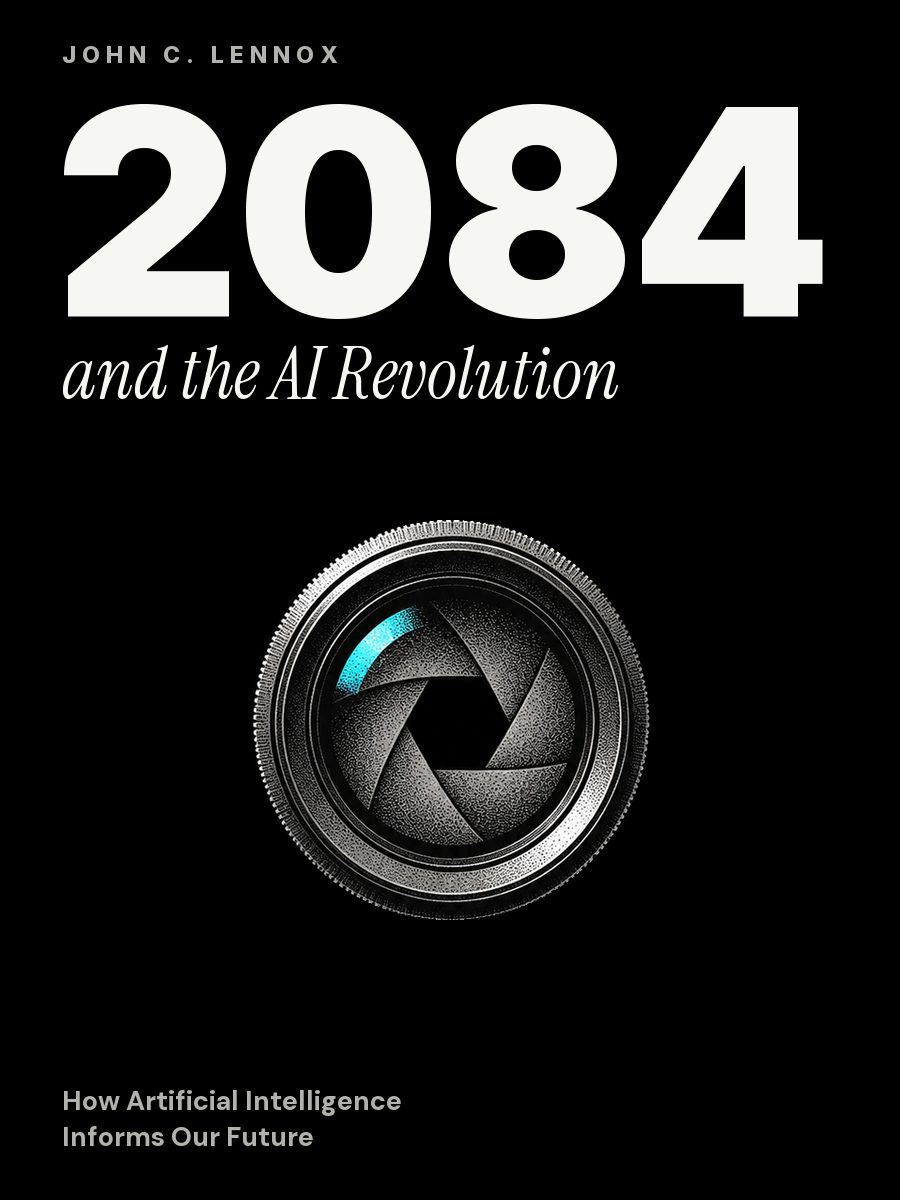
2084 and the AI Revolution: How Artificial Intelligence Informs Our Future
A one-minute clip of your voice is enough for a machine to call your family as you. Oxford mathematician John Lennox separates the truth about AI from the hype, shows the dangers that are already here, from deepfakes to total surveillance, and asks a question technology cannot answer: what is a human being worth? His answer is a Christian one, and he argues for it openly.
Who it is for
For anyone who uses ChatGPT and wonders whether the chatbot can really think. For parents worried about what technology is doing to their children. For believers and sceptics who want to hear a Christian mathematician argue about AI with Harari.
We need to treat people as people and not machines, and we need to treat machines as machines and not people.
From 1984 to 2084
In 1962 a Cambridge mathematics student ran a simple program on EDSAC 2, one of the first computers. When he said he wanted to go into computing, his tutor told him it had no future. The student was John Lennox.
Sixty years later, the Oxford mathematician and philosopher of science writes about the revolution he passed up. His title plays on Orwell’s novel 1984. As Neil Postman put it, Orwell feared that what we hate would ruin us, Huxley that what we love would. With AI, Lennox sees both fears coming true.
He asks what AI can really do, what dangers it already poses and what a human being is worth when machines outdo us. Behind all this lie Kant’s questions: what can I know, what can I hope for, what must I do. Lennox answers them openly as a Christian.
The machine answers without understanding the question
All AI today is narrow AI: a program that does one task needing human intelligence, such as playing Go. It runs on machine learning, which finds patterns in vast data sets and makes predictions from them. For Lennox this simulates intelligence without thinking.
John Searle’s Chinese room thought experiment explains the difference. A man who knows no Chinese sits with boxes of Chinese characters and a book of rules. Following the rules, he answers Chinese questions correctly but understands not a word. A computer, Searle argues, has nothing the man lacks.
ChatGPT predicts the likeliest next words and can produce confident nonsense: one chatbot, asked to write about inflation, cited five nonexistent books. Even the antibiotic halicin, hailed as AI’s find, owed its discovery to people who framed the problem and chose the data, said team leader Regina Barzilay.
C. S. Lewis gives Lennox the key to this difference: a carpenter makes a chair, but he begets a child. A machine is made, not begotten.
About the author
John Lennox is a mathematician and philosopher of science at the University of Oxford and a Christian apologist. He has spent years debating science and God in public with atheist scientists.
All books by this author: John C. Lennox
Terms from the book
- Jesus
- Huxley
- Kant
- narrow AI
- machine learning
- Lewis
- deepfake
- Solzhenitsyn
- homo deus
- EDSAC: One of the first stored-program computers, built at the University of Cambridge. The first EDSAC ran its first program in 1949; EDSAC 2 followed in 1958.
- Orwell: George Orwell, English writer, author of the dystopian novel 1984 (1949) about a state that watches its citizens all the time.
- Postman: Neil Postman, American media scholar and author of Amusing Ourselves to Death and Technopoly.
- Searle: John Searle, American philosopher at Berkeley, author of the Chinese room thought experiment.
- Chinese room: Searle’s thought experiment: a man who follows rules for Chinese symbols gives correct answers without understanding Chinese. The experiment argues that running a program is not the same as understanding.
- ChatGPT: OpenAI’s chatbot, built on a large language model that predicts the most likely continuation of a text.
- halicin: An antibiotic found in 2019 with the help of a deep learning system at MIT; it kills many drug-resistant bacteria. It is named after HAL, the computer in 2001: A Space Odyssey.
- Barzilay: Regina Barzilay, MIT computer scientist who led the team that found halicin.
- Crookes: Danny Crookes, professor of computer engineering at Queen’s University Belfast.
- social credit system: In China, a set of government and corporate schemes that rate how trustworthy companies and citizens are and reward or punish them for it.
- MERICS: The Mercator Institute for China Studies, a research centre in Berlin. Its 2022 report described how the social credit system actually works.
- Free University of Berlin: One of Berlin’s largest universities. Its researchers surveyed 2,200 people in China about the social credit system.
- McAfee: An American cybersecurity company.
- transhumanism: A movement that seeks to improve human beings fundamentally through technology: to eliminate ageing and greatly enhance intellectual, physical and psychological abilities.
- Harari: Yuval Noah Harari, Israeli historian, author of Sapiens and Homo Deus.
- Mariani: Jean Mariani, French neuroscientist who directs an institute that researches longevity.
- Tritsch: Danièle Tritsch, French neuroscientist, former co-director of a neuroscience research laboratory.
- cryonics: Freezing a body or a brain after death in the hope that future science will be able to revive it.
- Picard: Rosalind Picard, professor at the MIT Media Lab and founder of affective computing.
- affective computing: A field of research on computers that recognise and respond to human emotions, founded by Rosalind Picard.
- image of God: The biblical teaching (Genesis 1:27) that humans are created in God’s image. For Lennox it is the ground of every person’s dignity.
Similar books
- A Conflict of Visions, Thomas Sowell
- A Frog under the Tongue: Jewish Folk Medicine in Eastern Europe, Marek Tuszewicki
- A Hacker's Mind: How the Powerful Bend Society's Rules, and How to Bend Them Back, Bruce Schneier
- A Life on Our Planet: My Witness Statement and a Vision for the Future, David Attenborough
- Behave: The Biology of Humans at Our Best and Worst, Robert M. Sapolsky
- Behind the Beautiful Forevers, Katherine Boo
- Propaganda, Edward Bernays
- Better Small Talk: Talk to Anyone, Avoid Awkwardness, Generate Deep Conversations, and Make Real Friends, Patrick King
- The 48 Laws of Power, Robert Greene
- The 7 Habits of Highly Effective People, Stephen Covey