
The key ideas
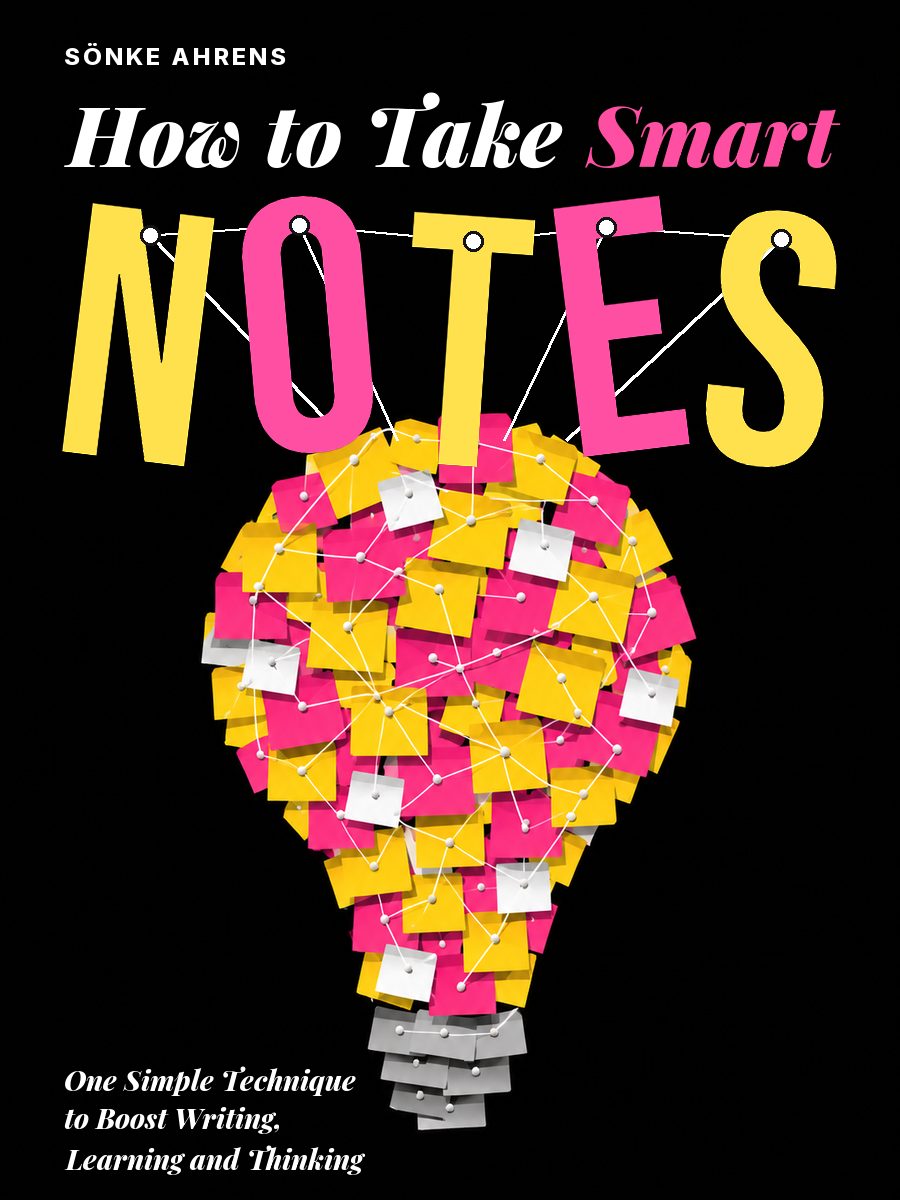
How to Take Smart Notes: One Simple Technique to Boost Writing, Learning and Thinking
Why is it so hard to write even a single page after reading dozens of books? Sönke Ahrens shows that a text begins long before the blank screen: in the notes a person takes every day. He takes apart the slip-box of the sociologist Niklas Luhmann, which helped him publish 58 books, and explains how to set up your own, on paper or in software.
Who it is for
For students, researchers and anyone who reads a lot but then can’t pull what they’ve read together into a text of their own, or even into one clear thought.
We have to choose between feeling smarter or becoming smarter.
The blank screen comes too late
Picture it: two weeks until the paper is due, dozens of articles read, and the cursor is still blinking on the screen. Sönke Ahrens, who has worked with students for many years, doesn’t see the cause in talent or willpower. Writing doesn’t begin with a blank page but with what a person wrote down long before it.
His main example is Niklas Luhmann, a brewer’s son who worked as a civil servant. In the 1960s, after work, he read philosophy and sociology and took notes. One day Luhmann showed a manuscript to the well-known sociologist Helmut Schelsky, who suggested he become a professor. Luhmann had no academic degree. In less than a year he wrote a doctoral thesis with the help of his slip-box, and in the same year his habilitation was ready too: the second major academic work without which no one in Germany gets a chair. In 1968 he became a professor in Bielefeld, and over thirty years he published 58 books and hundreds of articles.
Luhmann himself put this down to working with his slip-box. Ahrens believes the secret isn’t genius but the way the work is set up: an external system to think in.
Three kinds of notes that must not be mixed
Ahrens has an acquaintance who writes down everything: thoughts, quotes, scraps of conversation. In the end he has a shelf of notebooks full of wonderful thoughts and not a single publication. The notes are filed by date, the good drowns in the random, and connecting two thoughts is almost impossible.
As the author sees it, the trouble is that different notes are piled together. He suggests keeping three kinds apart.
• Fleeting notes. They catch a thought on the go: in a notebook, on a napkin, on your phone. Within a day or two they are sorted and thrown away.
• Literature notes. Short, in your own words, together with the source’s details.
• Permanent notes. Full sentences, as if for print: one idea per note, understandable without context. They are never thrown away.
Drafts, outlines and to-do lists for a single text stay in that project’s folder and go when it is done. Besides his acquaintance’s mistake, Ahrens names two more. Whoever collects notes only for the current project starts from zero after every project. Whoever piles up nothing but fleeting notes gets a growing heap, and at some point wants to sweep it all away and start over.
About the author
Sönke Ahrens is a German researcher in the philosophy of education who taught at the University of Duisburg-Essen. Before this book he published the academic monograph Experiment and Exploration (2014).
All books by this author: Sönke Ahrens
How to Take Smart Notes: One Simple Technique to Boost Writing, Learning and Thinking Quiz
Terms from the book
- compound interest
- Zeigarnik
- Index
- Mueller
- Oppenheimer
- Brainstorming
- Luhmann: Niklas Luhmann (1927–1998), a German sociologist and author of the theory of social systems. The book’s main example: his slip-box of about 90,000 notes.
- Schelsky: Helmut Schelsky, one of the most influential sociologists in Germany of his time. After reading Luhmann’s manuscript, he suggested that Luhmann become a professor.
- Habilitation: A second major academic work after the doctoral thesis, the highest academic qualification in many European countries. In Germany one usually can’t become a professor without it.
- Bielefeld: A city in western Germany. In 1968 Luhmann became a professor of sociology at the newly founded University of Bielefeld.
- Slip-box: A box of notes of one size. In the book this is the name for Luhmann’s note system, in which the notes are connected by numbers and links rather than sorted by topic.
- Fleeting notes: A term from the book: quick jottings made so as not to lose a thought. Within a day or two they are turned into permanent notes or thrown away.
- Literature notes: A term from the book: a short retelling, in your own words, of what a source says, together with its bibliographic details. They are kept separately from the slip-box.
- Permanent notes: A term from the book: one idea per note, in full sentences, understandable without context. They go into the slip-box and are never thrown away.
- McLean: Malcom McLean, an American trucking company owner and former truck driver. In 1956 he sent out a tanker converted to carry 58 containers.
- Zettelkasten: A German word, literally “box of slips.” It is the name for Luhmann’s slip-box and the method of working with it, and also for a free program that Ahrens recommends.
- Trollope: Anthony Trollope (1815–1882), an English writer and author of 47 novels. He wrote every morning, measuring out his words by the clock.
Similar books
- How to Win Friends and Influence People, Dale Carnegie
- How We Learn: The Surprising Truth About When, Where, and Why It Happens, Benedict Carey
- Hyperfocus. How to Manage Your Attention in a World of Distraction, Chris Bailey
- Indistractable: How to Control Your Attention and Choose Your Life, Nir Eyal
- It's How You Play the Game: The Powerful Sports Moments That Taught Lasting Values to America's Finest, Brian Kilmeade
- Labor and Discipline: A Worker's Notes, Ivan Rybakov
- Life Is in the Transitions: Mastering Change at Any Age, Bruce Feiler
- Make It Stick: The Science of Successful Learning, Peter C. Brown, Henry L. Roediger III, Mark A. McDaniel
- How to Talk to Children, Julia Gippenreiter
- Human Immortality: Two Supposed Objections to the Doctrine, William James