
The key ideas
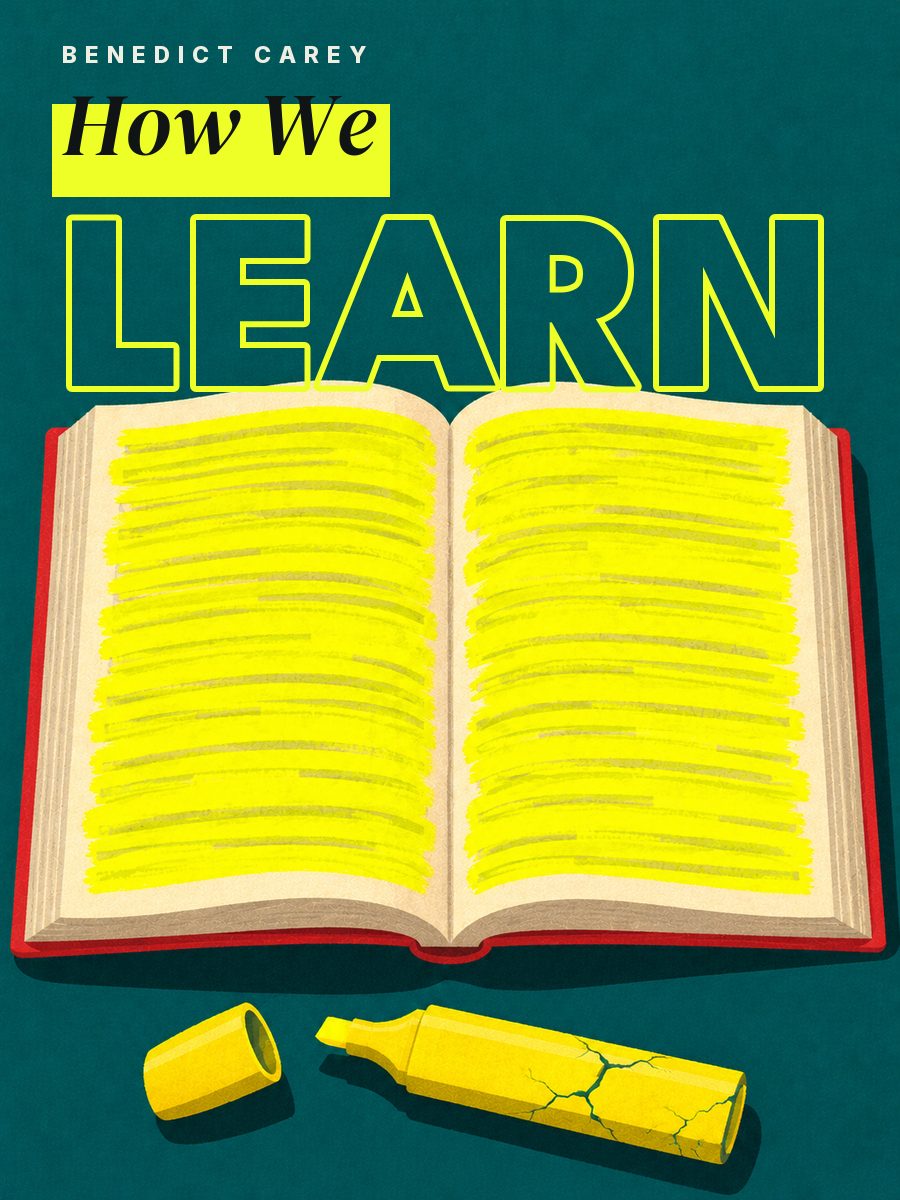
How We Learn: The Surprising Truth About When, Where, and Why It Happens
Why do schoolchildren remember more of a poem two days after learning it than on the day itself? Science reporter Benedict Carey gathers a century of research on memory and shows that forgetting, breaks, changing places and sleep, the very things we were taught to fight, can make learning deeper. The book explains when a pause helps with a problem you are stuck on, why the mind keeps working on an unfinished project and how the eye learns faster than the mind can explain.
Who it is for
For students and the people who teach them, and for anyone learning a language, an instrument or a new job who feels that more effort alone no longer helps.
If the brain is a learning machine, then it's an eccentric one.
The grind who fell short
As a teenager Benedict Carey got up at five to study before school, made flashcards and got mostly As. Then nearly all of his dozen college applications were refused.
He started again at the University of Colorado and loosened his grip: hiked, napped at odd hours, studied here and there. To his surprise, he became a better student, even in maths and physics.
Years later, as a New York Times science reporter, he found studies that explained it. A distraction can help, and so can a nap. A project left almost done stays in memory longer than a finished one.
Carey's main idea is that the brain is not a muscle that grows only with effort. It is a learning machine with quirks, and it works best when we use them: forgetting, breaks, new surroundings and sleep.
Forgetting makes room for learning
In the early 1900s Philip Ballard, a teacher in London's working-class East End, had children learn a ballad by Longfellow and recall it in writing. Two days later he tested them again without warning. Nobody had studied in between, yet scores rose by about 10 percent. Ballard named the effect reminiscence.
Robert and Elizabeth Bjork explain it with a theory Carey calls Forget to Learn. Every memory has two strengths. Storage strength shows how well something is learned, and by their theory it never decreases. Retrieval strength shows how easily it comes to mind, and it fades fast.
When you dig up something half-forgotten, both strengths grow more than when you repeat what is still fresh. So an Australian who learned to drive on the right in America relearns the left at home far faster than he learned the right.
So forgetting much of a new subject after the first evening does not prove a weak mind. It is the pause that lets the next round go deeper.
About the author
Benedict Carey is an American science reporter who has written about the brain and behaviour for more than twenty-five years, first for the Los Angeles Times and then for The New York Times. He has also written two science-based mysteries for children.
All books by this author: Benedict Carey
How We Learn: The Surprising Truth About When, Where, and Why It Happens Quiz
Terms from the book
- Longfellow
- Bjork
- Locke
- incubation
- Zeigarnik
- REM
- Ballard: Philip Boswood Ballard, English teacher and researcher who tested the memory of London schoolchildren in the early 1900s and published his findings in 1913.
- reminiscence: Ballard's name for the rise in recall in the days after learning, without any further study. It is strongest for images and poetry and almost absent for lists of words.
- storage strength: In the Bjorks' theory, how well something is learned. It grows with study and use and, by the theory, never decreases.
- retrieval strength: In the Bjorks' theory, how easily something comes to mind right now. It grows quickly and fades quickly without use.
- Steven Smith: Steven M. Smith, American psychologist at Texas A&M University who studied how surroundings affect memory and problem solving.
- Glenberg: Arthur Glenberg, American psychologist, co-author with Smith and Robert Bjork of the 1970s experiment with two study rooms.
- equilateral: Of a triangle: having all three sides equal.
- Sio: Ut Na Sio, psychologist at Lancaster University in the UK, co-author of a 2009 analysis of thirty-seven studies on incubation.
- Ormerod: Thomas C. Ormerod, psychologist at Lancaster University, Sio's co-author.
- percolation: Carey's word, not a scientific term, for the slow work on a big project between sessions, named after water slowly seeping through coffee.
- Aarts: Henk Aarts, Dutch social psychologist who studied how an active goal shapes what people notice.
- Gibson: Eleanor Gibson (1910–2002), American psychologist who founded the study of perceptual learning.
- perceptual learning: Learning in which the senses themselves get better at catching the differences that matter, often without any explanation or feedback.
- Kellman: Philip Kellman, American cognitive scientist who builds fast computer exercises that train the eye, first for pilots and later for doctors and pupils.
- Aserinsky: Eugene Aserinsky (1921–1998), American physiologist who, as a graduate student in Chicago, recorded bursts of brain activity in sleep. The phase with these bursts was later named REM.
- Night Shift Theory: Carey's name for a model of how the stages of sleep consolidate different kinds of learning. It is a working theory, not a settled fact.
- Stickgold: Robert Stickgold, neuroscientist at Harvard who studies sleep and memory.
- Carlyle Smith: Carlyle Smith, psychologist at Trent University in Canada who studies sleep and the learning of movements.
- slow-wave sleep: Deep sleep, named after the long, slow waves of brain activity it shows. Most of it comes in the first half of the night.
Similar books
- Hyperfocus. How to Manage Your Attention in a World of Distraction, Chris Bailey
- Indistractable: How to Control Your Attention and Choose Your Life, Nir Eyal
- It's How You Play the Game: The Powerful Sports Moments That Taught Lasting Values to America's Finest, Brian Kilmeade
- Labor and Discipline: A Worker's Notes, Ivan Rybakov
- Life Is in the Transitions: Mastering Change at Any Age, Bruce Feiler
- Make It Stick: The Science of Successful Learning, Peter C. Brown, Henry L. Roediger III, Mark A. McDaniel
- Make Your Bed: Little Things That Can Change Your Life...And Maybe the World, William H. McRaven
- Manage Your Day-to-Day, Jocelyn K. Glei (ed.), 99U
- Human Immortality: Two Supposed Objections to the Doctrine, William James
- Humble Inquiry: The Gentle Art of Asking Instead of Telling, Edgar H. Schein, Peter A. Schein