The key ideas
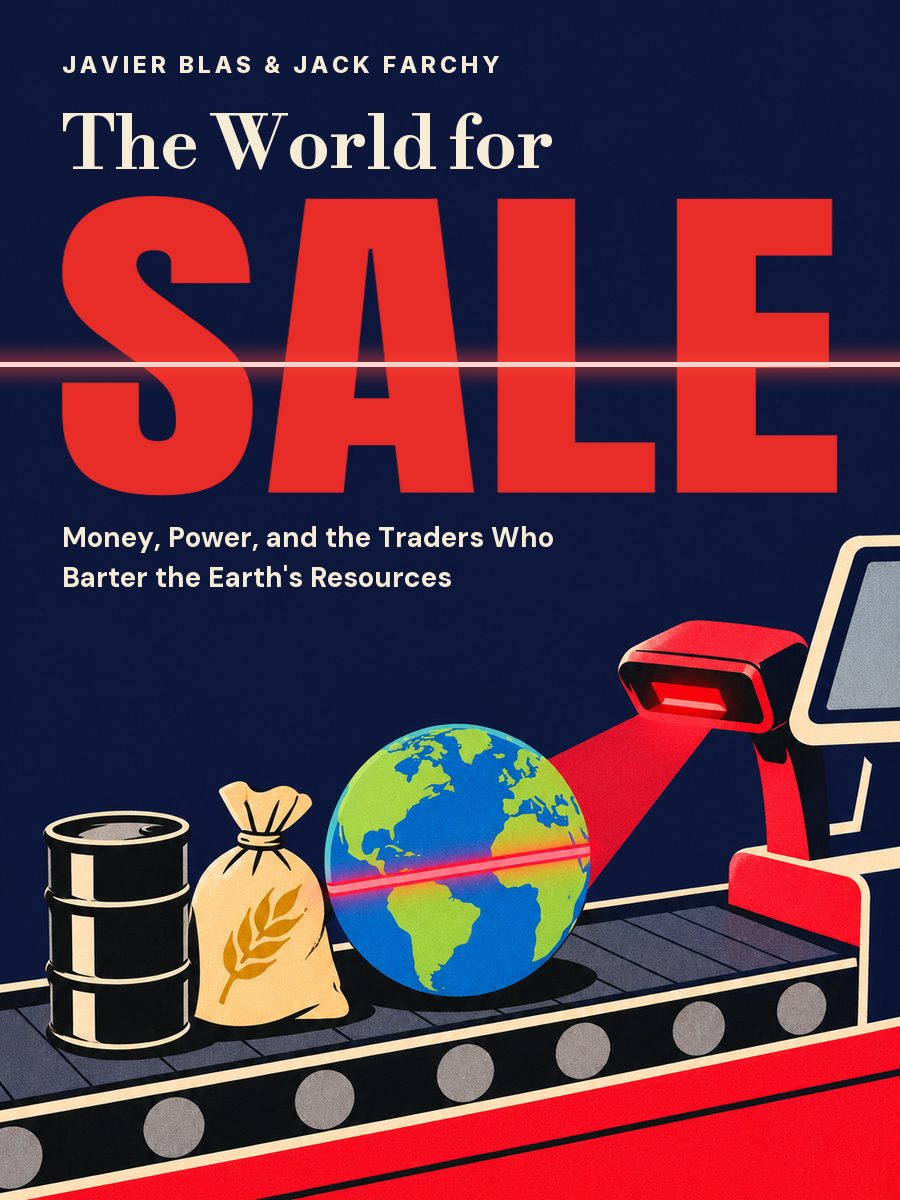
The World for Sale
The oil in your fuel tank, the copper in your wires and the wheat in your bread often pass through the hands of several companies whose names few people know. Journalists Javier Blas and Jack Farchy tell how Glencore, Vitol, Trafigura and Cargill learned to rescue governments, get around embargoes and profit from wars and failed harvests. They also explain why their era of impunity is coming to an end.
Who it is for
For readers who want to understand how the global trade in raw materials works and who decides where oil, metals and grain will go.
We would prefer you not to write it.
A deal in four minutes
In the spring of 2011 a small plane was descending steeply over Benghazi. Libya was in a civil war, and the rebels fighting Muammar Gaddafi were short of fuel. On board was Ian Taylor, head of Vitol, the largest oil trading company in the world. Before this, Qatar had asked whether Vitol would agree to ship fuel into the war zone, and had given it four hours to answer. The company needed only four minutes.
The rebels promised to pay in oil. Soon Gaddafi's forces blew up the pipeline, but Taylor kept the deliveries going, and the rebels' debt to Vitol passed a billion dollars. Without this fuel, the authors believe, the rebels would almost certainly have lost. Years later Taylor admitted that maybe Vitol should not have done this deal.
Journalists Javier Blas and Jack Farchy spent twenty years writing about commodities for the Financial Times and Bloomberg and interviewed more than a hundred traders. Their book is about a handful of companies through which the world's trade in oil, metals and grain flows. The authors' point: these inconspicuous middlemen shape not only prices but the course of history.
Oil that makes money at anchor
The essence of the trade, as the authors put it, is simple: buy raw materials cheaper and sell them dearer. The profit comes from price differences between ports, grades, delivery today and delivery in six months. This kind of profit is called arbitrage. That is why a trader often does not care whether the market rises or falls: what matters is a difference he spotted before anyone else.
In the spring of 1990 Andy Hall, head of Phibro's oil division, noticed that the world was awash with oil. A barrel today cost less than a barrel bought on futures, that is, under a contract for delivery in six months at a price agreed in advance. Hall bought oil and immediately sold futures, locking in a profit. There was nowhere to store the oil on land, so he anchored more than a dozen supertankers.
When Saddam Hussein began threatening Kuwait, Hall bought back some of the futures he had sold, that is, he deliberately left part of the oil without insurance. On August 2 Iraq invaded Kuwait, and within three months the price had doubled. According to Hall, the company made between $600 and $800 million. And in January 1991, when it became clear that the war would be short, he lost $100 million in a single night.
An exchange lets you both offload risk and bet on a rise. One trader told the authors plainly: the worst things in the industry happened when people pretended there was no speculation.
About the author
Javier Blas and Jack Farchy, journalists at Bloomberg, spent many years writing about commodity markets for the Financial Times. For this book they talked to more than a hundred current and former traders.
All books by this author: Javier Blas, Jack Farchy
Terms from the book
- Taylor
- trader
- arbitrage
- Hall
- futures
- Hart
- Chad
- embargo
- apartheid
- Benghazi: The main city of eastern Libya and the center of its oil industry. In 2011 the rebel government was based there.
- Gaddafi: Muammar Gaddafi, ruler of Libya from 1969. Overthrown by rebels and killed in 2011.
- Vitol: The world's largest independent oil trading company. Founded in 1966 in Rotterdam, it is owned by its employees.
- Qatar: A small, gas-rich state in the Persian Gulf. In 2011 it backed the Libyan rebels with money and weapons.
- Financial Times: A British business newspaper. The book's authors wrote about commodity markets for it for many years.
- Bloomberg: An American company that publishes financial news and makes terminals with market data for traders.
- Phibro: Phibro Energy, the oil division of the old trading company Philipp Brothers, which became part of Salomon bank in the 1980s.
- barrel: A unit of volume for oil, about 159 liters.
- Hussein: Saddam Hussein, ruler of Iraq. In August 1990 his troops invaded Kuwait.
- Rich: Marc Rich, founder of Marc Rich + Co, the company from which Glencore and Trafigura grew. He was a fugitive from U.S. justice for almost twenty years, was pardoned in 2001 and died in 2013.
- Alcoa: An American aluminum company, one of the largest in the world.
- alumina: Aluminum oxide, a white powder made from bauxite, from which aluminum is smelted.
- Glencore: A Swiss company, the world's largest metals trader and one of the largest miners. Until 1994 it was called Marc Rich + Co.
- Déby: Idriss Déby, a general and president of Chad from 1990.
- Botha: P. W. Botha, leader of South Africa from 1978 to 1989, in the era of apartheid.
- rand: The currency of South Africa.
- Cobuco: Compagnie Burundaise de Commerce, a company in Brussels that passed itself off as a trading enterprise of Burundi but was in fact a front for Marc Rich + Co.
- Ndolo: Monsieur Ndolo, the alias of a European trader at Marc Rich + Co who came up with and ran the Cobuco scheme. The book does not give his real name.
- Burundi: A small landlocked country in Africa's Great Lakes region, one of the poorest in the world.
- Belousov: Nikolai Belousov, head of the Soviet agency Exportkhleb, who bought huge amounts of grain in the United States in 1972.
- Exportkhleb: The Soviet state agency that ran the country's foreign trade in grain.
- Cargill: An American family company, the world's largest trader of grain and other agricultural goods.
- Tradax: Cargill's international unit, set up in 1953; since 1956 its hub has been in Geneva.
- Ognev: Yury Ognev, head of Glencore's Russian grain business in 2010.
- BNP Paribas: A large French bank, for many years the main lender to commodity traders.
- Trafigura: A Swiss trading company, one of the largest traders of oil and metals. Founded in 1993 by former Marc Rich + Co people.
Similar books
- Think Like a UX Researcher: How to Observe Users, Influence Design, and Shape Business Strategy, David Travis, Philip Hodgson
- Thinking in Bets: Making Smarter Decisions When You Don't Have All the Facts, Annie Duke
- Thinking in Systems: A Primer, Donella Meadows
- This Is Marketing, Seth Godin
- Traction, Gino Wickman
- Unreasonable Hospitality: The Remarkable Power of Giving People More Than They Expect, Will Guidara
- Verbal Judo: The Gentle Art of Persuasion, George J. Thompson, Jerry B. Jenkins
- Wake Up and Smell the Coffee, Simon Mac Rory
- Think and Grow Rich, Napoleon Hill
- Think Like a Rocket Scientist: The Workbook, Ozan Varol