
The key ideas
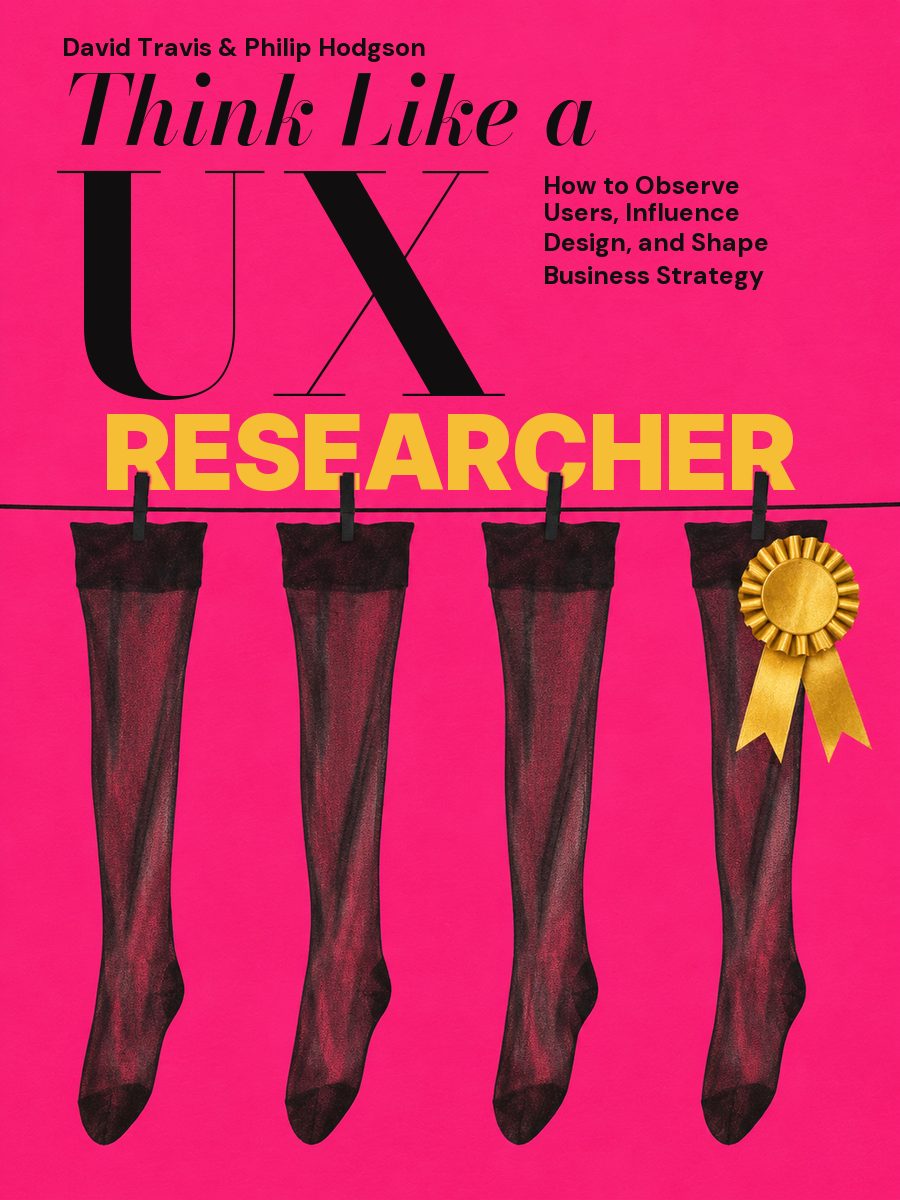
Think Like a UX Researcher: How to Observe Users, Influence Design, and Shape Business Strategy
Why do 80 percent of companies believe they give customers a superior experience, while their customers say only 8 percent do? Two UX researchers explain why asking people what they want misleads, and what to do instead. The book shows how to prove a problem exists before building, test an idea with paper and a few well-chosen people, and get a team to act on what it learns.
Who it is for
For anyone who makes something for other people, such as an app, a website, a service or a course, and for managers who decide what gets built.
Great design doesn't live inside designers. It lives inside your users' heads.
Eighty percent think they are the best
Bain & Company once asked more than 350 companies whether they gave customers a good experience. Eighty percent claimed a superior one. Their customers said only 8 percent did.
David Travis and Philip Hodgson, two UX researchers trained in experimental psychology, see this gap everywhere. UX research studies people using a product: what they are trying to do and where they get stuck. The book collects short essays from years of work with development teams.
Their main thought is blunt. Great design does not live inside designers. It lives inside the heads of the people who use the thing, and the way in is research that shows what to change and can be checked.
The essays address researchers, but these ideas fit anyone who makes things for others.
Watch the hands, not the answers
Over forty years ago the psychologists Richard Nisbett and Timothy Wilson set up a table outside a bargain store with four pairs of stockings, A to D, under the sign "Which is the best quality?" Forty percent of shoppers chose D, and only 12 percent chose A. The pairs were identical: people simply favour items on the right.
Asked why, nobody mentioned position. They praised the sheerness or elasticity of their pair. The authors call this confabulation: people invent plausible reasons for choices whose real cause they cannot see.
So asking users which design they prefer gives weak data. Behaviour is strong evidence, opinion is weak. Ask someone how they make instant coffee and you hear a tidy recipe. Watch, and you see them boil the kettle again and tip coffee straight from the jar when no spoon is near.
For interviews the authors keep two openings: "Tell me a story about the last time you…" and "Can you show me how you…". Both pull a person towards what they actually did.
About the author
David Travis and Philip Hodgson are UX researchers, both with doctorates in experimental psychology. Travis has run field research and usability tests since 1989, and the essays in this book first appeared on the Userfocus website.
All books by this author: David Travis, Philip Hodgson
Think Like a UX Researcher: How to Observe Users, Influence Design, and Shape Business Strategy Quiz
Terms from the book
- Nisbett
- Wilson
- confabulation
- sprint
- moderator
- Jill
- Bain: Bain & Company, an American management consulting firm. The authors cite its survey of more than 350 companies and their customers.
- UX research: User experience research: studying how people use a product or service, what they are trying to achieve and where they struggle, so the design can be improved.
- Khalsa: Mahan Khalsa, American business development consultant, author of Let's Get Real or Let's Not Play. Travis and Hodgson call it their favourite business book.
- field visit: Research in the user's own home or workplace, where the researcher watches how people solve their problem today.
- usability test: A session in which people try to complete realistic tasks with a product or prototype while a researcher observes where they struggle.
- hint text: Grey example text shown inside an empty form field. Some people mistake it for an entry that is already filled in.
- Wizard of Oz: A test in which a hidden person secretly produces the system's responses, so users believe they are using a finished product. Named after the man behind the curtain in the film.
- paper prototype: A model of an interface drawn by hand on paper, with sticky notes changed as the user makes choices.
- Jarrett: Caroline Jarrett, British expert on forms and surveys, who calls the belief "my job is to learn about users" the user researcher's fallacy.
- Spool: Jared Spool, American usability researcher and writer, known for counting how many hours the most effective teams spend watching users themselves.
Similar books
- Thinking in Bets: Making Smarter Decisions When You Don't Have All the Facts, Annie Duke
- Thinking in Systems: A Primer, Donella Meadows
- This Is Marketing, Seth Godin
- Traction, Gino Wickman
- Unreasonable Hospitality: The Remarkable Power of Giving People More Than They Expect, Will Guidara
- Verbal Judo: The Gentle Art of Persuasion, George J. Thompson, Jerry B. Jenkins
- Wake Up and Smell the Coffee, Simon Mac Rory
- Way of the Wolf: Straight Line Selling: Master the Art of Persuasion, Influence, and Success, Jordan Belfort
- Thinking, Fast and Slow, Daniel Kahneman
- Third Culture Kids: Growing Up Among Worlds, David C. Pollock, Ruth E. Van Reken