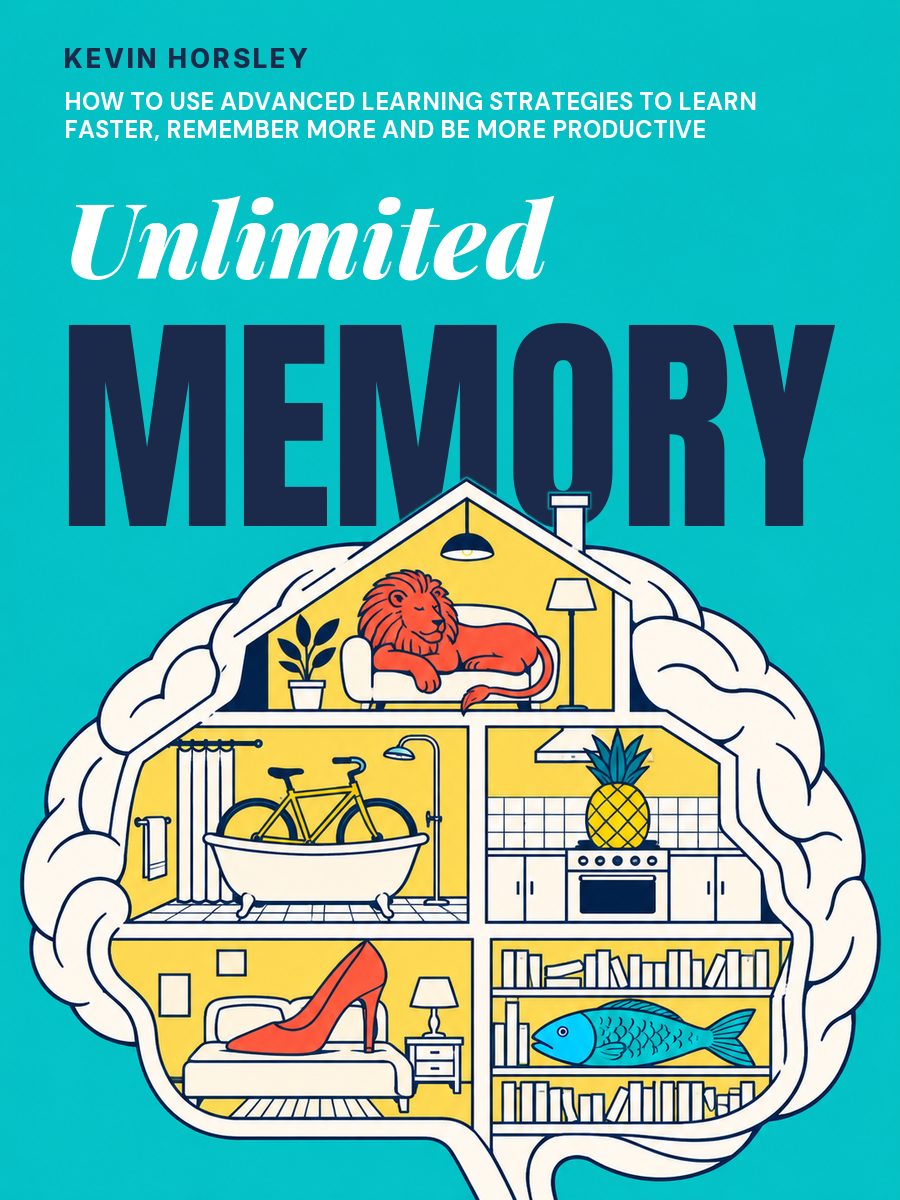

The key ideas
Unlimited Memory: How to Use Advanced Learning Strategies to Learn Faster, Remember More and Be More Productive
Why can some people remember thousands of digits while others forget why they walked into the kitchen? As a child, Kevin Horsley could barely read because of dyslexia, and later he became a grandmaster of memory. He is sure it isn’t a gift but a matter of methods, and he shows them step by step: how to hold your attention, turn dry facts into vivid images, lay them out in familiar places and keep them from slipping away afterward.
Who it is for
For anyone who forgets a new acquaintance’s name a minute after meeting, rereads the same notes for the third time and thinks they were simply unlucky with their memory.
There is no such thing as a good or bad memory for names, there is only a good or a bad strategy.
The boy they wanted to send to a special class
When Kevin Horsley was eight years old, a school psychologist suspected he had brain damage and suggested moving him to a special class. The boy had severe dyslexia, his attention kept slipping and his memory let him down. For twelve years he learned the school curriculum by ear: his mother and friends read the textbooks aloud to him. In all his school years he never read a single book from cover to cover on his own.
A couple of years after school, Horsley walked into a bookstore and bought three books by Tony Buzan. In one of them he found an idea that turned everything around: memory isn’t an inborn gift but a habit, and it can be trained. In 1995 he went to the World Memory Championships, came fifth and received the title of International Grandmaster.
He doesn’t have a photographic memory, Horsley writes. He has methods, and he boiled them down to four keys: concentrate, create an image, connect it to what you already know, and review regularly. Each of us has heard thousands of jokes, but can recall only four or five off the top of our head. This book is about turning “that sounds familiar” into “I remember it for sure.”
The lioness chases one antelope
Horsley doesn’t start with memory techniques but with attention: what you never noticed, you won’t remember. Attention, he says, is trained like a biceps in the gym. An ordinary morning trains it the other way, toward distraction: a blaring alarm, a check of the phone, a hundred worries in the shower, calls in a traffic jam.
The author gives the example of a lioness on the hunt. She chases one wildebeest and never goes after two, because then she will almost surely lose both. People, Horsley believes, work the same way: multitasking is in fact just switching, and while switching we are always half listening.
Purpose, interest and curiosity, the author advises, help keep your attention on the material. The purpose has to be precise. “Learn about memory” sounds vague, while “find six techniques I will start using” already steers the reading. Interest and curiosity appear when you ask yourself how this will help in your own work.
Worry steals attention too. Horsley suggests changing the question “What if I lose my job?” to “What would I do if I lost my job?” The first plays the same frightening movie over and over in your head, while the second gives you a plan.
About the author
Kevin Horsley is a South African memory trainer and business speaker, one of the few holders of the title International Grandmaster of Memory. Horsley twice set a world record in a test known as the Everest of memory tests.
All books by this author: Kevin Horsley
Terms from the book
- dyslexia
- multitasking
- Maxwell
- Clooney
- Spitzer
- Buzan: Tony Buzan (1942–2019), a British author of books on memory and thinking and the creator of mind maps. Horsley’s path began with his books.
- World Memory Championships: An international competition in which contestants memorize digits, words, playing cards and other information against the clock. It has been held since 1991.
- grandmaster: Here, the honorary title of International Grandmaster of Memory, awarded for high scores in memory competitions.
- wildebeest: A large African antelope, also called a gnu, and frequent prey for lions.
- Medina: John Medina, an American molecular biologist and brain researcher, author of the book Brain Rules, which Horsley cites.
- SEE: The author’s principle, not a scientific term. It is named after the first letters of Senses, Exaggeration and Energize, meaning giving an image movement. Together the letters spell the word see.
- liver: An organ meat. In Horsley’s example the word sounds like the French livre, “book.”
- Long-term memory: Memory that holds information for years: your own name, the layout of the rooms in your home, your native language.
- Short-term memory: Memory that holds just-received information for a few seconds or minutes, such as a phone number you have just heard.
- Journey Method: An ancient memorization technique, also known as the method of loci: information in the form of images is laid out along the points of a familiar route.
- buffet: A reception where guests eat standing at tables of food and snacks.
Similar books
- What the Most Successful People Do Before Breakfast, Laura Vanderkam
- Wherever You Go, There You Are: Mindfulness Meditation in Everyday Life, Jon Kabat-Zinn
- Who Moved My Cheese?, Spencer Johnson
- Who Says You Can't? You Do, Daniel Chidiac
- Win the Day: 7 Daily Habits to Help You Stress Less & Accomplish More, Mark Batterson
- Working Identity: Unconventional Strategies for Reinventing Your Career, Herminia Ibarra
- Year of Yes: How to Dance It Out, Stand in the Sun and Be Your Own Person, Shonda Rhimes
- You Are a Badass: How to Stop Doubting Your Greatness and Start Living an Awesome Life, Jen Sincero
- Unraveling: What I Learned About Life While Shearing Sheep, Dyeing Wool, and Making the World’s Ugliest Sweater, Peggy Orenstein
- Unreasonable Hospitality: The Remarkable Power of Giving People More Than They Expect, Will Guidara